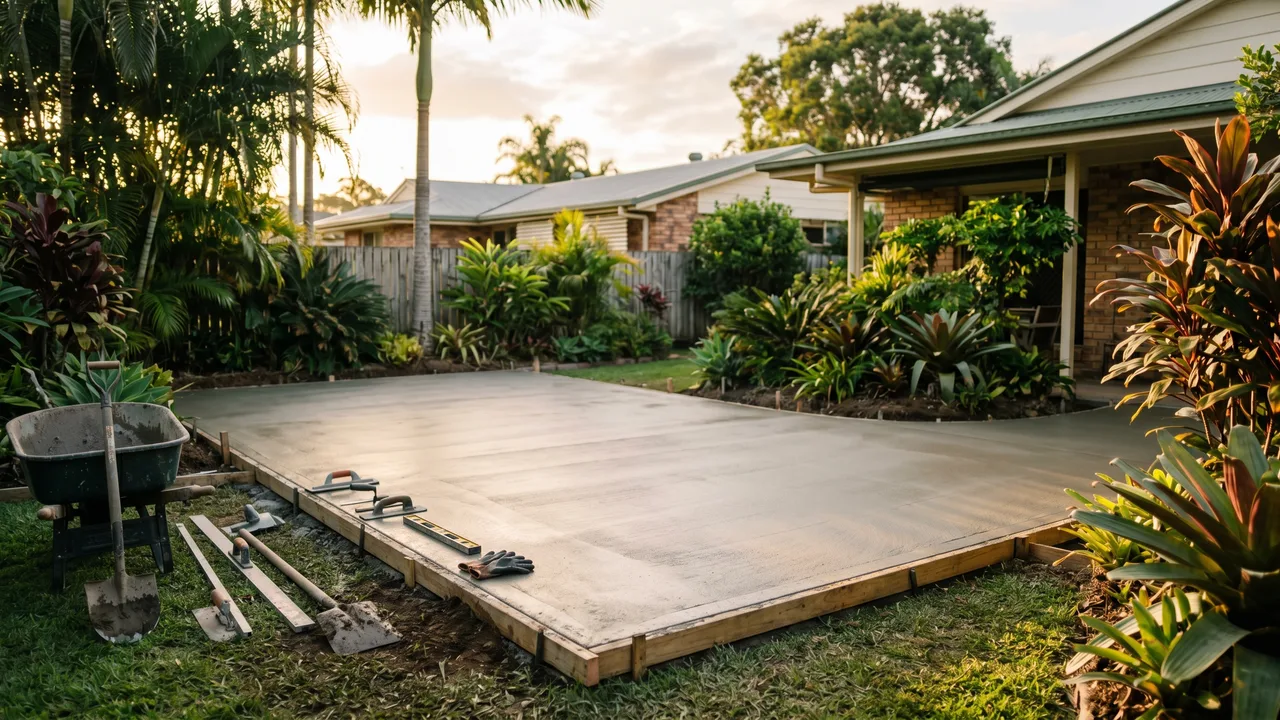
Concreting
Shed Slabs and Footings.
Concrete Slabs and Footings for Sheds, Garages and Granny Flats
If you're putting up a new shed, garage or granny flat in Bulimba or the surrounding Inner East suburbs, the slab or footing underneath it matters more than most people realise. Get it wrong and you're looking at cracking, uneven floors, drainage problems or a structure that doesn't meet council requirements. Get it right and the thing just sits there, solid, for decades.
This page covers what the work actually involves, what it costs in this part of Brisbane, and how to tell whether you need a straightforward shed slab or something more engineered.
What the Work Actually Involves
A shed slab or footing job is not just pouring concrete into a rectangle. The typical process includes:
- Site assessment and measuring to confirm levels, drainage fall and setbacks from fences or boundaries
- Excavation and ground preparation — cutting down to a stable base, removing topsoil or fill material that would shift under load
- Formwork installation — timber or steel edge boards set to the correct finished height
- Sub-base compaction — typically a layer of compacted road base, because bare clay (common across Bulimba, Norman Park and Morningside) doesn't hold load evenly on its own
- Reinforcement placement — steel mesh or rebar, depending on the slab size and what it needs to support
- Concrete pour and finishing — using a ready-mix truck for anything over a small area; broom or steel finish depending on use
- Curing — keeping the slab damp or covered for the first few days so it doesn't cure too fast in Brisbane's heat and develop surface cracks
For footings specifically (used when the structure has posts or loadbearing walls), the work involves digging and forming individual pier holes or strip footings, placing reinforcement, and pouring in sections. A granny flat footing system is more involved than a garden shed base — it typically needs engineer certification before council will approve the building permit.
When You Actually Need This
Most people in the Inner East come to this when they're:
- Building a new Colorbond or timber shed and the supplier says "prepared slab required"
- Adding a detached garage or carport on a property that only has lawn or pavers underneath
- Getting a granny flat DA approved, where council requires a certified concrete footing system
- Replacing a thin, cracked concrete base that was poured years ago without proper prep or reinforcement
There's no seasonal urgency for this type of work, but dry weather helps. A pour during Brisbane's wet season (roughly November to March) isn't impossible, but it needs to be timed around rain and the ground needs to be stable and not waterlogged before the crew can dig and compact properly.
What It Typically Costs in Brisbane
For a standard shed slab in the Inner East, expect to pay somewhere in the range of $80 to $130 per square metre for a basic slab on a reasonably accessible flat block. A typical 6m x 3m garden shed base (18sqm) might come in around $1,500 to $2,500 installed.
A double garage slab — say 6m x 6m — is more likely to sit in the $3,500 to $6,000 range, depending on site conditions. Granny flat footings, which usually need engineer-designed drawings and potentially a soil test, can push well above that.
What moves the price:
- Site access — tight side passages in Hawthorne or Balmoral terraces add labour time
- Excavation depth — if the ground needs significant cut-down or fill removal, that adds cost
- Soil type — expansive clay soils (present across much of this area) sometimes require deeper or wider footings
- Thickness and reinforcement spec — a slab for a vehicle workshop needs more steel and more concrete depth than one for a garden shed
- Formwork complexity — sloped blocks require more setup time to get the level right
What's Typically Included (and What's Not)
A standard quote for this work usually includes formwork, sub-base prep, mesh reinforcement, the concrete pour and basic finishing. Most concreters in the area include a standard broom finish.
Often quoted separately or not included:
- Soil disposal if significant excavation is needed
- Engineering drawings or soil reports (required for granny flats and some garages)
- Council application fees
- Stump or tree root removal if they're in the slab zone
- Any electrical conduit or plumbing rough-in before the pour (organise those trades before the concrete goes down)
Is This the Right Service for Your Property?
A shed slab is appropriate if you're putting down a free-standing structure that doesn't require a building approval, or if approval is needed but the engineer's drawings call for a standard slab-on-ground.
You may need a more engineered footing system if the structure has loadbearing walls, if the block has significant slope, or if you're in a flood-affected zone (parts of Morningside and Murarrie fall into this category). Your local council or a structural engineer can confirm which category you're in before any concrete is ordered.
A Straightforward Note on Qualifications
Concreting work in Queensland doesn't always require a builder's licence for simple slabs, but any footing work associated with a building approval typically does. For granny flats, the concreter usually works under a licensed builder who carries the relevant QBCC licence and home warranty insurance. If you're getting quotes for anything beyond a basic garden shed slab, it's worth asking which QBCC licence category applies and whether the work is covered by statutory insurance. That's a reasonable question and any legitimate operator will answer it clearly.
We connect you with local concreters who work across Bulimba, Hawthorne, Norman Park, Balmoral, Morningside, Cannon Hill, Murarrie and Tingalpa. If you're ready to get a clearer picture of what your project involves and what it's likely to cost, get in touch and we'll put you in contact with someone who can come out and take a look.
Quick answers
Frequently asked.
How thick should a concrete shed slab be in Brisbane?
Do I need council approval for a shed slab in Bulimba?
How long does a shed slab take to cure before I can build on it?
Can a shed slab be poured on a sloped block in Inner East Brisbane?
What is the difference between a shed slab and footings?
Will clay soil in Morningside or Bulimba cause problems with my slab?
Ready to book
Quickest is by phone.
Up-front pricing on the call. Booked in one go. No site visit needed.