Concreting
Concrete Retaining Walls Bulimba.
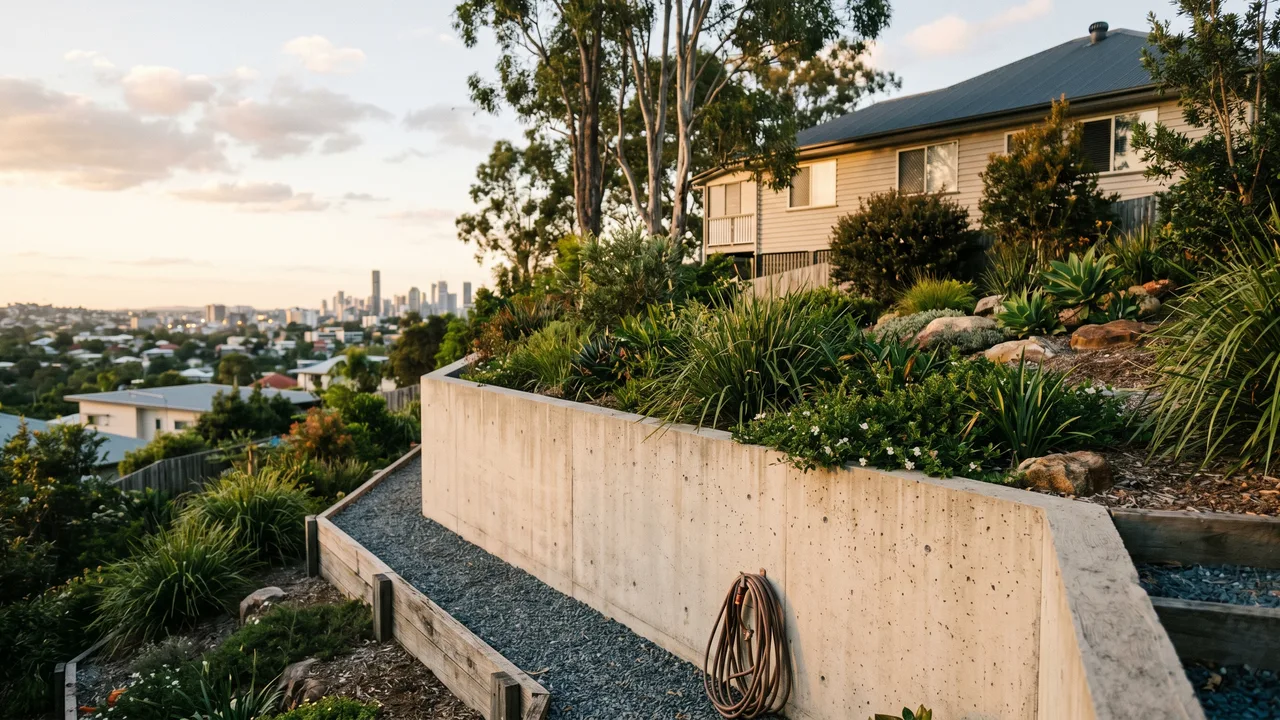
Poured Concrete Retaining Walls for Sloped Bulimba Blocks
Bulimba and the surrounding Inner East suburbs sit on undulating ground. Balmoral rises steeply toward the ridge. Norman Park and Hawthorne have plenty of blocks that drop away at the back. If your yard is on a slope, soil movement is a constant pressure, literally. A poured concrete retaining wall holds that soil in place, turns an unusable gradient into flat, usable space, and protects your foundations, driveway and garden beds from creeping erosion.
What the Work Actually Involves
A poured (or "in-situ") concrete retaining wall is formed on site rather than assembled from precast panels or blocks. Here is roughly how the job unfolds:
- Excavation and footings. A bobcat or small excavator cuts into the slope to create a level base. The footing trench is dug below the frost-free depth, and compacted to give the wall a stable foundation.
- Formwork. Timber or steel forms are built to the wall's shape and height. This is what gives the finished wall its clean, straight face.
- Steel reinforcement. Reo bar (reinforcing steel) is tied into a cage inside the form. For walls over about 600 mm high, this is not optional; it is what stops the wall cracking under lateral soil pressure.
- Concrete pour. Ready-mix concrete is pumped or chuted in and vibrated to eliminate air voids.
- Drainage. Agricultural drain pipe ("ag pipe") and gravel backfill are placed behind the wall before the soil goes back. Without drainage, hydrostatic pressure builds up and pushes the wall forward over time.
- Stripping and finishing. Forms come off after the concrete has cured enough, typically 24 to 48 hours. The exposed face can be left as a natural broom finish or lightly textured.
The equipment on site usually includes a mini excavator, a concrete pump or chute, a vibrator (poker), and standard hand tools for formwork and finishing.
Signs You Need One
You might need a retaining wall if you notice any of these on your Bulimba property:
- Soil slumping or washing onto the driveway or path after rain.
- An existing timber sleeper wall that is leaning, cracking or rotting at the base. Treated pine sleepers typically last 15 to 25 years in Brisbane's climate before they need replacing.
- A sloped backyard that you cannot mow safely or want to convert to a flat entertaining area.
- Erosion around your foundations or along a boundary where the neighbour's yard sits higher.
- A new concrete entertaining area or shed slab planned for a site that needs to be levelled first.
Brisbane's wet season (roughly November through March) is when sloped blocks show their problems most clearly. That said, quoting and forming work can happen year-round; a long dry spell actually makes excavation easier.
What It Typically Costs
Poured concrete retaining walls in the Brisbane Inner East generally fall somewhere between $350 and $700 per lineal metre, depending on height, access and site conditions. A short garden wall (600 mm high, 5 metres long) might come in around $2,000 to $3,500. A taller boundary wall at 1.2 metres over 10 metres could reach $6,000 to $8,000 or more.
Factors that move the price up:
- Wall height (more steel, more concrete, more formwork).
- Poor vehicle access to the yard (Morningside and Cannon Hill laneways, steep Balmoral driveways).
- Rock or tree roots encountered during excavation.
- Council requirements if the wall is over 1 metre high or close to a boundary (development application fees are separate and paid direct to Brisbane City Council).
What Is (and Is Not) in a Typical Quote
A standard quote usually covers: excavation to standard depth, formwork, reinforcement, ready-mix concrete, ag-pipe drainage behind the wall, and basic backfill with the excavated material.
What tends to cost extra, or vary between providers: disposal of excess spoil, retaining wall footing upgrades if rock is struck, decorative finishes or applied coatings, and council application fees if required.
Ask upfront whether spoil removal is included and what the call-out rate is if rock is encountered. That conversation prevents surprises.
Is a Poured Concrete Wall the Right Choice?
Poured concrete suits walls where you want longevity and a clean, solid finish. It handles height well, integrates neatly with concrete slabs or driveways on the same job, and requires very little ongoing maintenance compared to timber sleepers.
It is not always the right fit for purely decorative garden bed edges under 300 mm high (where besser block or sleepers are simpler and cheaper), or for heritage-streetscape areas where the look matters more than structural performance.
A Word on Safety, Permits and Insurance
Retaining walls over one metre in height typically require a development application with Brisbane City Council, and in some cases an engineer's design. Make sure whoever quotes your job is aware of the height and location before work starts.
Any concreter working on your property should hold current public liability insurance. It is reasonable to ask for evidence of that before signing anything.
The providers we connect Bulimba homeowners with are local, licensed and carry appropriate insurance. If you want a no-pressure quote on a retaining wall project, get in touch and we will put the right person in contact with you.
Quick answers
Frequently asked.
How much does a concrete retaining wall cost in Bulimba?
Do I need council approval for a retaining wall in Brisbane?
How long does a poured concrete retaining wall last?
Can a retaining wall be built close to my neighbour's boundary?
What is the difference between a poured concrete wall and a besser block wall?
Does the quote include removing the excavated soil?
Ready to book
Quickest is by phone.
Up-front pricing on the call. Booked in one go. No site visit needed.