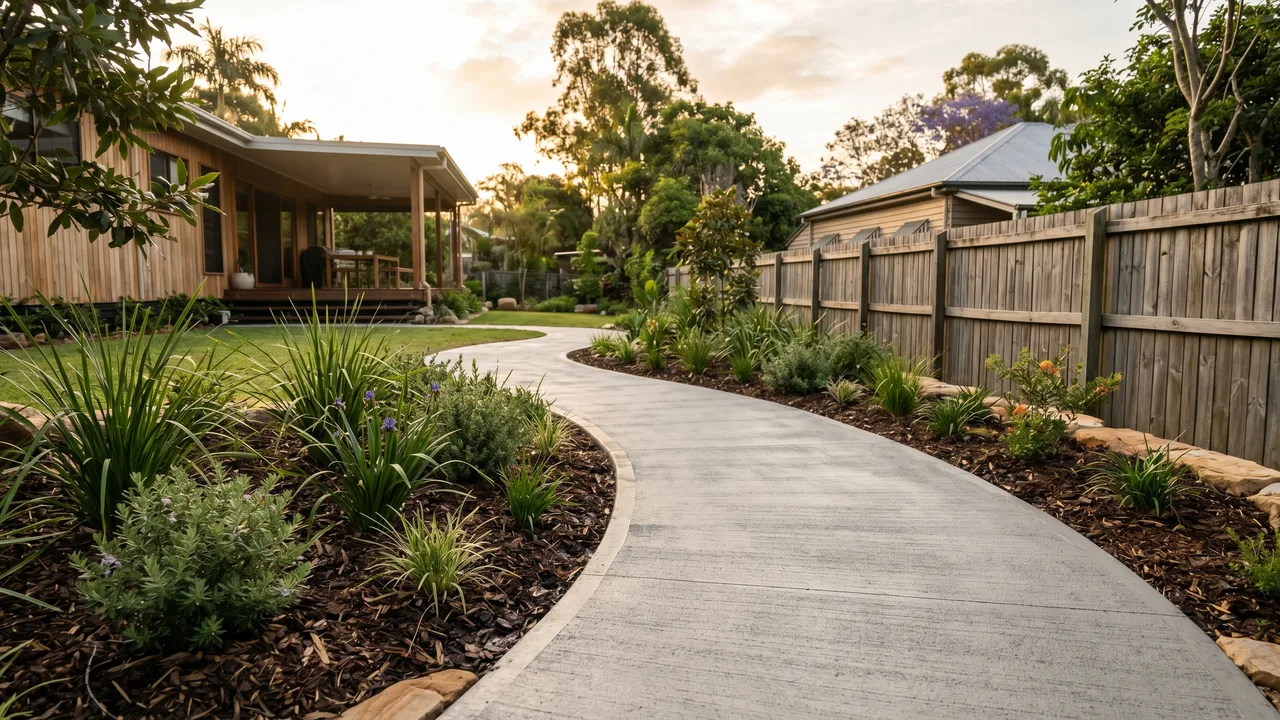
Concreting
Pathways and Footpaths.
Concrete Pathways and Footpaths in Bulimba
A concrete pathway sounds simple enough. In practice, it involves excavation, formwork, reinforcement, a pour, and a finish that has to last through Brisbane summers, subtropical downpours, and root pressure from nearby garden beds. Done properly, a footpath or garden path ties your outdoor spaces together and holds up without cracking for decades.
What the Work Actually Involves
A typical pathway job in Bulimba or the surrounding Inner East suburbs runs like this:
- Mark-out and excavation. The ground is dug to a consistent depth, usually 75–100 mm for a residential footpath, depending on foot traffic and soil conditions.
- Base preparation. Compacted road base or sand is laid to create a stable, level substrate. Brisbane's reactive clay soils, common across Bulimba, Balmoral and Norman Park, make this step especially important.
- Formwork. Timber or steel frames are set to define the edges and control the finished level.
- Reinforcement. Steel mesh (SL72 or similar) is typically placed mid-slab to control cracking. Some jobs use fibre reinforcement instead, or as well.
- Pour and finish. Concrete is placed, screeded level, and finished to suit the location. A broom finish is standard for outdoor paths because it stays non-slip when wet. Exposed aggregate, stencil, or other decorative finishes are available if the path is a visible feature of the property.
- Joints and curing. Control joints are tooled or cut to manage where shrinkage cracks occur. The slab is kept moist during curing, typically for at least three days.
Width varies. A side-of-house access path is often 900 mm to 1.2 m. A front entry path connecting the street kerb to the front door is typically 1.2–1.5 m. A backyard entertaining path linking a back door to a pergola or pool area can be wider still.
When Does a Bulimba Home Need This?
You are probably looking at this page because one of these applies:
- Your existing concrete path has cracked, settled, or has trip-hazard lips between panels.
- The property has no path and you are tired of grass or gravel turning into mud after summer storms.
- You are landscaping and want a clean edge between garden beds and outdoor living zones.
- You are preparing the property for sale or rental and the entry looks tired.
There is no fixed season, but late autumn through winter (May to August) is generally the preferred period for concrete work in Brisbane. Extreme heat in January and February speeds up the set and can cause surface issues if the pour is not managed carefully. Rain in March and April can delay finishing work. That said, experienced concreters work year-round and manage conditions accordingly.
What It Costs in Brisbane
For most residential pathway jobs in the Bulimba cluster, expect a range of roughly $80–$140 per square metre, all-in, for a plain broom-finished concrete path. A basic 10 m x 1.2 m path (12 square metres) typically lands somewhere between $1,000 and $1,700. Longer runs or more complex layouts sit higher.
Prices move based on:
- Access. A side-of-house path that requires a wheelbarrow run rather than direct truck access adds time and cost.
- Soil conditions. Extra excavation depth for poor or reactive soil, or the need to import additional base material, adds to the job.
- Existing concrete. If old concrete needs to be broken up and removed first, that is usually a separate line item (see our Concrete Removal and Replacement service).
- Finish type. Broom finish is cheapest. Exposed aggregate, stencilled or coloured concrete costs more, typically $120–$200+ per square metre depending on complexity.
- Path width and shape. Curved paths require more formwork time than straight runs.
What a Quote Should Cover (and What It Might Not)
A reasonable quote for a pathway job in this area typically includes excavation, base prep, formwork, reinforcement, concrete supply and pour, standard broom finish, and basic site clean-up.
Watch for items that are sometimes excluded: skip bin hire for spoil and old concrete, tree root removal if roots are in the excavation zone (relevant in older Queenslander streets like parts of Hawthorne and Norman Park where mature trees are common), and any stormwater or drainage work needed if the new path changes surface water flow.
Ask specifically about those three before you sign anything.
Is Concrete Right for Your Path?
Concrete is a strong choice where you want a long-lasting, low-maintenance surface. It handles foot traffic, wheelbarrows, bins, and light vehicles. It does not shift like pavers can over time, and it is easier to keep clean.
If your path runs close to large tree roots, that is worth discussing with whoever quotes the job. Tree root pressure is a real cause of path cracking in older suburbs of the Inner East. A deeper slab, thicker reinforcement, or a root barrier might be recommended. Alternatively, if the root situation is severe, pavers might flex more forgivingly, but that is a different trade entirely.
A Note on Qualifications and Safety
Residential concreting in Queensland does not require a trade licence for most pathway work, but any work that involves drainage, structural footings, or connecting to a building typically does. The providers we connect homeowners with carry public liability insurance. It is reasonable to ask any contractor for proof of that before work starts.
If your path is cracked, missing, or just not doing the job anymore, we can connect you with a local concreter who knows the soil conditions and drainage quirks of the Bulimba area. Fill in the short form and we will pass your details on.
Quick answers
Frequently asked.
How much does a concrete path cost in Bulimba?
How long does a concrete path take to cure before I can walk on it?
Will tree roots crack my new concrete path?
What width should a residential footpath be?
Do I need council approval for a concrete path on my property?
What is the difference between a broom finish and exposed aggregate for a path?
Ready to book
Quickest is by phone.
Up-front pricing on the call. Booked in one go. No site visit needed.