Concreting
Concrete Entertaining Areas Bulimba.
Concrete Entertaining Areas in Bulimba
An alfresco slab or decorative patio is one of the more rewarding concrete jobs a Bulimba homeowner can do. Done well, it turns a patch of compacted dirt or cracked old timber decking into a year-round outdoor room. Done poorly, it cracks, lifts, or pools water every time storm season rolls through.
Here is what the work actually involves, what it costs, and how to know if it is the right move for your block.
What the Work Actually Involves
A concrete entertaining area starts well before the first mix is poured. The concreter will:
- Excavate and compact the sub-base to a consistent depth, typically 100 mm for a residential patio slab
- Set up formwork (timber or steel edge boards) to define the shape and hold the pour
- Lay steel reinforcement mesh (SL72 or SL82 in most residential jobs) or bar where heavier loads are expected
- Pour and screed the concrete to a level finish
- Apply the chosen decorative finish while the surface is still workable
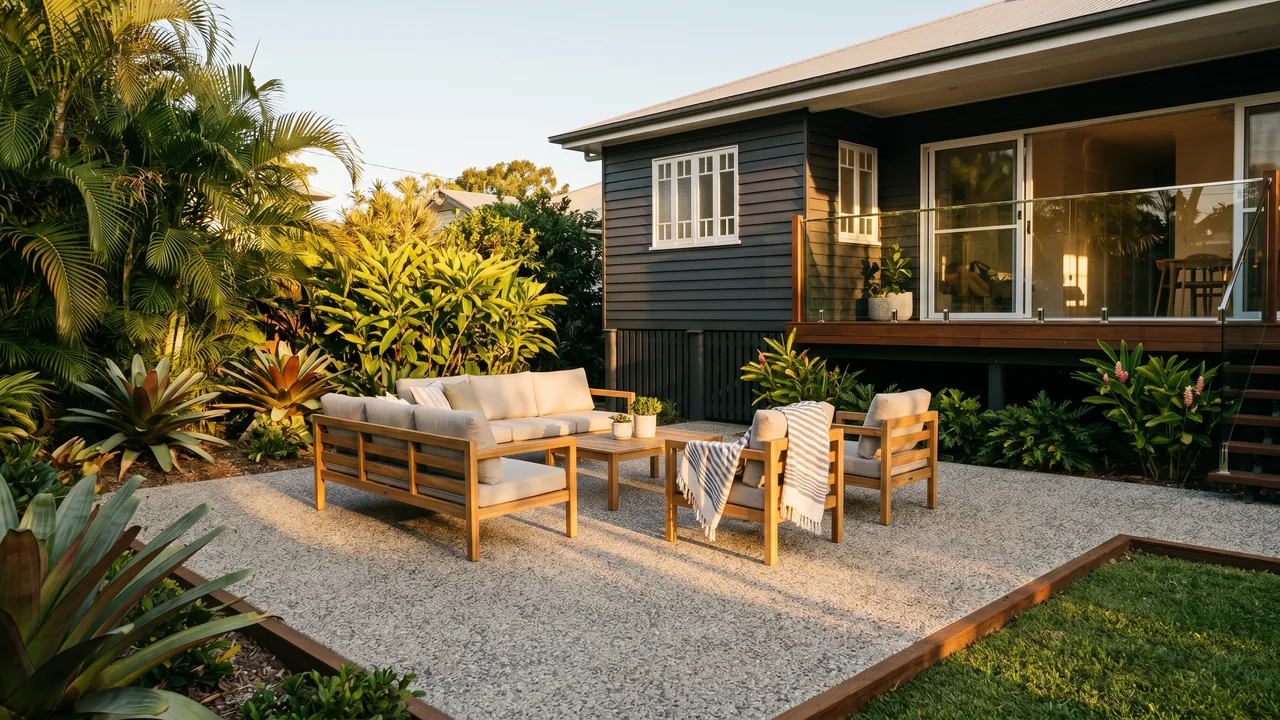
The finish is where the choices open up. Exposed aggregate is the most popular option in this part of Brisbane. The top layer of cement paste is washed back while the concrete is still green, leaving the stones visible. It gives a textured, slip-resistant surface that handles Brisbane's wet summers well and hides dirt between cleans. Colours and aggregate types vary, from small river pebbles to larger quartz or basalt mixes.
Other finish options include:
- Broom finish (raked texture, straightforward, cost-effective)
- Coloured or oxide concrete (pigment added to the mix for a consistent tone)
- Honed concrete (ground smooth after curing, more of an indoor-outdoor look)
- Stencilled or stamped patterns (mimics pavers or tile, labour-intensive but popular for period homes)
On most Bulimba blocks, control joints are cut into the slab within the first day or two after pouring. These are planned weak points that let the concrete move slightly as temperatures shift without cracking randomly across the surface.
When a Bulimba Homeowner Typically Needs This
You are probably in the right place if:
- You have an existing slab that is cracked, sunken, or too far gone to resurface economically
- You have bare ground, pavers, or an old timber deck you want to replace with something lower maintenance
- You are building a new alfresco area to connect with a renovation
- Your existing concrete has become rough or stained beyond what cleaning and sealing can fix
There is no strict season for pouring concrete in Brisbane, but most concreters prefer to avoid pouring during the hottest part of summer days and immediately before heavy rain is forecast. A slab poured in autumn or late winter tends to cure in more forgiving conditions. That said, experienced crews work year-round here.
What It Costs in Bulimba and the Inner East
For a residential entertaining area in this cluster, typical pricing runs from around $85 to $160 per square metre, depending on the finish and site conditions. A simple 30 m² broom-finish slab might come in around $2,500 to $3,500. The same area in exposed aggregate with a curved edge and a seat wall will push well past $5,000.
The main factors that move the price up or down:
- Finish type - exposed aggregate and stencilled work cost more than plain broom finish
- Site access - tight side gates in Hawthorne or Balmoral mean concrete may need to be hand-mixed or pumped, which adds cost
- Excavation depth and disposal - if there is existing concrete, pavers, or deep tree roots to remove, expect extra
- Shape complexity - curves and angles require more formwork time than a straight rectangle
- Reinforcement spec - thicker slabs or higher-load areas need more steel
What Is (and Is Not) in a Typical Quote
A standard quote for this type of work usually covers supply of concrete and reinforcement mesh, formwork, the pour itself, finishing, and basic control joint cutting. Most contractors include one coat of curing compound.
What typically sits outside the base quote:
- Removal and disposal of existing concrete or pavers
- Retaining formwork if the slab is elevated and needs edge support
- Feature strips, exposed aggregate borders, or second-colour pours
- Sealing (often quoted separately, and worth doing on exposed aggregate)
- Any drainage work connected to the slab
Ask the contractor to itemise these specifically before you sign anything.
Is This the Right Service for Your Block?
A concrete entertaining area suits most standard Inner East blocks well. If your yard is level or close to it, the job is fairly routine. If your block has a significant slope (common in parts of Norman Park and Balmoral), you may need a retaining wall alongside the slab, or the concreter may recommend raising the slab and backfilling rather than cutting down.
Older Queenslanders on stumps sometimes have limited access under the house. If your alfresco area wraps close to the structure, the concreter needs to account for clearance, drainage falls, and connections to existing footings.
A Note on Licensing and Insurance
Concrete flatwork in Queensland is generally classified as trade work. Any contractor you hire should hold a current Queensland Building and Construction Commission (QBCC) licence and carry public liability insurance. It is reasonable to ask for both before work starts. We connect homeowners with contractors who hold the appropriate credentials, but confirming this directly before you commit is good practice on any job.
If you want a rough number for your specific block before committing to a full quote, a quick call or message with the rough dimensions and your preferred finish is a good place to start.
Quick answers
Frequently asked.
How much does an exposed aggregate patio cost in Bulimba?
How long does a concrete entertaining slab take to cure before I can use it?
Do I need council approval for a concrete patio in Bulimba?
Can exposed aggregate concrete be slippery when wet?
What is the difference between exposed aggregate and stencilled concrete for a patio?
Will a new concrete slab crack over time?
Ready to book
Quickest is by phone.
Up-front pricing on the call. Booked in one go. No site visit needed.