Concreting
Driveway Concreting.
New Concrete Driveways for Bulimba and the Inner East
A new concrete driveway is more than a cosmetic upgrade. It's a poured-in-place structure that ties your home to the street, handles vehicle loads day after day, and in Brisbane's Inner East, it often has to work within tight council setbacks and heritage streetscapes. Getting it right means more than just mixing concrete.
Here's what the actual work looks like.
What the Work Involves
A standard driveway installation in this area covers several distinct stages:
- Site preparation - the existing surface (pavers, asphalt, cracked concrete or compacted rubble) is broken up and removed, and the subbase is graded and compacted. In Bulimba and surrounding suburbs, many blocks have older fill or reactive clay beneath the surface, so this step matters more than people expect.
- Formwork - timber or steel edging is set to control the shape, thickness and finished level of the slab. For a sloped block in Norman Park or a tight entry in Hawthorne, this takes care and checking against council kerb crossover requirements.
- Steel reinforcement - typically SL72 or SL82 mesh, sometimes bar, laid before the pour. Driveways without reinforcement are more common in DIY jobs and tend to crack sooner.
- Concrete pour - ready-mix is ordered from a batching plant and delivered by truck. For residential driveways, a 20 MPa or 25 MPa mix is standard; stronger mixes are available and worth asking about if you park heavy vehicles.
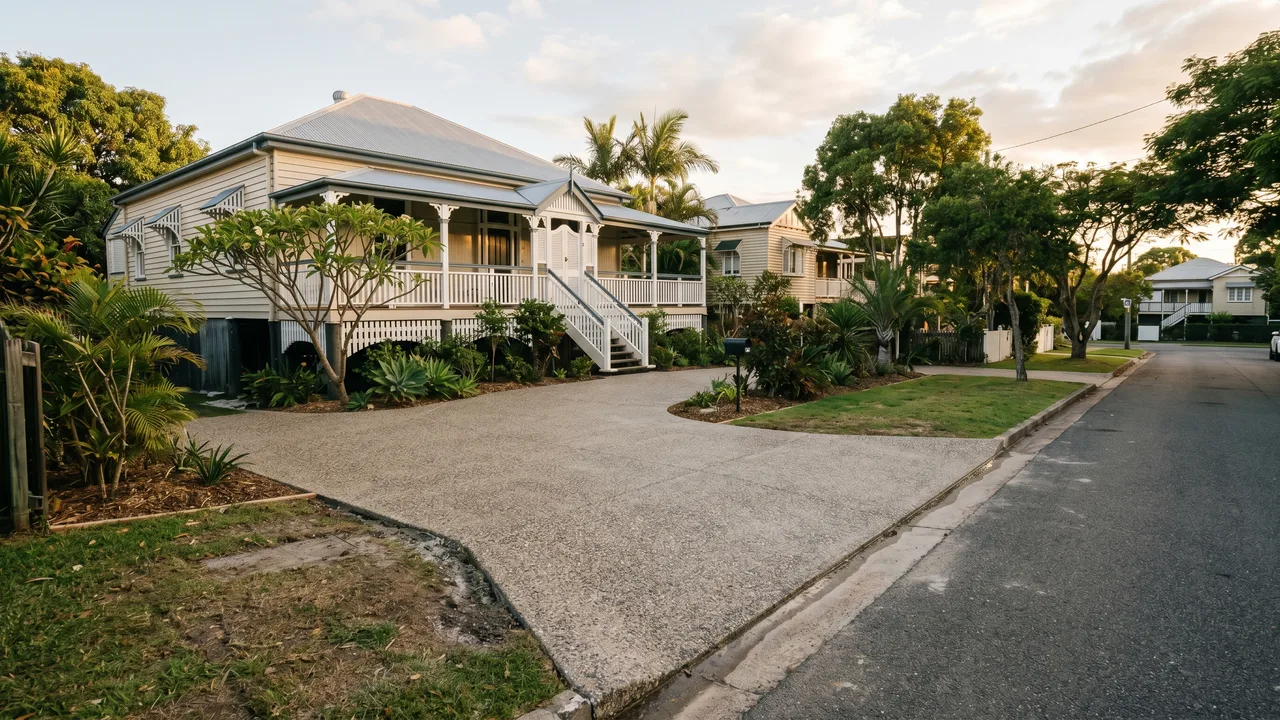
- Finishing and curing - the surface is screeded, floated and then finished to the agreed texture (broom finish is practical and common; exposed aggregate is a step up in cost and visual appeal). Curing compound or wet curing follows for several days.
When You Need a New Driveway
Most Bulimba-cluster homeowners reach this point when the old surface has gone past patching. Signs to look for:
- Cracks wider than about 5 mm, especially if they're growing or have become trip edges
- Sunken sections near the kerb crossover or garage apron (often drainage-related in our wetter months)
- Spalling or flaking surface concrete that's exposing aggregate and creating loose material
- A pavers-only driveway that has shifted, subsided or become uneven
If you're building new, extending an existing slab, or converting from gravel to concrete, that's a straightforward new installation rather than a repair situation.
There's no single "right season" to pour in Brisbane, but the wet season (December to March) can complicate scheduling. Rain during or just after a pour damages the surface finish. Most local concreters prefer autumn through early spring for outdoor work.
What It Typically Costs
For a standard single-car driveway (roughly 3 m wide by 5-6 m long), expect to pay somewhere in the $2,000 to $4,500 range in Brisbane. A double-car driveway or one with a long run from street to garage can push well past $6,000.
The main factors that move the price:
- Area - cost per square metre drops slightly on larger jobs
- Excavation depth - if there's significant existing concrete or deep soil prep required, that adds to the quote
- Access - truck access for the concrete pump or barrow run affects time and cost. Tight blocks in Balmoral or Morningside sometimes need a pump hire ($400-$800 on top of materials)
- Finish type - plain broom finish is the base; exposed aggregate or stencilled concrete adds cost
- Council crossover works - in Brisbane City Council areas, any modification to the kerb crossover typically requires a separate application and may involve additional fees
What's Usually in the Quote (and What Isn't)
A solid quote should include: demolition and removal of the existing surface, subbase compaction, formwork, reinforcement mesh, ready-mix concrete supply, pour, finishing and curing.
Things that may be quoted separately or excluded:
- Concrete pump hire if required by site access
- Council permit or crossover application fees
- Any unexpected subbase issues found during excavation
- Decorative treatments (stencilling, colour, sealer) if not specified upfront
Ask your contractor to itemise before you sign anything. A clear written quote saves disagreements later.
Is This the Right Service for Your Property?
Concrete is a good fit if you want a low-maintenance, long-lasting surface and your site can handle a truck delivery (or pump). It suits most standard suburban blocks across Bulimba, Cannon Hill, Tingalpa and Murarrie.
It may not be the first choice if your home is on a very steep slope where drainage design becomes complex, or if you're in a heritage streetscape where council may prefer other materials. Worth a conversation before committing.
A Note on Licences and Insurance
In Queensland, concreting work above certain values typically requires the contractor to hold a current QBCC (Queensland Building and Construction Commission) licence. Ask to see it. You should also confirm the contractor carries public liability insurance.
We connect homeowners with local providers who carry appropriate licences and insurance. If you're getting quotes independently, those are the two documents worth requesting before any work starts.
If you'd like a ballpark figure for your specific block and driveway dimensions, get in touch with the details and we'll put you in contact with a local concreter who knows this part of Brisbane.
Quick answers
Frequently asked.
How long does a new concrete driveway take to install in Bulimba?
Do I need council approval for a new driveway in Brisbane?
What concrete thickness is right for a residential driveway?
Can I get a coloured or decorative finish on a new driveway?
How do I check if a concreter is licenced in Queensland?
Is concrete or pavers better for a Bulimba driveway?
Ready to book
Quickest is by phone.
Up-front pricing on the call. Booked in one go. No site visit needed.