Concreting guide
Should You Repair or Replace Your Concrete Driveway?
Repair or Replace? Here's the Honest Answer
If your driveway has a few hairline cracks and looks a bit tired, repair is almost certainly the right call. If it's heaving, crumbling, or riddled with deep structural damage, replacement will save you money in the long run. The tricky cases sit in the middle, and that's what this article is for.
What the Damage Actually Tells You
Not all driveway damage is equal. Before you call anyone, spend five minutes looking at what you actually have.
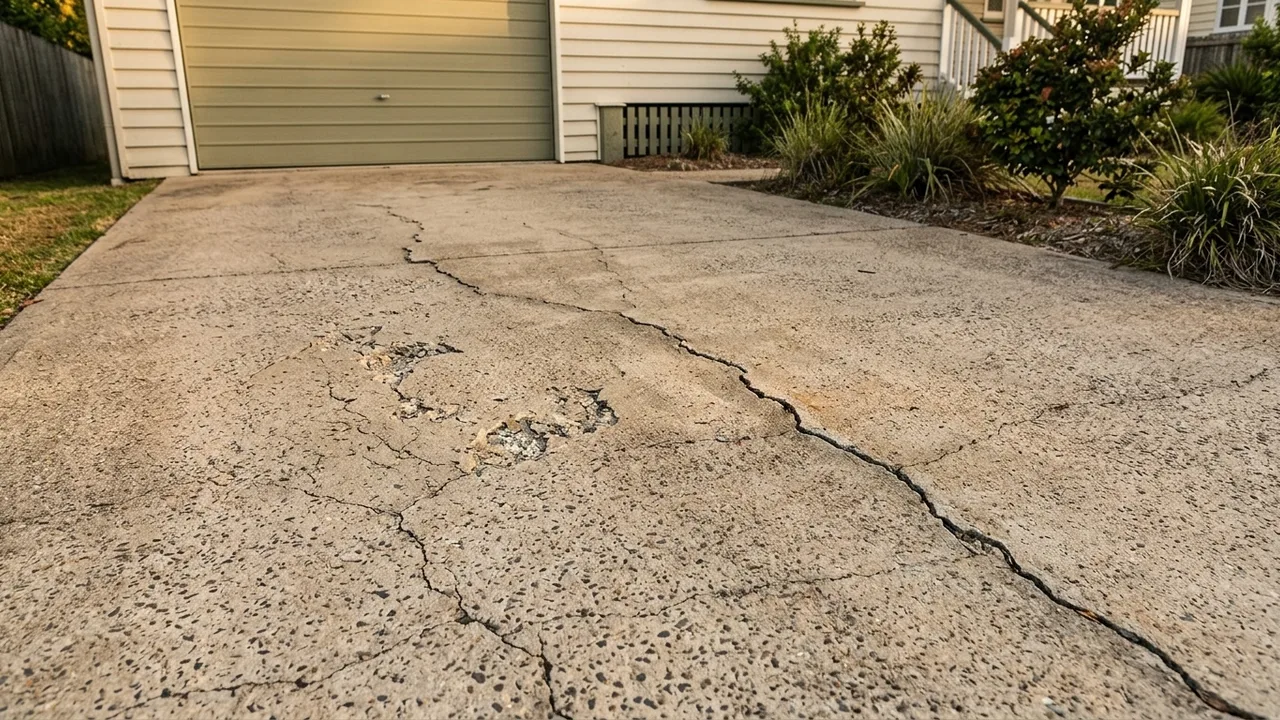
Hairline cracks (under 3mm wide, shallow, no movement) are surface-level stress cracks. Concrete expands and contracts with Brisbane's heat cycles, and fine cracking is a normal result over time. These can be filled and sealed without drama.
Structural cracks are wider, run deep, or show vertical displacement where one side of the crack sits higher than the other. That offset tells you the ground beneath has shifted. In the Inner East suburbs, this is more common than people expect. Bulimba, Norman Park, and Hawthorne sit on a mix of clay and fill soil that moves with the wet season. A structural crack that's opened up more than 5mm, or that keeps reopening after repair, is telling you the slab itself is compromised.
Spalling is when the surface layer flakes or pops off, exposing the aggregate underneath. Light spalling from a worn sealer is repairable. Deep spalling that's left the reinforcing steel exposed is a different situation entirely, and resurfacing over rusted reo is generally a short-term fix.
Sunken or raised sections point to subgrade failure. If your driveway rocks when you walk across it, or water pools in depressions rather than draining away, the base course underneath has eroded or settled. Resurfacing won't fix a bad base.
The Repair Case: When It Makes Sense
Repair is the right move when the concrete itself is structurally sound but has surface or cosmetic problems. Typically, that means:
- Cracks that are stable (not growing) and under 5mm wide
- Surface scaling or pitting from UV exposure or old sealer failure
- Minor unevenness along a single joint or expansion gap
- A driveway that's under 15-20 years old with otherwise solid footing
In Brisbane's climate, UV degradation is a real issue. A slab poured in the early 2000s might look rough on the surface but still have plenty of structural life. Grinding back the surface and applying a quality resurfacing compound can add another decade of service. It's significantly cheaper than a full replacement, typically $30-$80 per square metre for resurfacing versus $100-$150 per square metre for a full replacement slab, depending on the finish and site conditions.
Crack injection and joint filling are also legitimate repairs when done properly. A good concrete repair product (polyurethane or epoxy based, not just cement slurry) will flex slightly with the slab rather than cracking again immediately.
One honest trade-off: repaired surfaces rarely look identical to the surrounding concrete. If you're matching a coloured or exposed aggregate driveway, getting a seamless result is difficult. That's not a reason to avoid repair, but it's worth knowing.
The Replacement Case: When You Should Pull the Trigger
Some driveways are simply past the point where repair is economical. Consider replacement when:
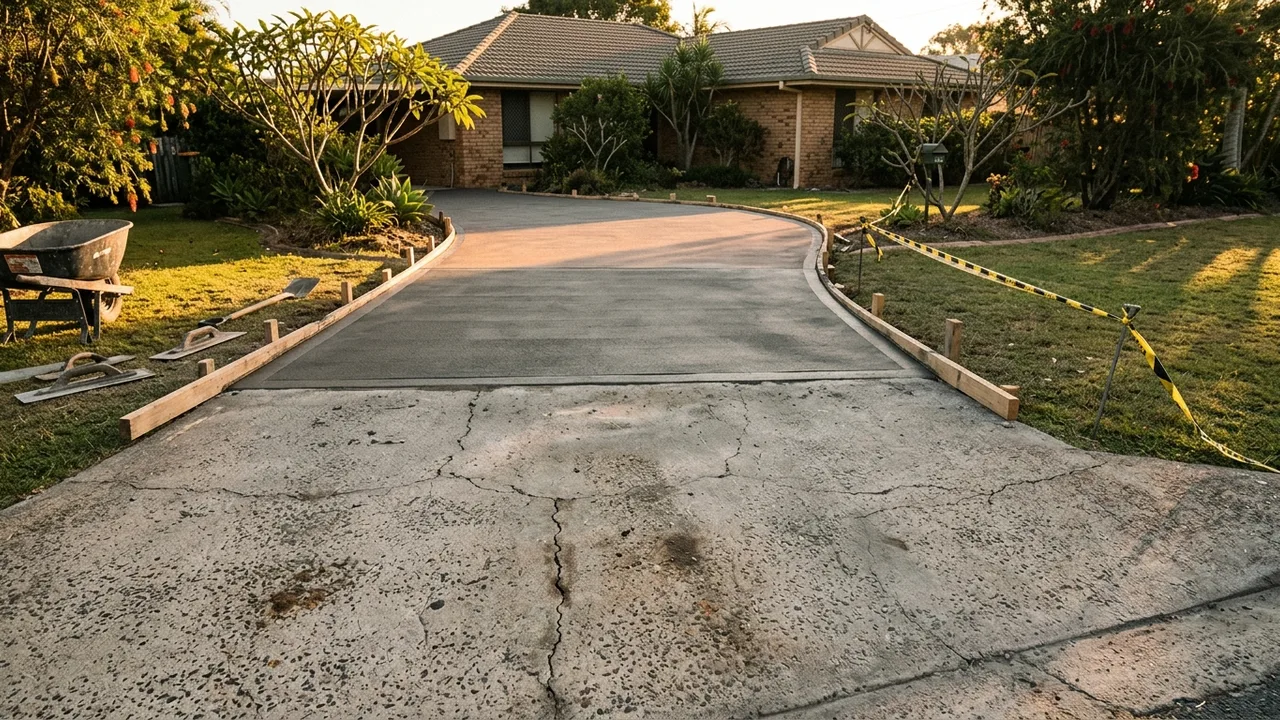
- Multiple large structural cracks cover more than a third of the surface
- The slab has heaved or dropped unevenly and can't be ground back without losing structural thickness
- Water consistently pools against the house or garage, which means the fall was never right to begin with
- You're planning a renovation or addition, and the driveway layout needs to change anyway
- The slab is 30-plus years old and has had multiple repairs that haven't held
In the Inner East, older Queenslander blocks often have driveways that were poured decades ago to accommodate a carport or single car. If you've got a new double garage or you've pushed the build out during a renovation, the old slab probably doesn't suit the new layout regardless of its condition.
Replacing a standard single-car concrete driveway in suburbs like Morningside or Cannon Hill typically runs $3,000-$7,000 depending on length, access, and the finish chosen. A double driveway with an exposed aggregate or coloured concrete finish will sit higher, often $7,000-$12,000 or more for a full Bulimba block with a long frontage. Those are indicative figures; actual quotes will vary based on your specific site.
The Middle Ground: When It's Genuinely a Judgement Call
There's a range of situations where reasonable people (and competent concreters) will disagree. If your slab has:
- Several moderate cracks but no heaving
- Spalling over 20-30% of the surface but no exposed reo
- Some drainage issues that might be solvable with grinding rather than full replacement
...then the answer depends on a few things you'll need to weigh up yourself.
How long are you staying? If you're planning to sell within two years, a quality resurface gives the driveway presentable kerb appeal at a fraction of the replacement cost. If you're staying 10+ years, replacement might be better value over that horizon.
What's underneath? If you or a previous owner knows the base was poorly prepared (no compaction, no base course, just concrete poured on clay), a resurface is hiding a problem rather than solving it. A replacement done properly, with a compacted road base underneath, will last significantly longer.
Is it getting worse quickly? A crack that's doubled in width over one wet season is an active problem. One that's been stable for three years is a different conversation.
Getting a Quote You Can Actually Use
One reason homeowners get confused is that they receive quotes without understanding what they're comparing. A few things worth clarifying when you speak to anyone:
- Is the quote for a full removal and replacement, or for resurfacing over the existing slab?
- What preparation is included? (Grinding, crack injection, base assessment)
- What thickness is being specified? A residential driveway typically needs 100mm; 75mm is thin for vehicle traffic.
- What's the curing and sealing plan?
If a quote seems significantly cheaper than another, ask why. Sometimes it's legitimately more efficient; sometimes it's thinner concrete or less subgrade preparation.
We connect homeowners in Bulimba and the surrounding Inner East with local concreters who can give you a proper site assessment. A quote based on photos alone won't tell you about the subgrade condition, which is the thing that matters most.
A Sensible Way to Make the Call
Here's a rough framework, without overcomplicating it.
If your driveway is under 20 years old, cracks are stable and narrow, and no sections have moved vertically: get a repair quote first. Compare it to a replacement quote and think about your timeline.
If your driveway is over 25 years old, has sections that move or rock, drains badly, or has been patched more than once without lasting improvement: get a replacement quote. Ask the concreter to look at the base when they come out.
If you're genuinely unsure: ask two concreters to give you an honest assessment, not just a price. A good operator will tell you when repair is the better option, even if replacement is a bigger job for them.
Your driveway is a long-term investment. A well-prepared concrete driveway in Brisbane should last 25-40 years with reasonable maintenance. Getting that foundation right, whether through a quality repair or a proper replacement, is worth taking the time to do properly.
If you'd like us to put you in touch with a local concreter who works across Bulimba, Hawthorne, Norman Park, and the surrounding suburbs, use the contact form and we'll match you based on your suburb and job type.
Quick answers