Concreting guide
Sloped blocks make concreting harder: what Inner East homeowners should know
Sloped blocks make concreting harder. That's simply true. The extra work involved in forming, pouring and finishing concrete on a gradient costs more, takes longer and demands more experience from the concreters you hire. If your home sits on one of the many sloped blocks across Norman Park, Hawthorne, Balmoral or the other Inner East suburbs, here's what you actually need to know before you get quotes.
Why slope makes concrete work more complicated
On a flat site, a concreter sets up formwork, pours, screeds and finishes. Gravity is their friend. On a sloped block, gravity becomes a problem to manage.
Wet concrete wants to flow downhill. On anything steeper than a gentle fall, the crew has to work faster, use a stiffer mix or both. A stiffer mix (lower slump in the jargon) is harder to work into corners and around reinforcing steel. That puts pressure on the finishing team to move quickly before the surface sets unevenly.
The formwork itself is more involved too. On a slope, the forms need to hold back the weight of concrete pushing against them, not just contain a level pour. That means heavier stakes, bracing and sometimes temporary retaining boards that a flat-site job simply doesn't need.
Then there's the question of drainage. A slab or driveway on a slope needs to direct water somewhere deliberate, whether that's a channel drain, a kerb, or a carefully graded edge. Get it wrong and you end up with pooling, erosion under the slab or water sheeting into your garage.
What the Inner East terrain actually looks like
The Inner East cluster (Bulimba, Hawthorne, Norman Park, Morningside, Cannon Hill and surrounds) sits along the ridges and gullies running down toward the Brisbane River. Lots vary enormously. A flat street-fronting block in Morningside can back onto a drop of two metres or more. Older Queenslander-era subdivisions in Norman Park and Balmoral were laid out without much thought for future concrete work; the blocks follow the natural contour.
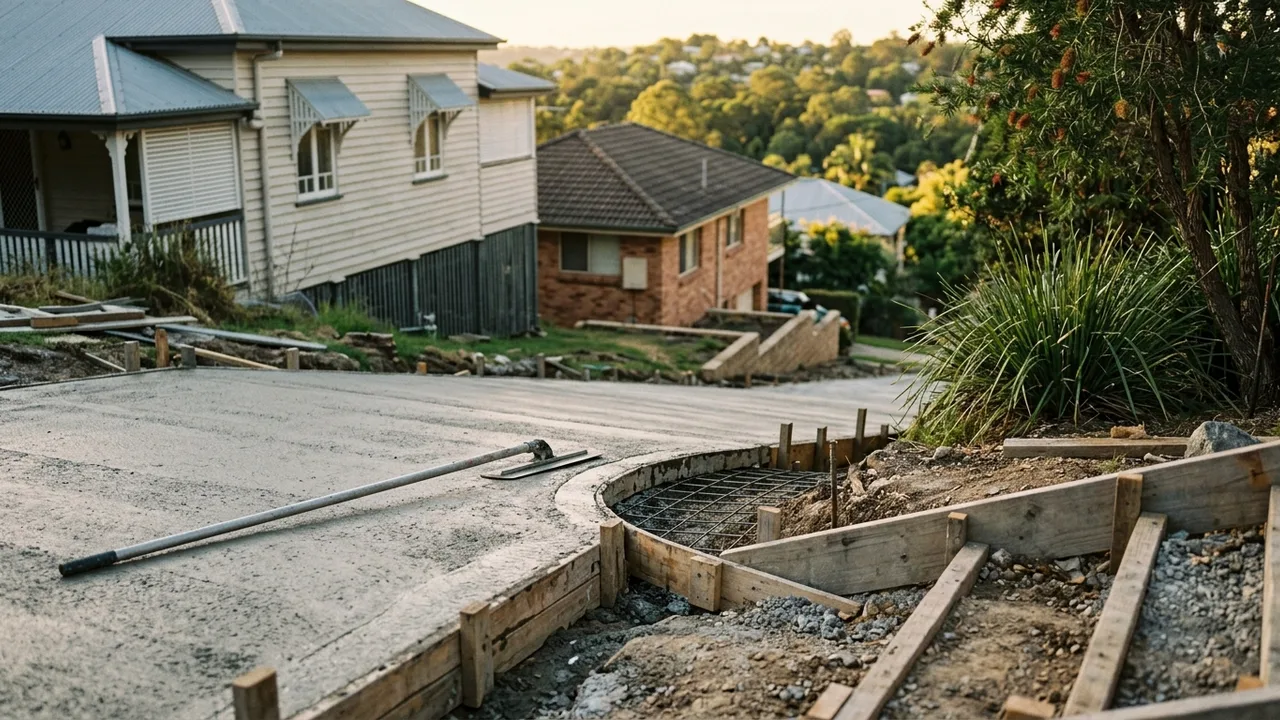
Timber-framed Queenslanders on stumps handle slope well because the structure lifts above it. Concrete doesn't have that luxury. Every pour has to deal with the site as it is.
If your property sits on the western or southern-facing ridges above Norman Park or Balmoral, you're more likely to encounter significant cross-falls or back-to-front slopes. If you're closer to the river flats around Bulimba or Murarrie, your block is more likely to be level, but drainage toward a low point is still a real consideration.
The practical impact on your quote
Expect sloped-site concreting to cost more than a comparable flat-site job. How much more depends on the steepness, the job type and whether retaining work is involved.
A rough way to think about it:
- Mild slope (under 1:20 fall): Minimal extra cost. A concreter may adjust their mix slightly and spend a bit more time on the finish. Most standard quotes will absorb this.
- Moderate slope (1:20 to 1:10): You'll likely see line items for additional formwork, drainage allowances and potentially a thicker slab to manage the grade. Add roughly 15-30% over a flat-site equivalent, though that's a rough guide only.
- Steep slope (steeper than 1:10): This is where costs can climb significantly. Some jobs require a retaining wall to create a level platform before any slab can be poured. That's essentially two jobs: the retaining structure and the concrete work on top of it.
On a job valued between $1,500 and $15,000, those percentages can represent real money. Get at least two quotes and ask each contractor to itemise the slope-related costs specifically. A contractor who can't explain what they're charging for on a sloped site is a contractor worth being cautious about.
Retaining walls: when they become necessary
Sometimes a slope can be managed with good formwork and drainage design. Other times, the ground needs to be cut and held back before any horizontal surface is practical. That's when a retaining wall enters the picture.
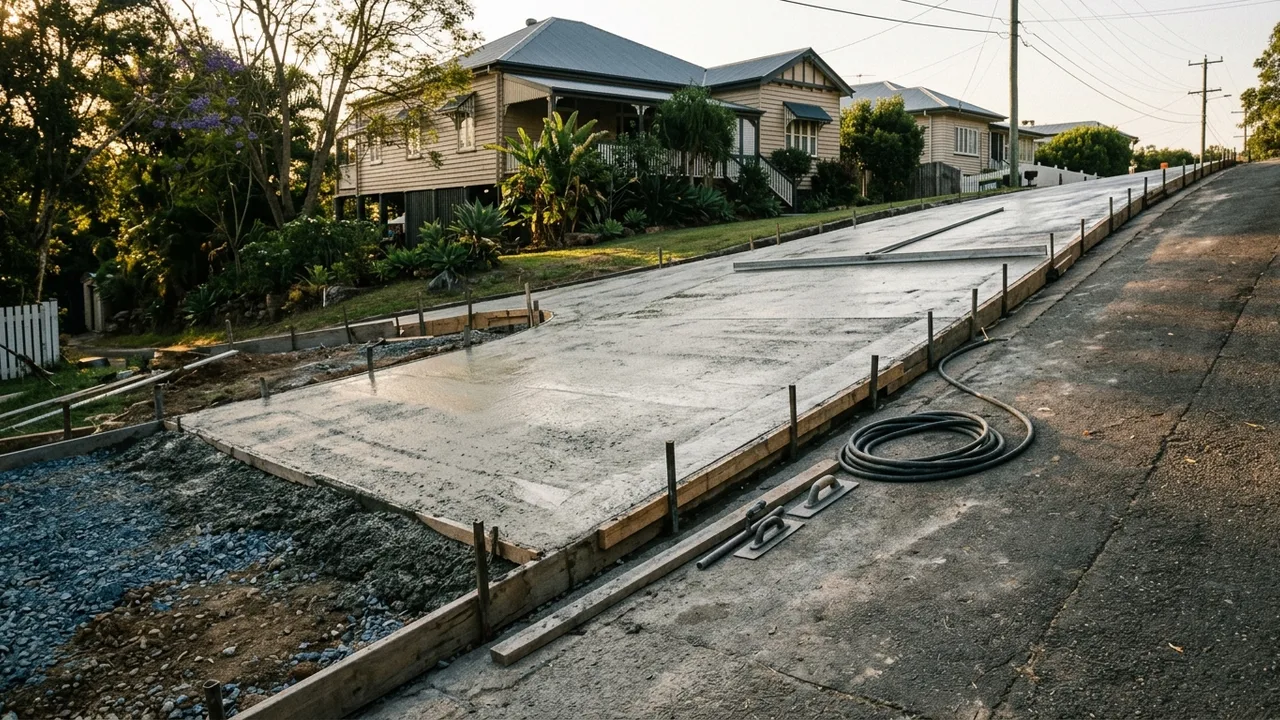
Poured concrete retaining walls are one option for Inner East blocks. They're solid, long-lasting and can be finished to match or complement a driveway or patio slab. Compared to timber sleeper walls, concrete doesn't rot and won't need replacing in 15-20 years. Compared to block or stone walls, a poured wall is monolithic, meaning there are no mortar joints to crack or weeds to grow through.
The trade-off is cost and construction time. A poured concrete retaining wall involves formwork, reinforcing steel, a pour and a cure period before backfilling can begin. If you're doing a driveway at the same time, the sequence matters and needs to be planned from the start.
In Brisbane, retaining walls over 1 metre high (measured from the bottom of the footing) typically require a building permit. Your concreters should be across this. If a quote doesn't mention it and your wall is going to be substantial, ask directly. Skipping permits on retaining walls can create problems when you sell.
Drainage: the detail most homeowners miss
A sloped concrete surface without a drainage plan is a problem waiting to happen. Water follows the path of least resistance, and if your driveway or slab channels it toward your garage slab, your neighbour's fence line or the base of your house stumps, you'll see damage eventually.
The main drainage options for sloped concrete work in the Inner East:
- Channel drains (strip drains): Installed across the width of a driveway at the low point. Water collects here and is piped away. This is probably the most common solution on steep residential driveways.
- Side drainage: Concrete is graded to shed water to one or both sides, where a gravel strip or garden bed absorbs it. Works well on gentler slopes.
- Ag-pipe and soak pits: Sometimes used behind retaining walls to relieve hydrostatic pressure. Important if your wall is holding back saturated soil.
Brisbane's Inner East can receive intense summer rainfall in short bursts. A drainage solution that handles a light shower might be overwhelmed in a storm event. Ask your concreter what flow rate they've designed for.
Choosing between DIY, a handyman and a licensed concreter
Some small concrete work (a garden step, a small level pad) is within reach of a confident DIYer. Sloped-site work is not that category.
The reasons pile up quickly. Mix consistency matters more on a slope. Formwork failure on a steep pour wastes an entire batch of concrete and can be dangerous. Getting the drainage grade exactly right requires experience reading a site, not just following a formula. And if a retaining wall is involved, the structural implications of getting it wrong are serious.
A handyman or unlicensed operator might quote less. The risk is that sloped work doesn't forgive inexperience. A slab that moves, cracks along a joint or pools water is expensive to repair and may not be repairable at all without a full replacement.
For anything involving significant slope, a retaining wall or a driveway that needs a drainage permit, use a licensed concreters with demonstrated experience on sloped Inner East sites specifically.
A sensible approach before you commit
Before you call anyone, take a few minutes on your block. Walk from the street to the back boundary and notice where the water goes when it rains. Note where the highest and lowest points are relative to where you want your concrete. Check whether any of the work will be within 1.5 metres of your boundary (which can trigger council setback rules in Brisbane City Council's jurisdiction).
Then get two or three quotes from concreters who have worked in your suburb or nearby. Ask them to walk the site with you, not just hand you a number over the phone. A concreter who can stand on your block and explain exactly how they'll handle the grade, the drainage and the formwork sequence is one who actually knows what they're quoting.
The slope on your block is a real constraint. But it's a solved problem, managed every day on Inner East sites across Hawthorne, Norman Park and Balmoral. The key is working with someone who's solved it before.
If you'd like to be connected with a local concreter who works regularly across the Inner East and can quote your specific site, that's exactly what this service is here for.
Quick answers