Concreting guide
How do concreters work on the narrow lots and tight side access common in the Inner East?
Concreters who work regularly in Bulimba, Hawthorne, Norman Park and the surrounding Inner East suburbs have a simple answer to the tight-access problem: they plan for it before the truck arrives. Narrow side passages, steep grades, and Brisbane's older subdivision layouts make concrete work genuinely more complex here than in newer outer suburbs, but it is not a showstopper. It just requires specific equipment, honest scheduling, and a crew that has done it before.
Why Inner East Brisbane Lots Create Real Access Challenges
The Inner East's character is part of the appeal. Queenslander-era homes on elevated stumps, mature trees along the fence lines, and blocks that were subdivided long before anyone imagined a concrete pump truck sitting on the street. Many lots in Hawthorne and Balmoral have side access passages as narrow as 900 mm to 1.2 m. That is not unusual. It is, however, tight enough to rule out most conventional equipment.
Compounding this, a lot of Inner East homes sit on sloping blocks. The rise from street level to the back yard can be 1.5 m or more in some Norman Park and Morningside properties. Moving wet concrete uphill through a narrow gap is not the same job as pouring a flat suburban slab in Tingalpa with a truck backing straight in.
Council easements, overhanging vegetation, and fixed boundary fences further restrict manoeuvrability. Before a concreter even thinks about mix design or finish, they need to answer one question: how does the concrete physically get from the street to the pour location?
The Three Main Methods for Getting Concrete Into Tight Spaces
Concrete pump (line pump or trailer pump)
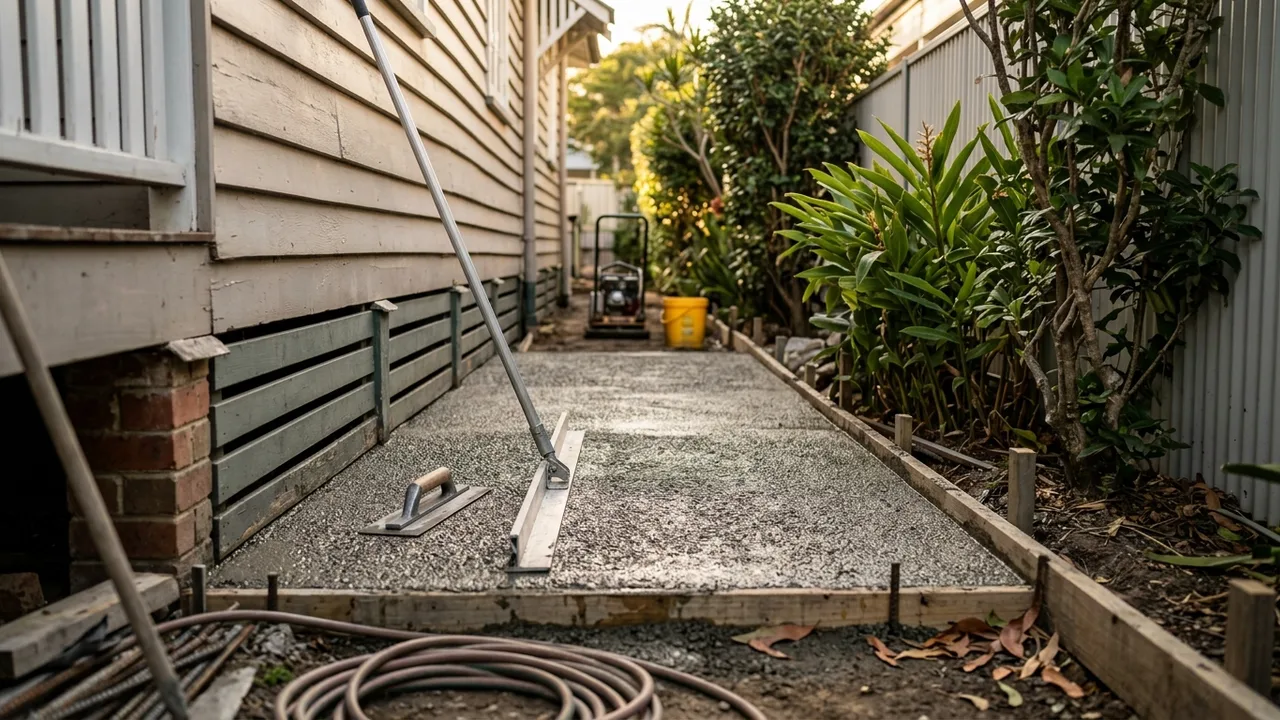
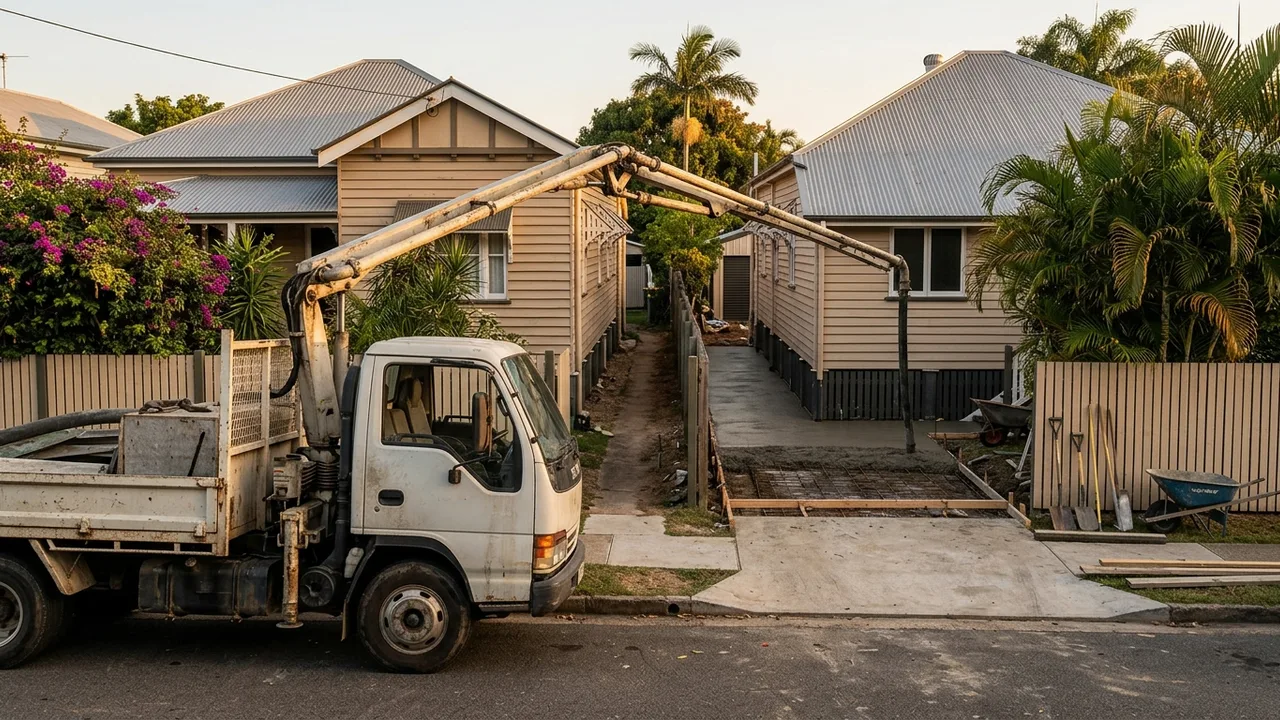
A line pump sits on the street or in the driveway and pushes concrete through a flexible hose. The hose can snake through a side passage, around corners, and up a slope. For most Inner East jobs with limited access, this is the most reliable option. It adds to the cost (typically $500 to $900 for a half-day hire in the Brisbane metro, on top of labour), but it removes a lot of manual handling risk and keeps the pour continuous.
Concrete kibble and crane (rare for residential)
On some heritage properties where even a pump hose cannot get through, a kibble (a large bucket) lifted by a small crane or telehandler can work. This is uncommon for standard residential concreting in Bulimba or Cannon Hill, and the mobilisation cost makes it hard to justify for jobs under roughly $8,000 to $10,000.
Wheelbarrows and manual labour
For smaller pours on very tight sites, experienced concreters still use barrows. A competent crew can move 1 to 2 cubic metres of concrete by hand in a reasonable timeframe, and for a small shed slab or a garden path this is often the most cost-effective approach. The trade-off is labour fatigue: wet concrete is heavy (around 2,400 kg per cubic metre), and speed matters because concrete starts setting. A crew needs enough hands to make it work before the mix stiffens.
In practice, most concreters in the Inner East use a combination of these. The pump handles the bulk of the pour, and barrows handle the last sections that the hose cannot quite reach.
Formwork, Compaction, and Finishing in Constrained Conditions
Access is only part of the challenge. Once the concrete is on site, the crew still needs room to work.
Setting formwork in a narrow side passage typically means using shorter boards and more stakes, since there is no room to swing a full-length timber. Steel road forms (the metal edge frames that give a slab its shape) are often preferred on tight sites because they hold their line better when workers are squeezing past them.
Compaction with a vibrating screed is harder in confined spaces. A standard highway screed (typically 1.8 to 3 m wide) may not fit a 1.1 m passage, so concreters switch to a hand tamper or a shorter strike-off board. This takes longer and requires more care to avoid honeycombing (voids in the slab caused by poor compaction).
Finishing the surface - whether that is a broom finish for a driveway apron, a smooth trowel finish for a garage slab, or an exposed aggregate surface for a back patio - is also physically harder when you cannot get a power trowel machine into the space. Expect more hand work, which is reflected in the labour component of any quote.
How This Affects Timeframes and Cost
A straightforward driveway replacement in a suburb with good access might take one crew day. The same area of concrete in a property with tight side access in Morningside or Balmoral might take 1.5 to 2 days, partly because of setup, partly because the pour itself takes longer.
On cost, a concrete path or side access slab that would be $2,000 to $3,500 on an easy-access block can move to $3,000 to $5,500 once pumping, extra labour, and extended time are factored in. That is a meaningful difference. Any quote for an Inner East tight-access job that does not acknowledge this complexity is worth querying.
A few specific cost drivers to ask about when getting quotes:
- Is pump hire included or quoted separately?
- How many labourers will be on site for the pour day?
- Is the quote based on a site inspection, or was it done from photos or measurements alone?
- Are tree root barriers or edge protection required near the boundary fence?
An honest concreter will have visited the site before pricing the job, or at minimum asked for detailed photos and measurements.
Working Around Queenslander Stumps and Existing Structures
Many Bulimba and Hawthorne properties have under-house areas that sit on hardwood or concrete stumps. Pouring a new slab against or under an existing Queenslander requires careful attention to drainage, formwork, and reinforcement placement.
Concrete should not trap water against timber stumps. A good concreter will fall (slope) the slab away from the house structure, typically at a minimum 1:100 gradient, and may install a strip drain at the junction. This is particularly worth discussing if you are concreting an under-house area or a laundry slab against an existing timber subfloor.
Reinforcement in tight spaces also needs thought. Steel reinforcing mesh (SL72 or SL82 for most residential slabs) is typically cut to fit on site. In very confined areas, bar chairs (the plastic spacers that hold mesh off the substrate) sometimes get knocked out of position during the pour, which can reduce effective slab depth. Worth asking your concreter how they manage this on tight jobs.
What to Expect on the Day
If you are home for the pour, a few things to know. The concrete truck will park on the street. In Inner East suburbs with narrow roads (parts of Norman Park and Hawthorne in particular), this may require a quick conversation with neighbours or a council permit for the truck to stand in a clearway. An experienced crew will have sorted this before the day.
The pump hose, if used, will run from the truck along the side of your property. It will be heavy and will leave a narrow track on any lawn or garden bed it sits on. Worth laying down protective boards beforehand if you care about the garden.
The actual pour is usually the fastest part of the day. Setup and formwork take the most time, and cleaning up the pump and tools after the pour can take an hour or more. On a tight site, that cleaning process happens in your driveway or on the footpath.
A Practical Recommendation
If you are planning concrete work on an Inner East property with limited access, the most useful thing you can do before calling anyone is to measure your side access width at the narrowest point and note the approximate height change from street level to the pour location. Those two numbers will immediately tell a concreter whether they need a pump, how many labourers they should plan for, and whether the job can be quoted confidently without a site visit.
From there, it is worth asking at least two local operators to come and look. Not because price is everything, but because the way someone responds to a tight-access site (whether they ask the right questions, suggest sensible solutions, or gloss over the complexity) tells you a lot about the quality of work you can expect.
Quick answers