Concreting guide
How do you know when a concrete driveway actually needs replacing?
Some driveways need replacing. Most just need honest assessment.
A concrete driveway that looks bad is not automatically a driveway that needs to come out. But one that looks fine can sometimes be hiding structural problems that will cost you more the longer you leave them. The honest answer to the headline question is: it depends on whether the damage is cosmetic, structural, or somewhere in between.
Here is a practical way to work through that question yourself, before you spend a dollar on anyone's advice.
Surface Damage vs Structural Damage: Know the Difference First
This is the single most important distinction. Surface damage is what lives in the top 10 to 20 millimetres of the slab. Structural damage goes deeper, affecting the integrity of the concrete and sometimes the subbase underneath it.
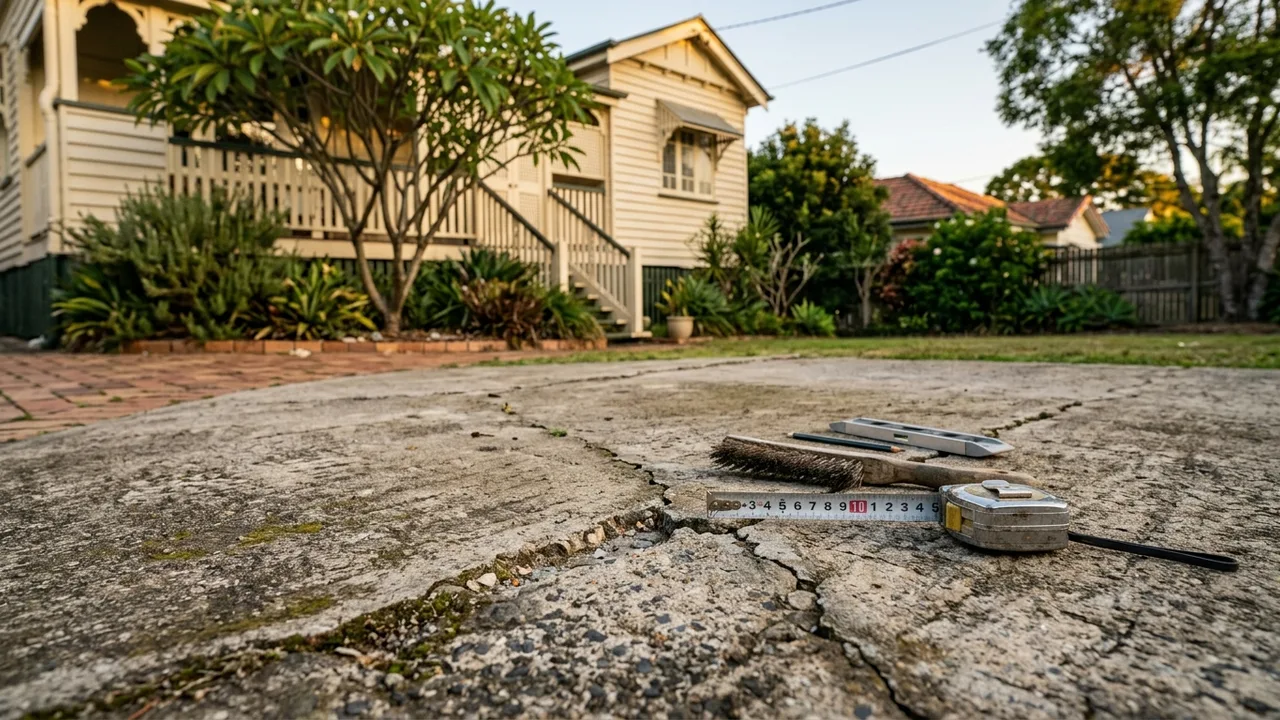
Surface damage typically looks like:
- Fine map cracking (sometimes called "crazing") spread across the face
- Spalling, where small flakes or chips have popped off the top layer
- Staining, efflorescence (the white chalky residue), or general weathering discolouration
- Shallow scaling from years of UV exposure or old sealer failure
Most surface damage is repairable. Grinding, resurfacing or a bonded overlay can extend a slab's life by a decade or more, at a fraction of replacement cost. If your driveway is otherwise sound, a full rip-out is usually hard to justify financially.
Structural damage looks different:
- Cracks wider than around 5 to 6 mm, or cracks that have a lip on one side (meaning the two slabs have shifted to different heights)
- Sunken sections, particularly near the kerb or garage apron
- A hollow sound when you walk on the slab and knock on it (suggesting voids beneath)
- Crumbling edges that break away easily by hand
When you have structural movement, resurfacing is applying makeup to a broken bone. It will fail within a few years and you will be back to square one.
How Brisbane's Inner East Conditions Affect Concrete Life
In suburbs like Bulimba, Hawthorne, Norman Park and Balmoral, a few local factors are worth understanding because they do affect how concrete ages here versus other parts of Brisbane.
Tree roots. Many streets in the Inner East and inner-west corridor have large street trees and established garden plantings, including fig varieties, poinciana and jacaranda. These are beautiful; they are also hard on concrete. Root intrusion under a driveway can lift sections and crack slabs from below. If your driveway is heaving upward in a line that roughly follows where a tree sits, the subbase may already be compromised.
Clay subbase movement. Large parts of Brisbane's Inner East sit on reactive clay soils that expand when wet and shrink when dry. This seasonal movement can open hairline cracks over time, particularly in driveways that were poured without adequate reinforcement or a properly compacted subbase. A driveway on a reactive clay site that was poured 15 or 20 years ago may simply have reached the end of its reasonable service life.
Older homes, older slabs. Bungalow and Queenslander-style homes in suburbs like Morningside, Cannon Hill and Tingalpa often have driveways that were poured in the 1970s through to the early 1990s. Standards for reinforcement and subbase preparation were lower then. A driveway of that age deserves a more critical eye.
Slope and drainage. Many blocks in the Inner East have a moderate slope. Driveways on sloped sites need to be designed so water runs away from the garage and the house. If your current driveway is channelling water toward the structure, that is a design problem a simple resurface will not fix.
The Age Question: When Does a Concrete Driveway "Wear Out"?
A well-poured residential concrete driveway, properly reinforced and on a stable subbase, can last 30 to 50 years. That is the optimistic end. A driveway that was poured without reo mesh or steel reinforcement, on an uncompacted subbase, in a reactive clay area, might start showing structural problems inside 15 years.
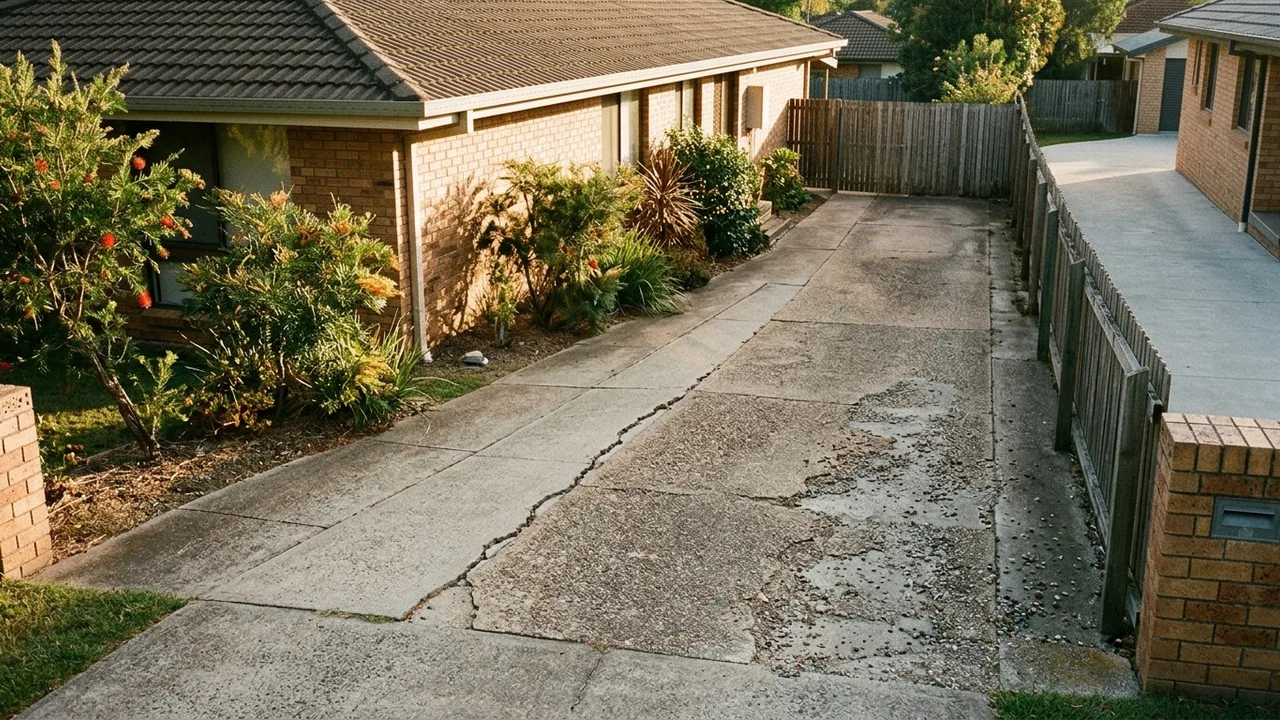
Age on its own is not a disqualifier. A 35-year-old slab with minor surface crazing and no movement is still a candidate for resurfacing. A 12-year-old slab that has sunk 30 mm near the kerb because the subbase was never properly compacted needs to come out and be done properly.
Ask yourself: how has it held up, not just how old is it.
Repair vs Replace: A Rough Cost Framework
There is no precise answer here without someone physically assessing your driveway, but a general framework helps.
Resurfacing or crack repair for a standard single-car driveway in the Inner East typically sits somewhere in the range of $800 to $2,500 depending on the extent of work, the product used and site access. This makes sense when damage is superficial and the slab is structurally sound.
Full replacement for a standard single-car driveway (roughly 30 to 40 square metres) typically runs $3,000 to $6,500 or more, depending on whether tree roots need removal, old concrete disposal is involved, and what finish is specified. A double driveway or one with significant slope, curves or decorative finish will be higher.
The trade-off is this: if repair costs are above 40 to 50 percent of replacement cost, and the slab has structural issues, replacement is almost always the better value over a 10-year horizon. You are not saving money with a repair that fails in three years and still requires a replacement.
What a Good Tradesperson Will Actually Check
When you get someone out to quote, they should be doing more than eyeballing the surface. A thorough assessment includes:
- Checking crack widths and whether there is vertical displacement (one side higher than the other)
- Walking the slab and listening for hollow sections, which suggest voids or subbase loss
- Looking at the drainage pattern and where water pools or runs
- Asking about tree roots on or near the site
- Checking the garage apron, which is typically the first section to move or crack because of the transition from slab to footpath or kerb
If a quote arrives without any of this and goes straight to a price, that is worth noting.
The Honest Recommendation
If you can walk your driveway right now and you see only surface-level cracking, fading or minor spalling, and the slab does not rock or flex underfoot, get a resurfacing quote first. It may solve the problem at a much lower cost.
If you are seeing sunken sections, cracks with a noticeable height difference on either side, or large areas that crumble or sound hollow, a replacement conversation is the right one to have.
Either way, get more than one opinion. The Inner East has enough older homes and enough clay-affected sites that an experienced local concretor will recognise these conditions quickly. A 15-minute site visit is usually enough for a straight answer.
If you want to connect with someone who knows this part of Brisbane and can give you an honest assessment without pressure, that is what we are here to help with.
Quick answers