Concreting guide
How long before you can use new concrete in Brisbane's climate?
The Short Answer First
New concrete typically needs 24 to 48 hours before you can walk on it, and 7 days before you should drive a standard passenger car over it. Full structural strength takes around 28 days. In Brisbane's climate, heat and humidity both affect that timeline in ways worth understanding before you use your new slab.
Why Concrete Strength Works on a Curve, Not a Countdown
Concrete does not "dry" the way paint does. It cures, which is a chemical process called hydration. Water reacts with cement particles to form interlocking crystals that give concrete its strength. That process continues for weeks, and in some respects for months.
The standard measure in the industry is 28-day compressive strength. At that point, a typical residential mix has reached roughly 99 percent of its design strength. But the curve is front-loaded: concrete reaches about 70 percent of that strength within the first 7 days. That is why concreters often talk in those two milestones, 7 days and 28 days, rather than a single finish line.
What this means practically: the slab is not fragile forever, but it is most vulnerable in the first week. Overloading it or stressing it during that window can cause surface cracking or worse, internal damage that does not show up immediately.
How Brisbane's Climate Affects the Curing Process
Brisbane sits in a subtropical zone, and that creates specific curing challenges that you would not face in Melbourne or Hobart.
Heat accelerates the early set, but can cause problems. When air temperatures are above 30°C, which is common across Bulimba, Hawthorne and Morningside from November through to March, the surface of a slab can begin to set faster than the interior. That differential can cause plastic shrinkage cracking, those fine surface cracks that appear within the first few hours after a pour.
Low humidity makes it worse. Brisbane summers bring humidity, but the shoulder seasons, particularly September and October, can deliver warm days with relatively low humidity and a northwesterly wind. That combination strips moisture from the surface rapidly. A concrete slab poured on a 28°C day with a dry westerly blowing is at real risk of surface cracking before the finishers have even packed up.
Rain in the first few hours is also a problem. A downpour within two to four hours of finishing can wash cement out of the surface, leaving a weakened layer that will powder and wear prematurely. Brisbane's afternoon storms in summer make timing critical.
A good concreter in the Inner East will account for all of this. They may pour early in the morning to avoid peak heat, use a retarding admixture to slow the set on hot days, and apply curing compounds or cover the slab with wet hessian or plastic sheeting immediately after finishing.
Practical Timelines: What You Can Do and When
Here is a realistic guide for a standard residential concrete pour in Brisbane conditions:
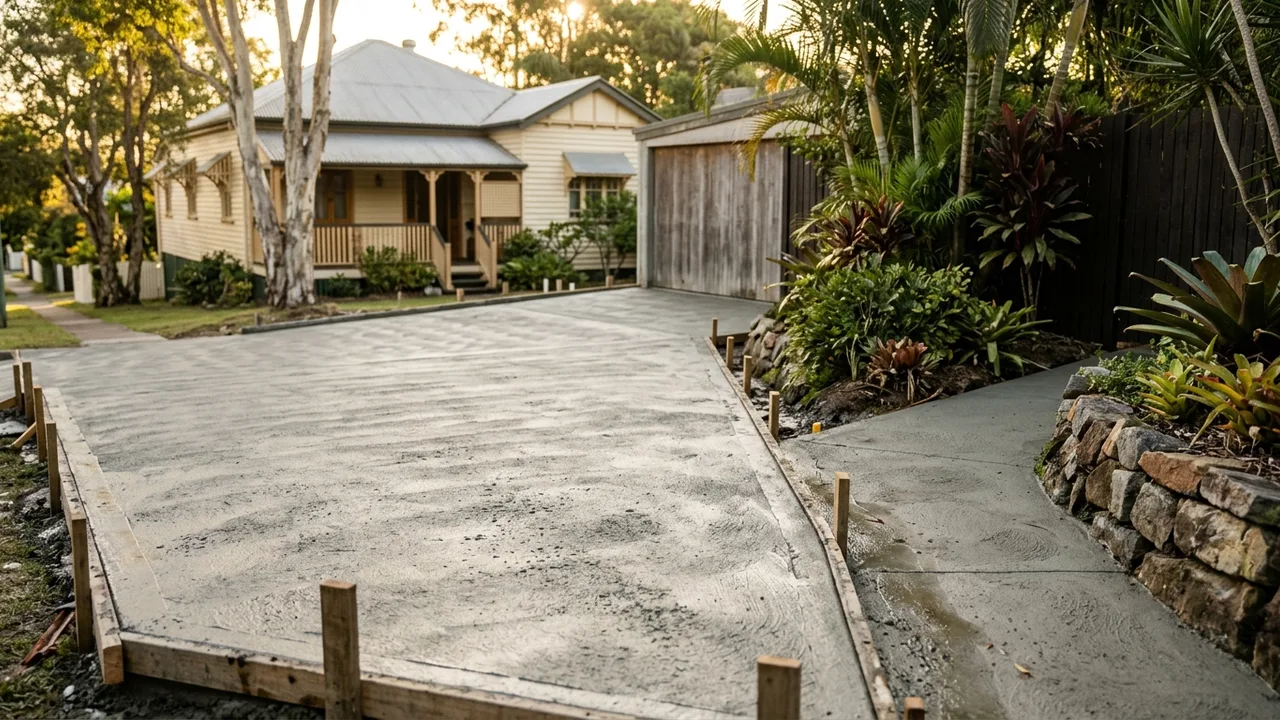
- 2 to 4 hours after pour: The surface will support a light footprint but should not be walked on. Finishing work is still happening.
- 24 hours: You can walk on the slab carefully. No heavy foot traffic, no dragging furniture or equipment across it.
- 48 to 72 hours: General foot traffic is fine. This is when most homeowners can safely use a new pathway or entertaining area for walking.
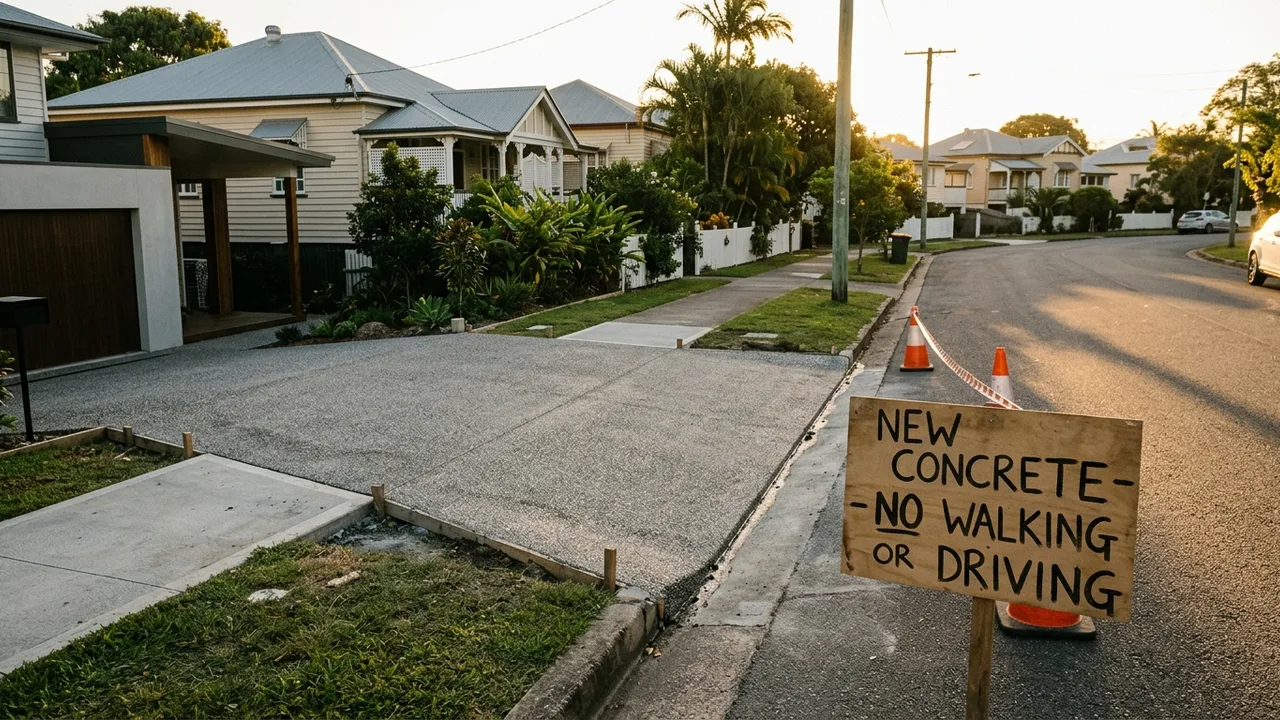
- 7 days: A standard passenger vehicle (up to around 2,000 kg) can drive on a new driveway. This is the milestone concreters typically quote for driveways in Bulimba and surrounds.
- 28 days: Full design strength. Safe for heavier vehicles, including utes, vans and skip bins. If you are having a concrete slab poured for a garage or workshop in Cannon Hill or Murarrie, this is the point at which you should bring in heavy equipment or loaded vehicles.
These timeframes assume a properly mixed and finished slab with adequate curing measures in place. A slab that was poured in high heat without curing compound or covering may need longer before you stress it.
Curing Methods and the Trade-offs Between Them
Not all curing is equal, and this is where some real cost-versus-benefit decisions come in.
Wet curing (hessian, wet blankets, or ponding water on a flat slab) is the most effective method for retaining moisture. It keeps hydration happening at a consistent rate. The trade-off is that it requires attention: the coverings need to stay wet, and they need to stay in place. It is also impractical on a sloped driveway or a vertical surface like a retaining wall.
Curing compounds (sprayed-on liquid membranes) are the most common choice on residential jobs across Inner East Brisbane. They seal the surface immediately after finishing, slowing moisture loss. They are less labour-intensive than wet curing. The trade-off is that they can interfere with some surface treatments applied later, so if you are planning a sealer or coloured coating over an exposed aggregate patio, make sure your concreter uses a compatible compound.
Plastic sheeting is a reasonable compromise for flat slabs. It is inexpensive and effective if it is held down at the edges to prevent the wind lifting it. In Brisbane's breezy conditions, especially on exposed blocks in Tingalpa or Balmoral near the river, securing the edges properly matters.
Doing nothing is not a neutral choice. An uncured slab in Brisbane's summer heat will lose surface moisture too quickly, and the result is a weaker top layer that dusts and erodes over time.
Driveway vs Entertaining Area vs Shed Slab: Does the Use Change the Answer?
Broadly yes, because the loads are different.
A concrete pathway or garden path carries foot traffic only. You can usually use it within 48 to 72 hours without any concern.
A decorative entertaining area is similar; furniture can go on it after 72 hours, and you can host a barbecue on a weekend if the slab was poured mid-week. Just do not drag a heavy fridge across it until the 7-day mark.
A concrete driveway sees vehicle loads. Seven days for a passenger car is a reasonable rule of thumb. But if your household runs a tradesman's van or a larger SUV with a tow bar and trailer, waiting the full 28 days is the smarter call.
A shed or garage slab is designed with reinforcing (typically F72 or F82 mesh for residential work in Brisbane) and a thicker pour. The curing timeline is similar, but the stakes of getting it wrong are higher if you plan to bring in a loaded trailer or a car hoist. Wait the full 28 days before anything heavy rolls onto it.
A Sensible Approach for Inner East Homeowners
Plan your pour for the cooler part of the day. If you have a choice, avoid the hottest weeks of summer and schedule for late autumn or early winter, when Brisbane temperatures are mild and the humidity is lower. May and June are particularly good months for concrete work in this part of the city.
Ask your concreter what curing method they plan to use. A good operator will answer without hesitation. If the answer is "nothing, she'll be right," that is worth knowing before they start.
And give the slab the time it needs. A week of waiting before driving on a new driveway is genuinely inconvenient, but it is a small cost against a 20-year-plus asset on a Bulimba or Hawthorne property. Concrete that is stressed too early does not always crack immediately. Sometimes the damage shows up months later, and by then there is no obvious link back to the cause.
If you want to talk through a new pour, a replacement driveway, or a slab for a backyard shed anywhere in the Inner East, we can connect you with a local concreter familiar with the area's conditions and block types. There is no pressure, just a straightforward conversation.
Quick answers