Concreting guide
How long should concrete last in Brisbane's climate before it needs attention?
Concrete laid properly in Brisbane's climate should last 25 to 40 years before it needs anything more than routine cleaning. That said, "needing attention" is a spectrum — minor cracking can show up in under a decade, while a well-specified slab might go 20 years without a single repair call.
The honest answer depends on what kind of concrete, where it sits on your property, and what Brisbane's specific conditions do to it over time.
Why Brisbane's Climate Is Harder on Concrete Than Most People Expect
Brisbane sits in a subtropical climate, and that combination of heat, humidity, UV intensity, and seasonal downpours creates a more aggressive environment than, say, Melbourne or Adelaide.
Here is what actually stresses concrete in this part of the world:
- Thermal cycling. Summer days in Bulimba and surrounds regularly push above 35°C. Concrete expands in heat and contracts at night. Over years, that movement opens micro-cracks that water then exploits.
- Heavy rain followed by dry spells. The wet season dumps significant rainfall in short bursts. Water sitting on or under a slab, then evaporating quickly, accelerates surface degradation.
- Tree roots. The Inner East is full of mature trees — poinciana, jacaranda, fig, and mango are common in Norman Park, Hawthorne, and Balmoral. Roots are one of the most frequent causes of cracked and heaved paths and driveways in this cluster.
- Clay soils. Much of the Inner East sits on reactive clay. Clay shrinks in dry conditions and swells when wet, which puts constant pressure on slabs from below. This is not a minor issue. Slabs poured without proper compacted base preparation on clay will typically show movement within five to ten years.
- UV degradation. Sealers and colour-treated surfaces fade and break down faster here than in cooler climates. An unsealed exposed aggregate surface in full sun at Morningside or Cannon Hill will look noticeably weathered within eight to twelve years.
None of this means Brisbane concrete is doomed. It means expectations should be realistic, and the quality of the original pour matters enormously.
What "Attention" Actually Looks Like at Different Ages
It helps to break the lifespan into rough stages rather than thinking in binary terms of "fine" or "failed".
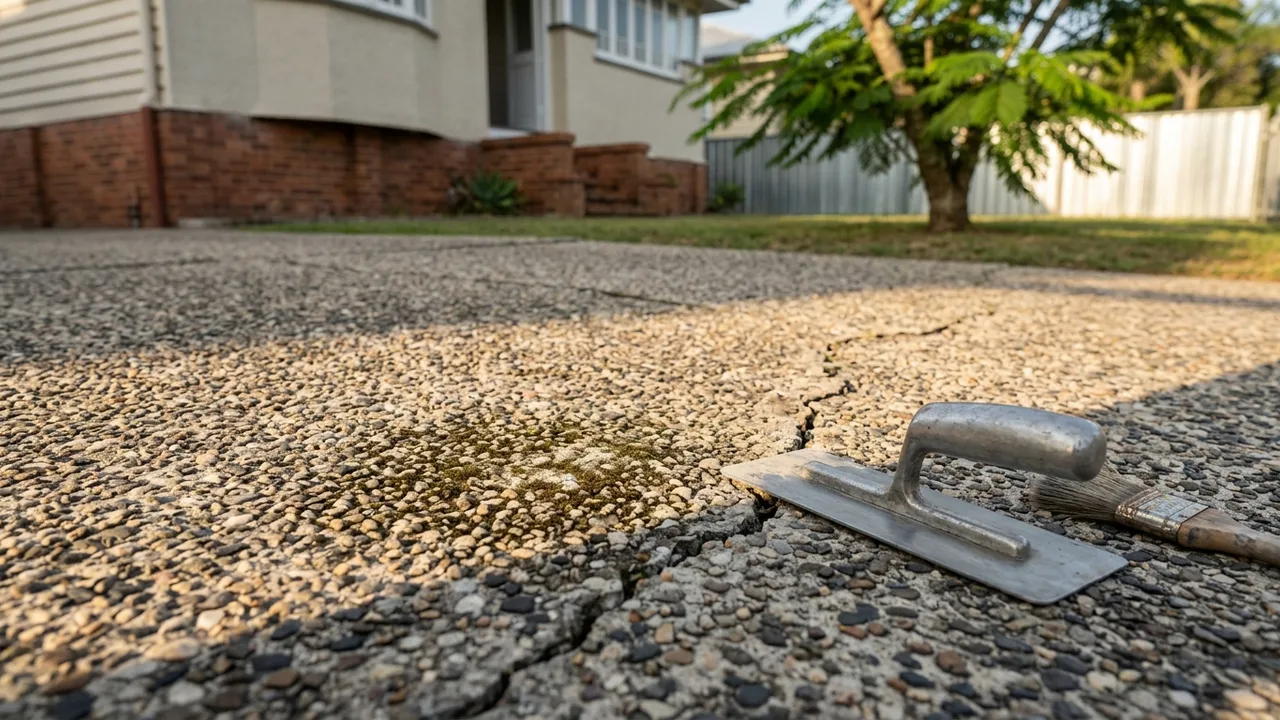
Years 1 to 5
Shrinkage cracking — fine, hairline cracks — is normal in fresh concrete. These are cosmetic in most cases and do not indicate a failing slab. What is not normal in this window: wide cracks (more than 3mm), cracks that move when you press them, or slab sections that rock underfoot. Those suggest either a poor mix, inadequate base preparation, or both.
Years 5 to 15
This is typically when surface wear becomes visible. Scaling (where the top layer flakes away), efflorescence (white salt deposits), and spalling (deeper surface chips) can all appear in this window, especially on driveways that see vehicle traffic daily. A quality reseal can buy several more years. Path surfaces in partial shade tend to hold better than sun-baked driveways.
Years 15 to 25
By this point, most Brisbane driveways and paths have at least minor cracking. The question at this stage is whether cracks are structural or surface-level. Surface cracks that run only a few millimetres deep can often be filled and resurfaced. Cracks that run through the full depth of the slab, or sections that have lifted due to root intrusion or clay movement, typically need replacement of those sections rather than a patch.
Years 25 and beyond
A well-poured slab on a properly compacted base, away from large trees, can genuinely last 30 to 40 years with periodic maintenance. But concrete at this age often has multiple interconnected issues — and at some point, resurfacing a slab that has moved significantly is money not well spent. Replacement becomes more cost-effective than ongoing repairs.
The Variables That Shift the Timeline Considerably
Two slabs poured the same year in the same suburb can look completely different at the fifteen-year mark. The reasons usually come down to:
Mix specification. A 20MPa mix is the minimum for most residential applications; 25MPa or 32MPa is more appropriate for driveways carrying vehicle loads. Stronger mixes cost more at the time but degrade significantly slower.
Base preparation. Compacted road base under the slab is not optional in Brisbane's clay-heavy soils. If you are in Tingalpa or Murarrie where ground conditions vary, skipping base preparation to save cost almost always shows up as movement within a decade.
Reinforcement. Steel mesh or reo bar does not stop cracking, but it holds cracked sections together and prevents them from lifting or separating. Unreinforced slabs on reactive soils tend to fail faster.
Drainage. Water pooling against or under a slab is the enemy. Good perimeter drainage, correct falls, and functioning stormwater connections extend slab life considerably. This is worth checking if you have an older property in the Inner East where drainage setups can be haphazard.
Sealing. A penetrating sealer applied within the first month of pour, and reapplied every three to five years, reduces water ingress significantly. It is a modest ongoing cost relative to the delay it provides on surface deterioration.
Repairs vs Replacement: Where the Trade-off Sits
This is the question most homeowners in Bulimba and surrounds eventually face. The honest breakdown:
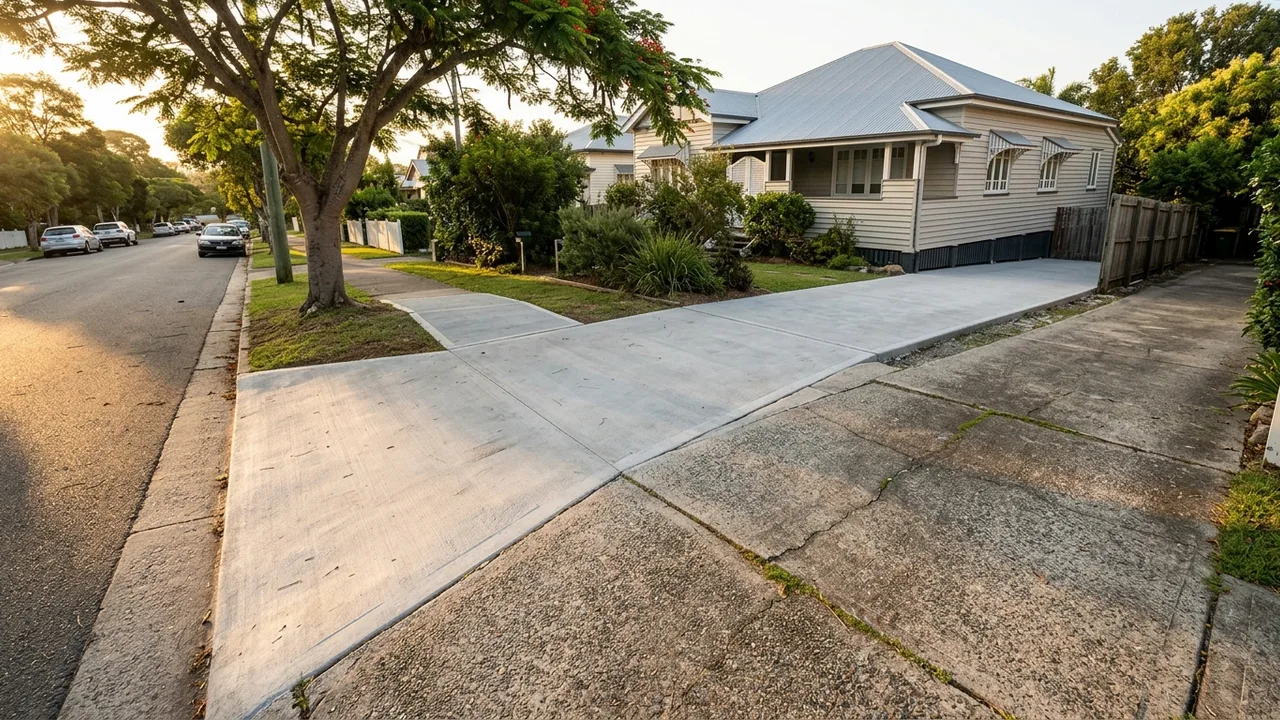
Crack filling and resurfacing makes sense when the underlying slab is structurally sound and relatively level. Resurfacing can restore appearance and add another ten to fifteen years of function for a fraction of replacement cost. Typical resurfacing on a standard double driveway might run $800 to $2,500 depending on condition and product.
Replacement makes sense when cracks are through-slab, when sections have heaved, when the base has failed and the slab rocks, or when tree roots have caused significant disruption. Patching over a fundamentally compromised slab is a short-term fix that tends to need repeating every few years. At that point, the cumulative repair cost often exceeds what replacement would have cost.
A useful rule of thumb: if more than 30 to 40 percent of a driveway or path surface needs attention, get a replacement quote before committing to repairs.
What to Check Before Calling Anyone Out
Before you spend money on repairs or replacement, a five-minute inspection tells you a lot:
- Walk across the slab and feel for movement or rocking sections.
- Look for cracks wider than a few millimetres, or cracks that run continuously across the full width of a driveway.
- Check whether water drains away from the slab or pools on it.
- Look at the edges for signs of subsidence, where the edge has dropped lower than the centre.
- If there are large trees nearby, check whether roots are pushing up any section.
Documenting this with photos before you get quotes helps a lot. A tradesperson who can see the current condition before attending can give you a more accurate estimate and a more honest recommendation.
A Sensible Approach for Inner East Homeowners
If your concrete is under ten years old and showing surface wear, a clean and reseal is almost always the right first move before spending on anything more involved.
If it is between ten and twenty years old and showing cracking, have someone assess whether those cracks are structural before committing to either option.
If it is over twenty years old and causing drainage problems, tripping hazards, or repeated cracking through the same sections, replacement of the affected areas is typically better value than another round of patching.
Brisbane concrete does not fail overnight. It degrades gradually, and most of the time you have a window to make a considered decision. Getting an assessment from a local concreter who knows Inner East soil conditions and drainage patterns is worth doing before that window closes. If you would like us to connect you with a local provider who works across Bulimba, Norman Park, Hawthorne, and surrounding suburbs, we are happy to help with that.
Quick answers