Concreting guide
What Should a Concreter Actually Do Before They Pour?
What a Concreter Should Do Before the Truck Arrives
Before a single litre of concrete gets poured, a good concreter should have already done most of the real work. Site preparation, not the pour itself, is what determines whether a slab lasts 30 years or starts cracking inside five.
Here is what that preparation actually involves, and why each step matters for homes in the Bulimba cluster and surrounds.
Checking the Site and Soil Conditions
The first thing any concreter worth hiring does is look at what is under your feet, not just what is on the surface.
Brisbane's Inner East has variable soil. Bulimba, Hawthorne and Balmoral sit close to the river, and pockets of those suburbs have alluvial fill or reactive clay that shifts with moisture changes. Norman Park and Morningside tend to have more stable ground, but you still find patchy clay in cut-and-fill blocks. Tingalpa and Murarrie can run into old disturbed fill from former industrial and rural use.
A concreter should physically inspect the ground and ask you a few direct questions: Has this area ever flooded or held water after rain? Is there an old garden bed or tree stump under the proposed area? Has any fill been brought in?
For most standard residential jobs, a full geotechnical report is not required. But an experienced concreter will probe or dig test holes to check that the ground is firm, level enough to work with, and free of soft spots. If the soil is loose or reactive, they may recommend compacted road base or a reinforced design. That adjustment costs more upfront but saves you a failed slab later.
Forming Up: Setting the Mould for Your Slab
Formwork is the timber or steel boxing that gives your concrete its shape. It sounds basic, but poorly set formwork is one of the more common causes of uneven surfaces and edges that crumble over time.
Before setting forms, the concreter needs to:
- Establish the correct level, allowing for drainage fall away from the house or structure
- Check finished height against the house floor level, any existing paths, and kerb or driveway crossover height if relevant
- Account for any required expansion joints (gaps that allow the slab to move without cracking at a predetermined point)
For driveways in the Bulimba area, the footpath crossing point is worth a particular mention. Brisbane City Council has setback and crossover requirements, and if a driveway levels up incorrectly against the existing kerb or footpath, you can end up with pooling water or a bump that catches low cars. A concreter should be aware of this before they set their forms, not after.
Formwork also determines slab depth. A standard residential path might be 85-100 mm thick. A driveway that takes regular vehicle traffic typically needs 100-125 mm. A shed slab or garage footing may go deeper again, depending on the span and load. If a concreter quotes a job without discussing thickness, that is worth asking about.
Sub-base Preparation and Compaction
This step gets skipped more than it should, especially on smaller jobs or when someone is working at a low price point.
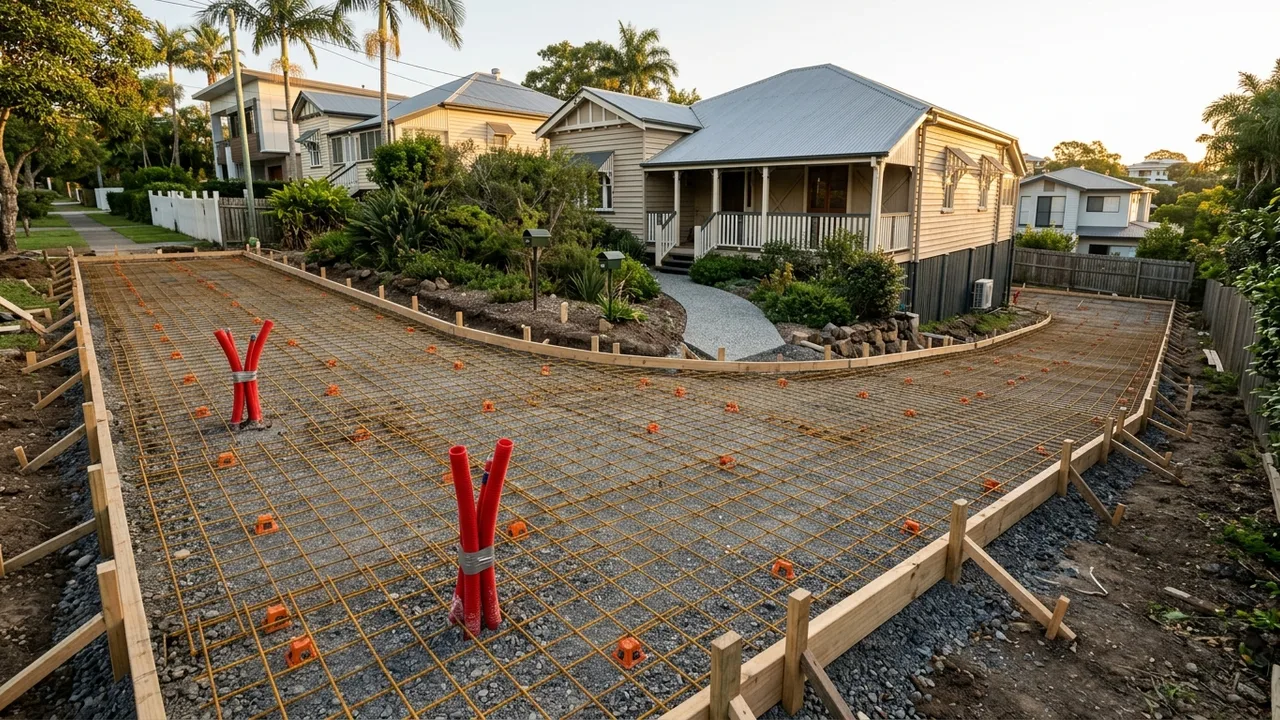
The sub-base is the layer of compacted material (usually crusher dust or road base) that sits between the natural ground and the concrete. Its job is to:
- Distribute load evenly
- Prevent the slab from moving or settling unevenly
- Allow moisture to drain away from beneath the pour
Typically, 75-100 mm of compacted road base is used for residential slabs. Compaction should be done with a mechanical plate compactor, not just by hand tamping. On reactive clay soils common to parts of Hawthorne and Balmoral, proper compaction is not optional.
One honest trade-off worth knowing: some concreters on small residential jobs will skip the road base layer and compact the natural ground directly, especially on stable sandy soil. Whether that is acceptable depends on the specific site. On a small garden path in well-drained ground it may be fine. On a driveway or shed slab it is a risk. Ask what sub-base they are planning to use before you sign anything.
Steel, Mesh and Reinforcement Decisions
Concrete is strong under compression (weight pushing down) but relatively weak under tension (forces pulling it apart). Reinforcement, whether that is steel mesh, reo bar, or fibre, helps it resist the tension forces that cause cracking.
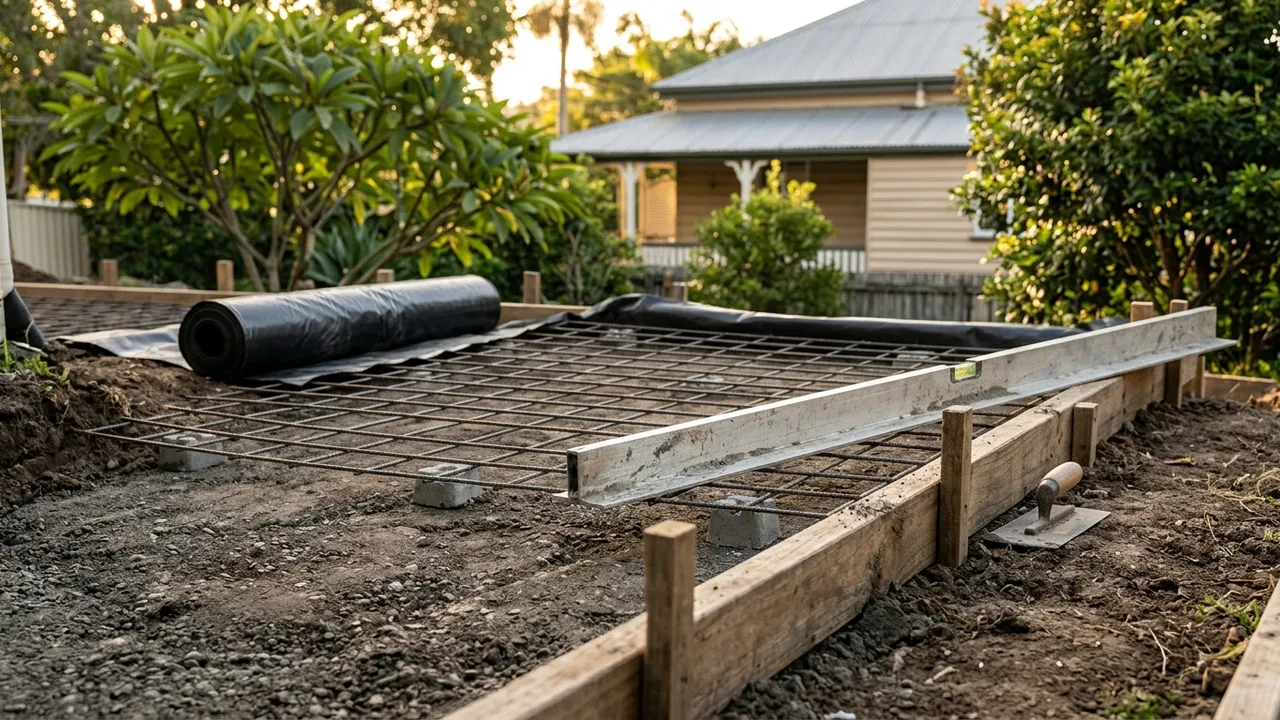
For most residential slabs in the Bulimba cluster, steel mesh (SL72 or SL82 mesh sheets) is standard. The mesh needs to be placed at the correct height within the slab, typically in the lower third, supported by bar chairs so it does not just sit on the ground. Mesh that gets walked down during the pour and ends up at the bottom adds almost no structural value.
A concreter should be able to tell you what mesh or reinforcement they are using and why. For a patio slab, SL72 is often appropriate. For a driveway carrying a heavy four-wheel drive or boat trailer regularly, SL82 or additional reo bar along the edges is worth the modest extra cost.
Expansion joints and control joints are also part of this conversation. Control joints are deliberate grooves or cuts that guide where the slab cracks, keeping any cracking straight and contained rather than random. For slabs larger than roughly 25 square metres, they are typically needed. Skipping them is a false economy.
Mix Design and Ordering the Right Concrete
Not all concrete is the same. The most common residential specification in Queensland is N20 or N25 (normal class, 20 or 25 megapascal compressive strength) with a slump of around 80-100 mm to make it workable without being too wet.
A concreter should be ordering from the batch plant based on:
- The design strength required for your specific application
- The site conditions (high-heat Brisbane days in summer affect workability and cure)
- The pour volume calculated from the slab area and thickness, plus a small overage buffer
Watering down concrete on site to make it easier to work with is a known problem in the industry. It makes the mix more fluid and faster to spread, but it weakens the finished slab. If you see someone adding significant water to the drum on site without explanation, it is reasonable to ask why.
For summer pours in Brisbane, a good concreter will also think about timing. Starting early in the morning, having enough hands on site, and having the finishing process planned before the truck arrives are all things that separate a clean job from a rushed one. Concrete does not wait.
A Final Check Before the Truck Is Called
The best concreters do a walkthrough of the site the morning of the pour, or the afternoon before. They check:
- That all forms are secure and at the right level
- That the sub-base is firm and not showing new soft spots after overnight rain
- That the reinforcement mesh is in position and properly supported
- That access for the concrete truck is clear (this is a real consideration in narrow Inner East Brisbane streets and back-access Queenslander blocks)
- That finishing tools and equipment are ready
It sounds methodical because it is. Concrete work has a short window from pour to finishing, and problems that arise during that window are hard or impossible to fix without cost.
What This Means for You as a Homeowner
You do not need to supervise every step, but you do want a concreter who can explain what they are doing at each stage and why. If you ask "what is your sub-base plan for this site?" or "what mesh spec are you using?" and you get a vague answer, that is useful information.
Typical residential concrete jobs in the Brisbane Inner East range from around $1,500 for a small path to $15,000 or more for a large driveway or entertaining slab. At those prices, the preparation stage is where you are buying most of your long-term value.
If you want to talk through a specific job and get connected with a local concreter who works regularly in Bulimba, Hawthorne, Norman Park or the surrounding suburbs, we can help with that.
Quick answers