Concreting guide
Exposed aggregate or plain concrete: which finish suits your Brisbane home?
Both finishes work well in Brisbane. The honest answer is that exposed aggregate suits most outdoor surfaces in the Inner East, while plain concrete earns its place in garages, sheds, and any area where budget is tight and looks are secondary. What matters most is where the concrete goes, who sees it, and what you expect it to handle.
What each finish actually is
Plain concrete (also called broom-finished or brushed concrete) is poured, levelled, and textured with a stiff broom before it sets. That broom drag creates a fine ribbed surface that adds grip and breaks up the visual monotony of a flat grey slab. It is straightforward to pour and finish, which keeps labour costs down.
Exposed aggregate takes the same concrete mix but adds a decorative stone component — typically a blend of pebbles, crushed granite, basalt, or river gravel. Once the concrete is poured, the surface retardant is applied or the top layer is washed away before full cure, leaving the stones visible and tactile. The result is a textured, speckled surface that hides dirt well and looks considerably better than brushed grey.
Neither is a novelty. Both have been poured on Brisbane homes for decades. The difference comes down to where you put them and what you are willing to spend.
How Brisbane's climate affects both finishes
Brisbane sits in a humid subtropical zone. That matters for concrete in a few practical ways.
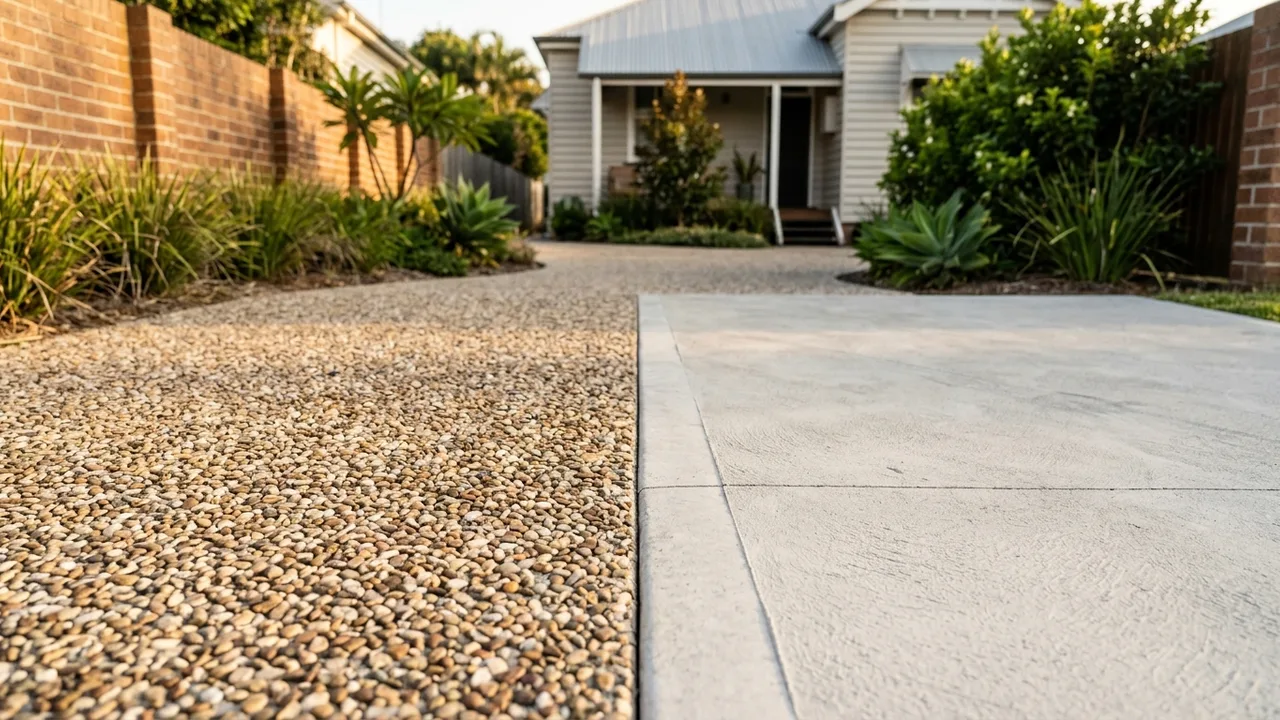
Heavy summer rain hits hard. A smooth plain concrete surface can become slippery when wet, especially under tree cover where a thin algae or lichen film builds up quickly. In leafy suburbs like Hawthorne, Norman Park, and Bulimba, where mature trees overhang driveways and paths, that bio-growth is almost guaranteed within a year or two of pouring. A broom finish helps, but it is not immune.
Exposed aggregate handles this better. The irregular pebble surface breaks up water flow and gives feet something to grip even when wet. For pool surrounds, side-access paths, and front entries, that grip advantage is meaningful.
Heat is the other factor. Brisbane footpaths and driveways can get very hot in summer. Lighter-coloured aggregate blends (cream river pebble, off-white granite) reflect more heat than dark plain concrete, which may matter if children or dogs use the area barefoot.
Cyclonic rainfall and the soil movement that follows can stress any slab. Both finishes crack when the ground shifts, but cracks are harder to disguise in plain concrete. In exposed aggregate, a repaired crack blends into the textured surface reasonably well with a skilled hand.
Cost: what to expect in the Inner East
As a rough guide for the Bulimba, Morningside, and Cannon Hill area:
- Plain broom-finished concrete typically runs $65 to $90 per square metre for a standard residential driveway or path, depending on thickness, access, and site prep.
- Exposed aggregate typically adds $20 to $40 per square metre on top of that, reflecting the cost of the aggregate blend, the retardant, the wash-down process, and extra finishing time.
A 40 square metre driveway in plain concrete might cost $2,800 to $3,600. The same job in exposed aggregate might be $3,600 to $5,200. Those are indicative figures — your actual quote will depend on site conditions, the blend you choose, and the contractor's current workload.
For shed slabs and garage floors, the calculus usually tips toward plain concrete. Nobody is paying a premium for a decorative finish that spends its life under a car or behind a roller door. A clean, well-poured broom finish is the sensible choice there.
For driveways, paths, patios, and pool surrounds visible from the street or used by the household every day, exposed aggregate starts to justify its extra cost.
Maintenance and longevity
Both finishes are low maintenance compared to pavers, timber decking, or tiles. That said, they are not zero maintenance.
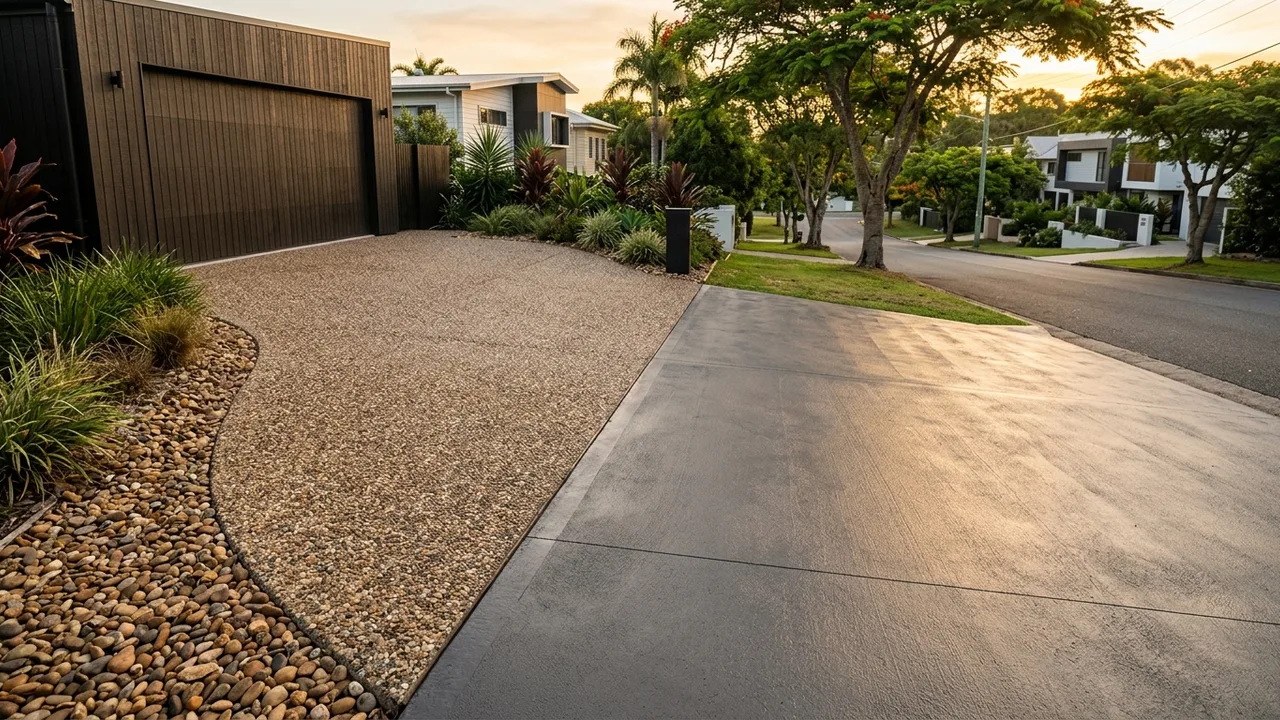
Plain concrete is easy to clean with a pressure washer. Stains from oil, tannins (common under jacaranda or fig trees in the Inner West), or rust are more visible on a grey surface. Sealing plain concrete every few years helps with stain resistance and gives it a slightly sheen finish some people like and others do not.
Exposed aggregate needs sealing too, typically every three to five years. A quality penetrating sealer keeps the stones looking fresh and reduces water ingress. Unsealed exposed aggregate can become dull, and individual stones can loosen over time if the surface is not maintained. This is not a big job, but it is a step some homeowners forget to budget for.
Cracks are the bigger conversation. Both finishes crack eventually, especially on reactive clay soils common through parts of Morningside and Tingalpa. Control joints (the lines a concretor scores into the slab before it sets) encourage cracks to occur in predictable, managed places rather than randomly. A contractor who skips control joints or spaces them too far apart is cutting corners. Ask about joint placement before work starts.
Resurfacing is an option for either finish if the surface deteriorates but the slab underneath is sound. Exposed aggregate cannot be truly replicated by a resurfacing overlay, but a decorative overlay can give a tired plain concrete slab a new life without full replacement.
Aesthetic fit for Queenslander and post-war homes
The Inner East suburbs of Brisbane, Balmoral, Hawthorne, and Bulimba in particular, have a strong character of Queenslanders, post-war fibro cottages, and 1970s brick homes on small blocks. The right concrete finish can complement that character or fight against it.
Exposed aggregate in a warm river-pebble blend or a charcoal basalt tends to sit comfortably against the timber, brick, and corrugated iron common in these streets. It reads as a deliberate finish rather than a default one. That can add to street appeal, which matters if you ever sell.
Plain concrete reads as functional. That is not inherently a problem, and a clean broom-finished driveway is certainly not an eyesore. But if the rest of the home has been improved and maintained, a plain slab can make a driveway feel like an afterthought.
That said, taste is personal. Some owners prefer a clean, minimal grey slab, and it pairs fine with contemporary landscaping. If the aggregate blends in your area feel fussy or busy to you, do not let anyone talk you into it.
Making the call
Think about it in terms of use, visibility, and budget in that order.
If the surface is a garage slab, a laundry path that runs behind a fence, or a shed base: plain concrete. Spend the savings elsewhere.
If the surface is your front driveway, your main entry path, a patio, or a pool surround: exposed aggregate is worth pricing. The extra cost is real but so is the durability and grip advantage in a Brisbane climate.
If budget is genuinely tight and the surface is a driveway: a well-specified plain concrete driveway with a proper broom finish, good thickness (100mm minimum, 125mm preferred for a vehicle-rated driveway), and correctly placed control joints will serve you for decades. Do not compromise on those structural basics in order to afford a decorative finish.
Get quotes for both options. Any concretor worth using will price them separately and explain what you get for the difference. If only one price is offered without explanation, ask why.
If you want to talk through which finish suits your specific job in Bulimba or the surrounding suburbs, we can connect you with a local concretor who works regularly in this area. No pressure to proceed.
Quick answers