Concreting guide
Exposed Aggregate or Plain Concrete: Which Finish Suits Brisbane Homes?
Both finishes work well in Brisbane. The honest answer is that exposed aggregate suits most Inner East homes better — but plain concrete has legitimate advantages that get overlooked, and the right choice depends on how you use the space.
What the Two Finishes Actually Are
Plain concrete is exactly what it sounds like: a poured slab that's floated and trowelled smooth, then cured. You can colour it, seal it, or leave it as-is. It's the baseline that every other concrete finish builds on.
Exposed aggregate starts the same way, but before the concrete fully sets, the surface layer of cement paste is washed or brushed away. That reveals the stone aggregate (the small rocks, pebbles or crushed materials) embedded in the mix. The stones become the visible surface. You choose the aggregate type, colour and size when you order the mix, which gives you a lot of control over how the final job looks.
Both are concrete. Both need a competent pour and proper curing. The differences are about texture, maintenance, cost, and how each one behaves under Brisbane's specific conditions.
How Brisbane's Climate Affects the Decision
Brisbane's Inner East gets a lot of sun. Suburbs like Bulimba, Hawthorne and Balmoral face long summers with intense UV, and the houses around Norman Park and Cannon Hill often have north-facing driveways or patios that bake for most of the day.
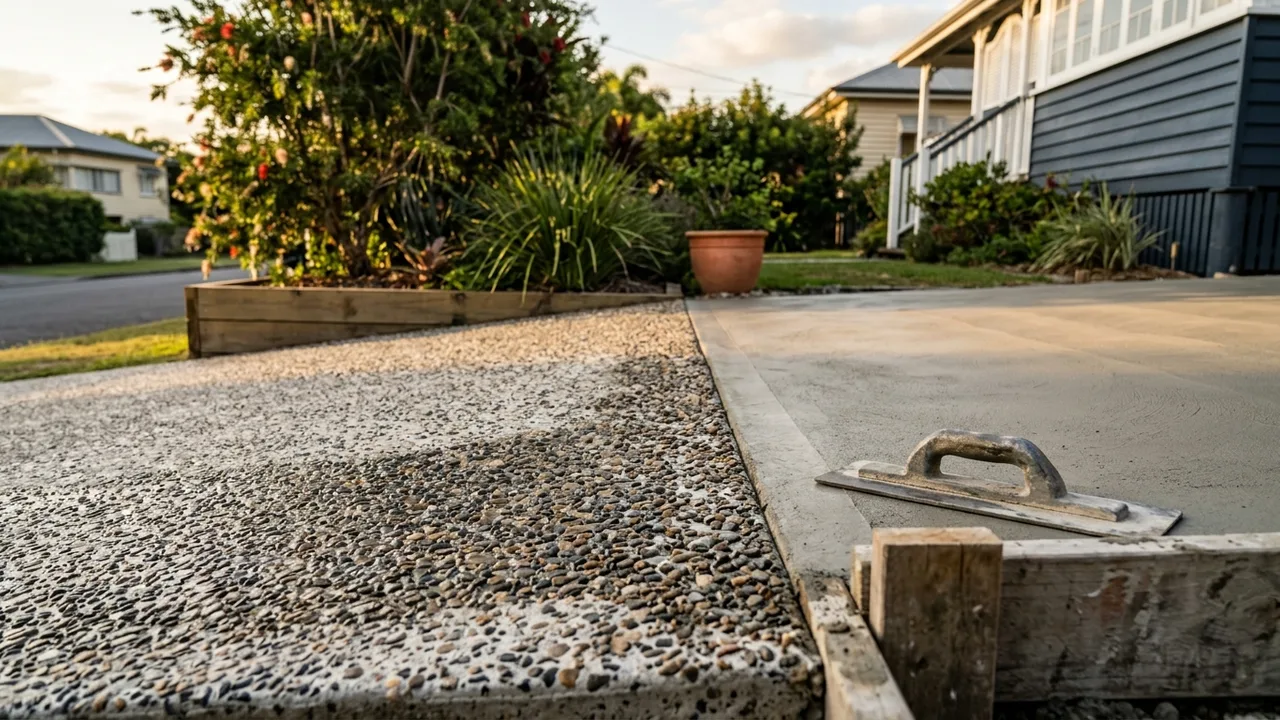
Smooth plain concrete in full sun can get uncomfortably hot underfoot. It also shows every scratch, tyre mark and oil stain more clearly than a textured surface does, because there's nowhere for variation to hide. UV bleaches it over time, and without a good penetrating sealer applied regularly, Brisbane's afternoon thunderstorms can drive moisture into micro-cracks and start the slow process of surface degradation.
Exposed aggregate handles heat a little better. The texture creates micro-shadows across the surface, which doesn't dramatically lower the temperature but does make it less glassy-hot to walk on barefoot. More importantly, the pebble texture disguises weathering and minor staining far better than a smooth slab does. If your patio sits under a jacaranda tree (common in Morningside and Hawthorne), the purple staining that plagues some homeowners is much less visible on a textured aggregate surface than on pale smooth concrete.
Drainage is another factor. A lightly broom-finished plain slab handles surface water fine, but a polished or hard-trowelled finish can be slippery when wet. Exposed aggregate is inherently non-slip, which matters for pool surrounds, sloping driveways and any path that gets wet regularly.
Cost Differences: What to Expect
As a rough guide, plain concrete is typically cheaper to install. A standard broom-finished slab for a driveway or patio in the Bulimba cluster might run somewhere in the $70-$90 per square metre range for supply and labour, depending on thickness, reinforcement and access. Exposed aggregate usually adds $15-$30 per square metre on top of that, partly for the premium aggregate blend and partly for the washing process, which requires experience to time correctly.
On a typical 40 m² driveway, that difference could be $600-$1,200 more for exposed aggregate. Over a larger entertaining slab, the gap grows. Whether that's worth it depends on what you're building and how long you plan to stay in the house.
Coloured concrete (oxide pigments added to the mix) sits roughly between the two in cost. Stencilled concrete, which mimics pavers or slate patterns, typically costs more than plain aggregate and requires resealing more often.
One cost that's easy to underestimate is long-term sealing. Plain concrete generally needs sealing every two to three years in Brisbane's UV and moisture conditions. Exposed aggregate needs sealing too, but a good penetrating sealer bonds well to the textured surface. If you skip sealing on either finish, you'll pay more in repairs eventually.
Driveways vs Patios vs Pool Surrounds: Does the Use Case Change the Answer?
It does, and it's worth thinking through each space separately rather than picking one finish for the whole property.
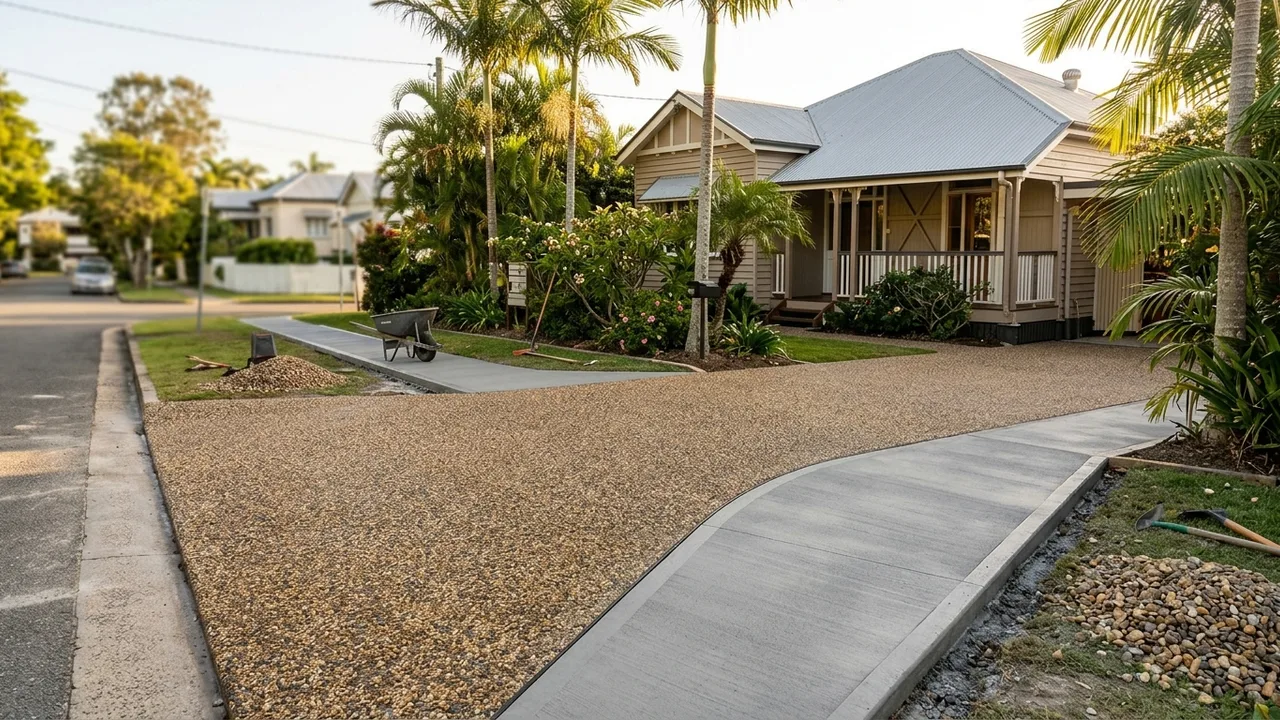
Driveways in the Inner East often have steep falls to the street kerb or tight turnaround spaces, especially in older Queenslander-era streetscapes around Norman Park and Balmoral. Exposed aggregate is a sensible default here. The slip resistance helps on any gradient, tyre marks blend into the texture, and it holds up well under the weight and friction of vehicle traffic. Plain concrete on a driveway isn't wrong, but it shows wear faster and requires more diligent maintenance to keep looking presentable.
Patios and entertaining slabs are where personal taste plays a bigger role. If you're going for a clean, modern aesthetic (more common in newer builds around Murarrie and Tingalpa), a honed or coloured plain concrete slab can look sharp and be easy to clean. If you're entertaining outdoors regularly and want something forgiving of spilled drinks, furniture scuffs and the general chaos of Brisbane backyard living, exposed aggregate is more practical.
Pool surrounds are probably the clearest case for exposed aggregate. Slip resistance around a pool is a safety consideration, not just a preference. Plain concrete around a pool should at minimum be broom-finished. A polished or smooth trowel finish near water is genuinely hazardous.
Shed slabs and footings are the one area where finish often doesn't matter at all. If the slab is inside a shed or garage, plain concrete is usually the sensible choice. Save the budget for surfaces people actually see and walk on.
Maintenance Honesty: What Both Finishes Actually Demand
Neither finish is maintenance-free. That's worth saying plainly, because some contractors imply otherwise.
Plain concrete needs:
- Sealing every two to three years (or more frequently in full sun)
- Prompt attention to oil stains (degrease quickly before they penetrate)
- Crack monitoring, especially if tree roots are nearby (common in leafy suburbs like Hawthorne and Norman Park)
Exposed aggregate needs:
- Sealing on a similar schedule, though the texture makes it slightly more forgiving if you're a year late
- Occasional weeding if fine grit or organic matter collects between stones (more common in shaded areas)
- Avoiding high-pressure washing at close range, which can dislodge stones if done aggressively over many years
If you're someone who wants to hose it down and forget about it, both options will disappoint you. Concrete is durable but not invincible, especially in Brisbane's climate.
A Straightforward Recommendation
For most Inner East Brisbane homes, exposed aggregate is the better default for driveways, paths and outdoor entertaining areas. The slip resistance, the way it hides weathering, and its suitability for Brisbane's UV and rain patterns make it a practical choice rather than just a decorative one. It typically holds its appearance longer with less visible maintenance effort.
Plain concrete makes sense when budget is tight, when the surface is largely covered or protected, or when you're specifically after a modern minimalist look and you're prepared to seal it consistently. Coloured plain concrete can look excellent in the right setting; it just demands more attention to stay that way.
Neither finish is a mistake if it's poured properly, reinforced correctly for the load it's carrying, and sealed on time. The finish is the last decision you should make. The first decision is finding a concreter who preps the base well, gets the mix right for Brisbane's conditions, and cures it properly in the heat. A beautiful aggregate surface poured on a poorly compacted base will crack regardless of how the stones look.
If you're working through the decision and want to talk through what makes sense for your specific block, our team connects Bulimba area homeowners with local concrete contractors who can look at your site and give you a realistic quote. No obligation to that, just a practical next step if you're ready.
Quick answers