Concreting guide
Getting drainage wrong is the most common concreting mistake Brisbane homeowners make
Getting drainage wrong is the single biggest concreting mistake Brisbane homeowners make. It is also the most avoidable. The slab itself can be perfectly mixed and beautifully finished, and it will still fail if water has nowhere useful to go.
Why Drainage Matters More Than the Mix
Concrete is strong in compression. Put a load on top and it holds. But put water underneath or alongside it for long enough and the story changes. Water softens clay subgrades, erodes sandy fill, and undermines the compacted base that the slab depends on. Once that base shifts unevenly, the slab cracks. No amount of reinforcement fully compensates for a substrate that moves with every wet season.
Brisbane's Inner East adds some specific pressure here. Suburbs like Norman Park, Hawthorne, and Balmoral sit on heavy black and grey clay soils that swell when wet and shrink in dry spells. That movement cycle is relentless. It does not kill a slab in one event; it fatigues it over several years of summer downpours followed by dry winters. A driveway or patio poured without proper drainage provision is essentially on a countdown.
The irony is that most homeowners focus almost entirely on the visible finish when they get quotes. Exposed aggregate or plain grey? What thickness? Sealed or unsealed? These are reasonable questions, but the drainage design underneath determines whether the job lasts eight years or twenty-five.
The Three Drainage Problems That Recur Most Often
Across typical residential concrete work in the Inner East, three problems come up repeatedly.
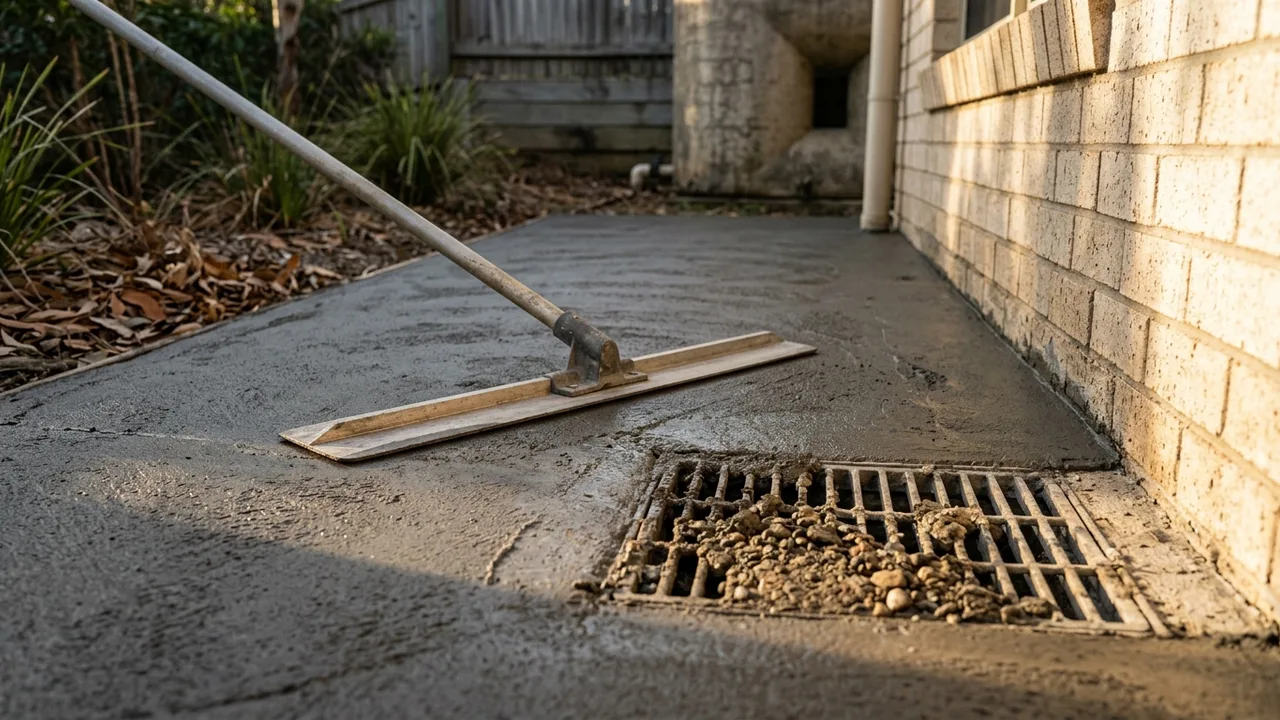
Inadequate falls. A fall is the deliberate slope built into a surface so water runs toward a designated outlet. Australian standards typically require a minimum 1:100 fall for concrete (one centimetre drop for every metre of run), and in practice most good concreters aim for 1:60 to 1:80 for driveways and patios. When a slab is poured too flat, water pools. Pooling water seeps into any joint or crack, freeze-thaw is not a major concern in Brisbane, but ground movement still does damage during wet-dry cycles.
Water directed toward the house. This one sounds obvious, but it happens. A short driveway from the street to a garage, on a block that slopes back toward the house, can funnel runoff straight to the footings if the drainage design is not deliberate. In Queenslander homes common to Bulimba and Morningside, the subfloor space can flood, leading to timber decay that costs far more than a proper drainage pit would have.
No consideration for neighbours or the street. Brisbane City Council has specific requirements about not concentrating stormwater onto neighbouring properties or discharging it uncontrolled to the street. A large new driveway or entertaining slab increases impervious surface area on the block. That water has to go somewhere. Channel drains, agricultural drainage pipe, and connection to existing stormwater pits are the tools; ignoring them is what generates the disputes and sometimes the council notices.
Falls, Channels, and Pits: What the Options Actually Cost
Good drainage is not expensive relative to the total job cost. Here is a rough sense of the trade-offs.
- Built-in falls only. The cheapest option and sufficient for some simple slabs on well-drained blocks. Relies on the natural topography cooperating. On flat or back-falling blocks in Cannon Hill or Tingalpa, it is rarely enough on its own.
- A channel drain (linear drain) at the low edge. A linear drain runs across the width of a driveway or the perimeter of a patio and collects sheet flow before it reaches the house or a boundary. These typically add $300 to $800 to a job depending on length and the grate spec. They need to connect to something, either an existing stormwater pit or a new one.
- A pit and agricultural pipe system. On blocks where surface drainage is complicated by slope or soil type, a drilled or poured concrete pit with ag-pipe feeding into it gives the water a place to go underground and slowly disperse. This is more involved, but on clay-heavy blocks in Balmoral or Norman Park it is often the right call. Budget $500 to $1,500 extra depending on depth and pipe run.
- Kerb adaptor and street connection. On some jobs, the right answer is a direct connection to the kerb via a driveway channel. Council approval requirements vary; your concreter should know the local rules or be willing to find out.
None of these additions are glamorous. They are invisible once the job is done. But they are what separates a slab that looks the same in fifteen years from one that is cracked and undermined by year eight.
How to Read Your Block Before You Get a Quote
You do not need to be an engineer to notice a few things before you talk to a concreter.
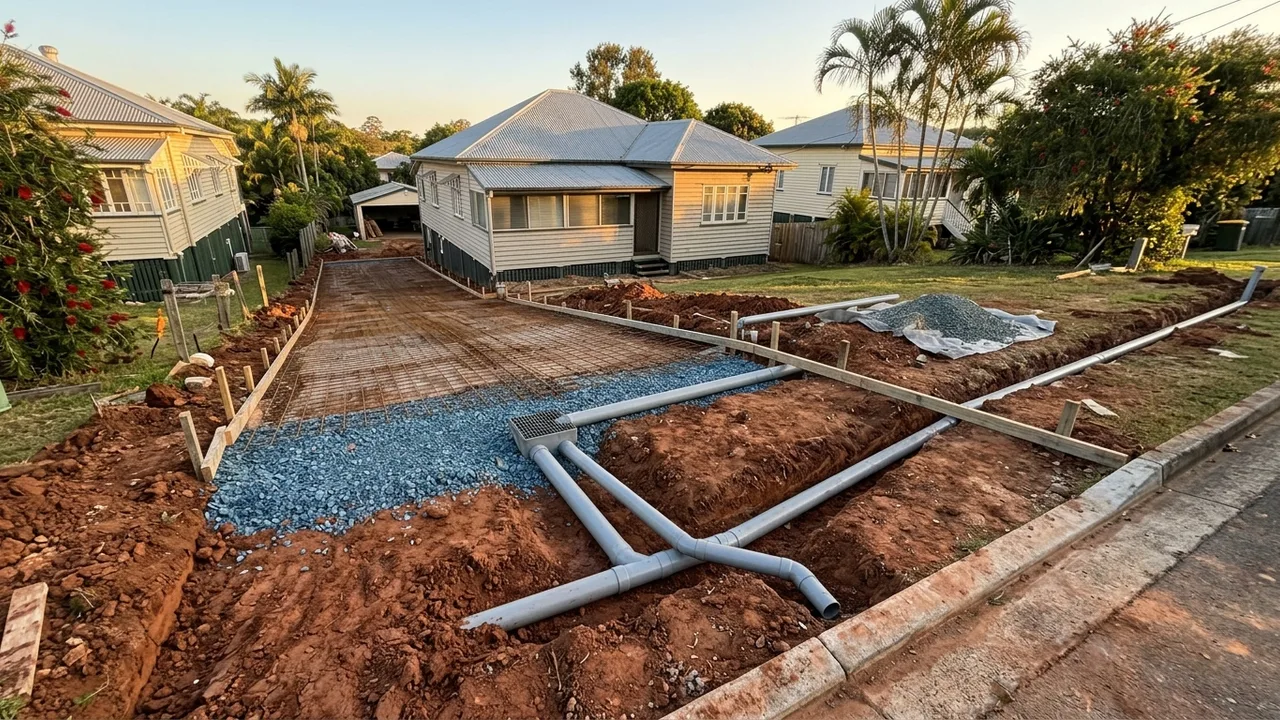
Stand at the proposed slab area after decent rain. Where does the water go? If it sits for more than thirty minutes on the existing surface, the underlying soil drains slowly. That matters for every drainage decision.
Look at where your stormwater pits are. Most Brisbane homes have at least one or two cast-iron grated pits in the yard or near the house. Knowing where they are, and roughly where the pipe runs, gives a concreter useful information about where new drainage can connect.
Note the slope relative to your house and your boundaries. A block that drops away from the house toward the street or a rear drain is in a much simpler position than one that slopes back toward the footings.
If your block is in Murarrie or Tingalpa and backs onto lower-lying land, think about what happens during a heavy event. The Inner East recorded significant localised flooding in recent years; those events expose any drainage weakness fast.
DIY Vs Engaging a Concreter: Being Honest About the Limits
Some homeowners pour small garden path sections or shed aprons themselves, using pre-mix bags and timber formwork. That is a reasonable DIY scope if you are comfortable with physical work and the area is small and simple.
But getting falls right across a driveway or patio, connecting drainage correctly, and achieving a finish that does not crack early requires experience that is hard to replicate on a first attempt. The concrete mix needs to go in at the right slump, the base needs to be properly compacted before the pour, and the timing of screeding and floating matters more than most people realise. In Brisbane's climate, hot westerly winds in summer can skin a slab surface before the bleed water has cleared, leading to surface delamination.
The cost of getting it wrong is not just the cosmetic damage. It is breaking out a failed slab (typically $80 to $150 per square metre for demolition) and starting again. That is usually two to three times more expensive than engaging a tradie to do it right the first time.
What to Ask Before You Sign Off
When you get quotes for a driveway, entertaining area, or any substantial slab, ask specifically about drainage. A few practical questions:
- What fall are you building in, and how will you check it before the pour?
- Where will the surface water go when it reaches the low edge?
- Do I need a channel drain or a new pit to handle runoff from this area?
- Is this connected to my existing stormwater system, and does it comply with Brisbane City Council requirements?
A concreter who gives clear, specific answers to these is thinking about your job properly. One who waves the question away or cannot explain the fall is telling you something important.
You are not being difficult by asking. You are protecting a piece of work that could cost anywhere from $1,500 to well over $10,000 and needs to last decades. Getting the drainage right is the single thing most worth spending extra attention on before the concrete goes in, because once it does, the decisions are set.
If you would like help finding a local concreter in Bulimba or the surrounding suburbs who can assess your specific block, that is what this service is here for.
Quick answers