Concreting guide
Can You Lay Concrete Yourself, or Is It Always a Job for a Pro?
Can You Lay Concrete Yourself, or Is It Always a Job for a Pro?
The honest answer: yes, you can do some concrete work yourself, and no, not every job needs a licensed concretor. But the line between a sensible DIY project and an expensive mistake is narrower than most people expect.
Whether you're in Bulimba, Morningside or Hawthorne, the decision comes down to the scale of the pour, the type of surface, and how much risk you're willing to carry if things go wrong. Here's how to think it through properly.
What Concrete Work Actually Involves
Concrete looks simple. You mix it, pour it, smooth it, done. In practice, each of those steps has failure points.
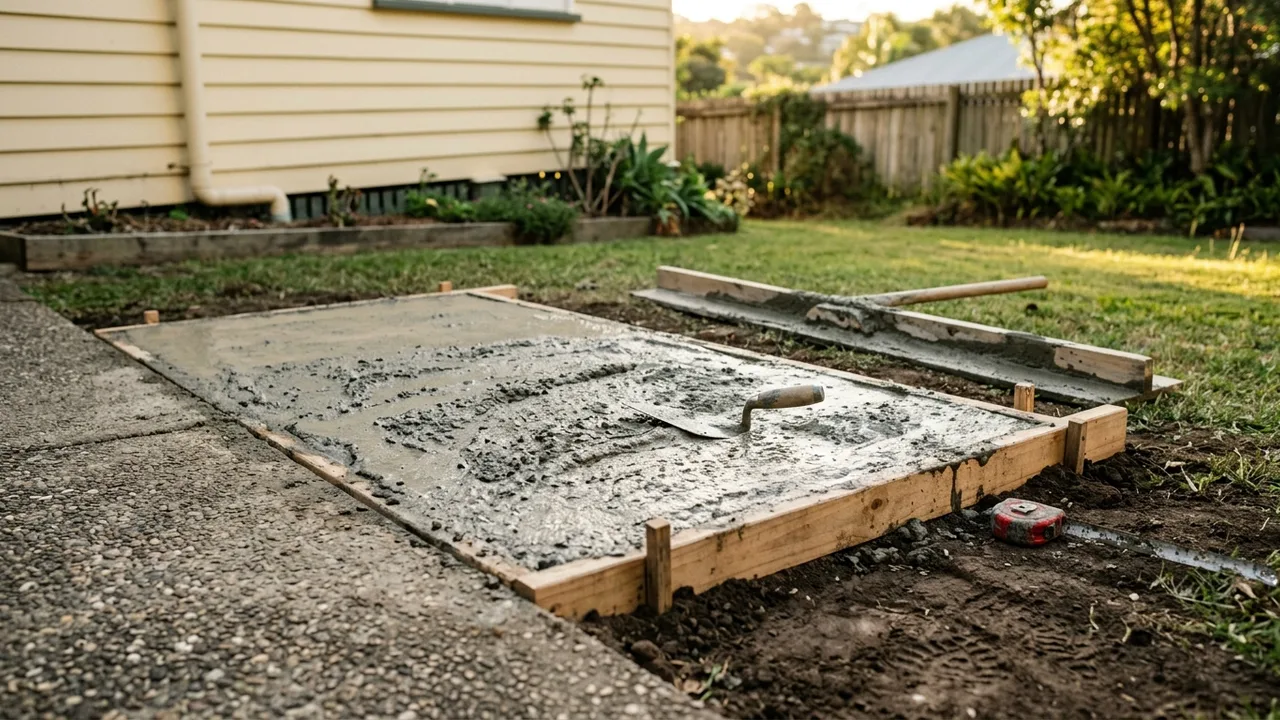
Mixing: Pre-mixed bags are fine for small volumes, but hand-mixing is physically demanding and hard to keep consistent. Ready-mix (truck delivery) is more consistent but commits you to a tight working window, usually 90 minutes from the drum starting to turn.
Formwork: This is the timber frame that holds wet concrete in shape. If it's not square, level and adequately braced, your slab won't be either. This step is where many DIY pours go wrong before a drop of concrete hits the ground.
Compaction and screeding: Air pockets weaken concrete significantly. Proper compaction requires either a screed bar worked methodically or, on larger pours, a mechanical vibrator. Getting this wrong doesn't show up immediately but contributes to cracking and surface failure within a few years.
Finishing: Trowelling the surface to a consistent finish is a skill that takes time to develop. Overworking the surface brings too much water to the top, which weakens it. Underworking leaves it uneven.
Curing: Concrete isn't fully cured in a day. It typically needs to stay moist for at least three to seven days. In Brisbane's heat and wind, this matters more than it does in cooler climates. Skipping proper curing is one of the most common reasons DIY concrete deteriorates prematurely.
Which Jobs Are Actually DIY-Friendly
Some concrete tasks are genuinely manageable for a careful, patient homeowner with the right tools.
- Small garden path sections (under 1 square metre each, poured in panels)
- Post footings for clotheslines, fences or pergola posts
- Garden edging or small retaining pads
- Repairing minor cracks with concrete filler or patching compound
These jobs are small enough that errors are contained, and if a footing doesn't come out perfectly level, it's fixable. You can hire a mixer from most hardware stores, buy bagged concrete, and take your time.
What makes these manageable is volume control. You're not locked into a fast-setting truck delivery, and the stakes for getting the finish slightly wrong are low.
Where DIY Concrete Gets Risky Fast
Scale changes everything. Once you're looking at a driveway, a shed slab, a patio or an entertaining area, the risk profile shifts considerably.
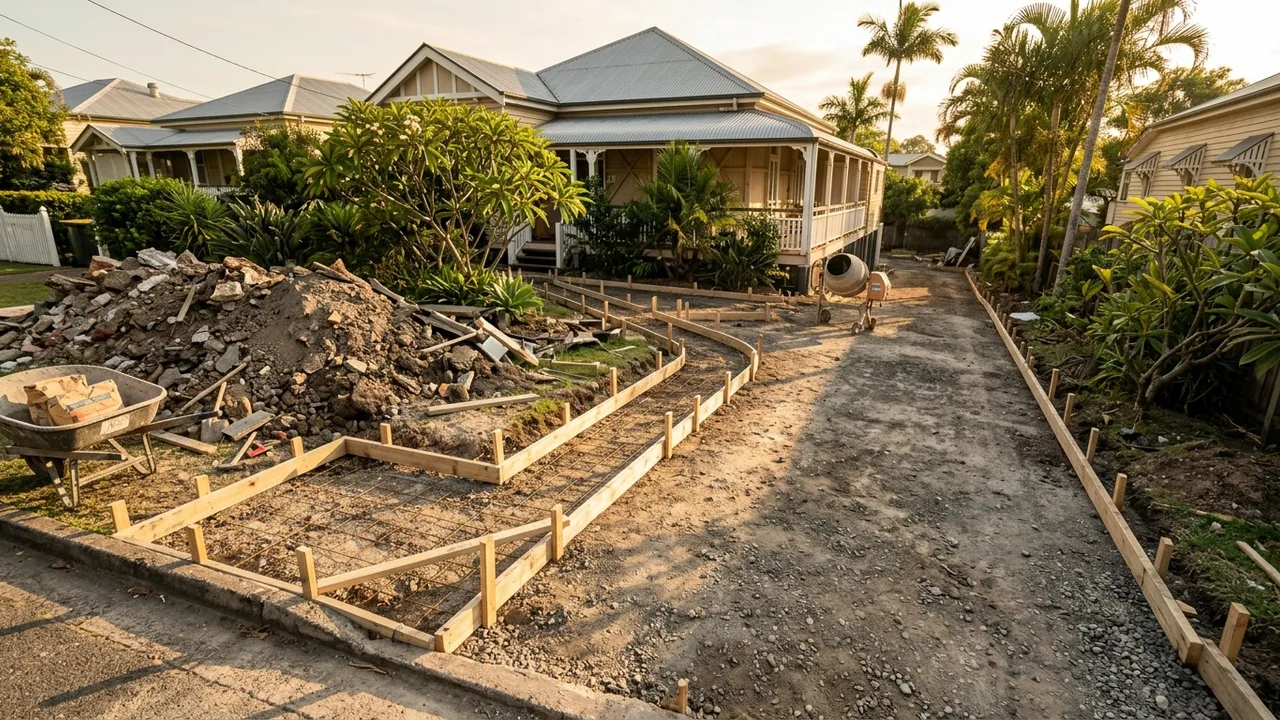
Driveways in the Bulimba cluster typically need to handle repeated vehicle loads. The concrete mix specification, slab thickness and reinforcement (usually F72 mesh or reo bar, depending on ground conditions) are not optional choices — they determine whether the driveway lasts 5 years or 30. Getting your street setback wrong can also cause issues with Brisbane City Council's requirements for kerb crossings. A licensed concretor handles this as routine.
Shed slabs and footings for anything larger than a modest garden shed often fall under building code requirements. If you're pouring a slab for a granny flat or garage in Morningside or Cannon Hill, you'll almost certainly need engineering input and, depending on the structure, a building approval. The slab depth, edge beams and reinforcement are specified, not guessed.
Entertaining areas and patios seem more forgiving but have their own traps. Drainage falls — the slight gradient that stops water pooling against your house — are easy to misjudge. Getting them wrong means water sitting against your footings or reflecting back toward the structure. On sloping Queenslander blocks common through Norman Park and Hawthorne, this gets complicated quickly.
Decorative finishes like exposed aggregate or stencilled concrete are not DIY territory at all. The timing, chemical application and surface preparation involved require experience to get a repeatable result. A batch that goes wrong often can't be fixed — it has to come out.
The Cost Comparison: DIY vs Hiring a Concretor
This is where people often get the maths wrong. DIY concrete appears cheaper upfront but has hidden costs.
A typical small driveway or patio in the Inner East (say, 40 square metres) might cost $2,500 to $4,500 through a local concretor, depending on access, finish and site prep. DIY materials for the same area, excluding tool hire, could run $800 to $1,200. That gap looks significant.
But factor in: tool hire, delivery fees for ready-mix (minimum charges apply regardless of volume), mesh and reo costs, formwork timber, and the labour time that, honestly, is not a one-person job. A concrete pour requires at least two people working simultaneously.
Then there's the contingency cost. If your pour goes wrong, you're not just redoing the surface. You're potentially paying for concrete removal, which is its own job involving a jackhammer or breaker and skip bin hire. Concrete removal and replacement typically starts around $1,500 and climbs depending on access and volume.
The honest maths: for anything over 10-15 square metres, the labour saving often doesn't justify the risk, especially when your home is the asset you're protecting.
Brisbane-Specific Factors Worth Knowing
Brisbane's climate, soil and housing stock create a few specific considerations that affect concrete work here compared with cooler or drier parts of the country.
Heat and working time: In summer, ambient temperature and direct sun can accelerate concrete's set time noticeably. Pouring on a 35-degree day in Murarrie or Tingalpa is not the same as pouring in mild conditions. Experienced concretors adjust their approach; DIYers often don't know this until it's too late.
Reactive clay soil: Much of inner east Brisbane sits on reactive clay. This soil swells when wet and shrinks when dry, which puts cyclical stress on any slab sitting on it. Proper sub-base preparation (typically compacted roadbase) and appropriate reinforcement are essential. A slab poured directly onto poorly prepared ground will crack regardless of concrete quality.
Tree roots: Bulimba and Hawthorne in particular have significant established tree coverage, including poinciana and jacaranda. Tree roots can undermine slabs over time, and planting distances should influence where and how you pour. A good concretor will flag this; a DIY pour often doesn't account for it.
Corrosive soil conditions: Less relevant in the Inner East than in bayside suburbs, but worth noting if your property has unusual fill or drainage issues.
A Sensible Way to Make the Decision
Start with an honest assessment of the job size and consequence. Ask yourself:
- Is this under 5 square metres and low-consequence if it's not perfect?
- Do I have a second person available for the pour?
- Am I comfortable with the formwork being genuinely level and square?
- Is the finish purely functional, or does it need to look good?
If you can answer yes to all four, DIY might be reasonable. If any answer is no, or if the slab is structural, load-bearing, or requires council consideration, get a quote from a concretor first. The quote is free and gives you real numbers to compare against your DIY estimate.
For jobs in Bulimba, Norman Park, Balmoral and the surrounding suburbs, a local concretor who knows the soil, slope patterns and council requirements for this area is worth talking to before you commit either way. That conversation costs nothing and often saves a lot.
Quick answers