Concreting guide
Can you concrete a driveway yourself, or is it a job for a professional?
Can You Concrete a Driveway Yourself, or Is It a Job for a Professional?
The short answer: yes, you can do it yourself, but for most homeowners in Brisbane's Inner East, it probably isn't worth it. A full concrete driveway pour involves more preparation, time, physical effort and specialist equipment than most DIY guides let on.
That said, "worth it" depends on your situation. Let's look at what the job actually involves, where things go wrong, and how to decide honestly which path makes sense for you.
What the Job Actually Involves
Concreting a driveway isn't just pouring a wet mix into a hole. There's a sequence of steps, and skipping or rushing any one of them creates problems that can last for years.
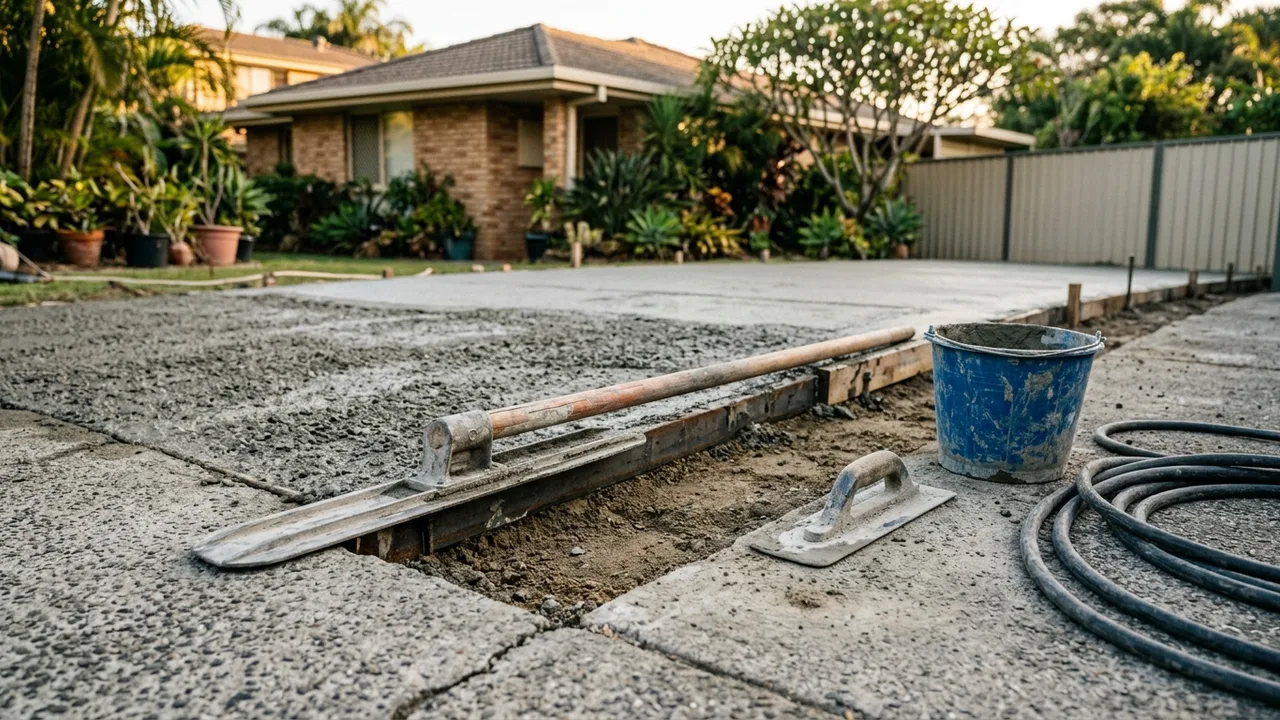
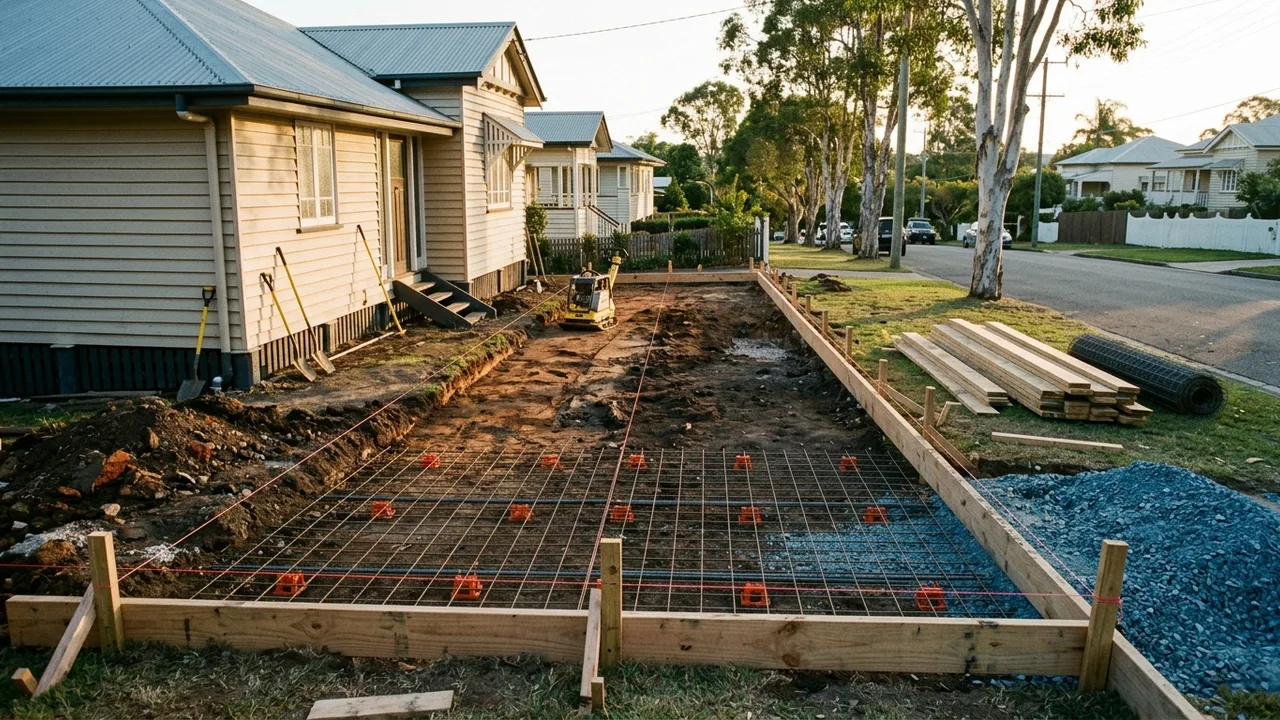
Site preparation comes first. You need to excavate to the right depth (typically 100 mm for a residential driveway slab, sometimes deeper on soft or reactive ground), grade the base for drainage, compact the sub-base, and lay plastic sheeting as a moisture barrier. In many parts of Bulimba, Morningside and Cannon Hill, you're dealing with clay-heavy soils that shift with rainfall. That reactive ground needs careful attention, or your slab will crack as the soil swells and shrinks.
Formwork is next. Timber boards are set around the perimeter to hold the wet concrete in shape. Getting the levels right here determines whether water drains away from your house or pools toward it.
Reinforcement goes in before the pour. Steel mesh (or reo bar for heavier applications) is laid and propped off the ground so it sits within the finished slab. This is what stops a crack from becoming a structural failure.
The pour itself is where time pressure kicks in. Concrete begins to set from the moment it's mixed. A standard driveway for an average Brisbane home might need 2 to 4 cubic metres of mix. At that volume, you're typically ordering a ready-mix truck. The driver won't wait around. You need enough hands to screed, float, and edge the concrete before it goes off, and that window is narrow, especially on a warm Queensland afternoon.
Finishing and curing wrap it up. The surface needs to be trowelled smooth (or broom-finished for grip), edges need to be rounded, and expansion joints need to be cut at regular intervals before the slab cures solid. Then the concrete should be kept damp for at least three to seven days to cure properly. Rush this and you get surface dusting and cracking.
Where DIY Concrete Driveways Go Wrong
The most common failures aren't from the pour itself. They're from what happened before and after.
- Poor base preparation. If the ground beneath isn't compacted properly, the slab will settle unevenly and crack. Clay soils in the Inner East are particularly unforgiving.
- Wrong mix or water ratio. Adding too much water to make the mix easier to work with weakens the finished concrete. This is a frequent mistake when hand-mixing or when the mix arrives slightly stiff and someone adds water on site.
- Inadequate reinforcement placement. Mesh that sinks to the bottom of the slab during the pour isn't reinforcing anything useful.
- No expansion joints, or joints in the wrong place. Concrete moves with temperature changes. Without planned joints, it will crack where it wants to, not where you'd prefer.
- Finishing in hot weather. Brisbane summers are brutal. The surface can skin over while the core is still wet, making it impossible to finish properly and leading to flaking within a season or two.
A botched driveway slab typically costs more to remove and replace than the original professional job would have cost.
The Real Cost Comparison
DIY concrete materials for a standard double driveway (roughly 40 to 50 square metres) typically run $1,200 to $2,500, depending on mix, reinforcement, formwork timber, and hire costs for a plate compactor, concrete mixer or pump, and finishing tools.
A professional concrete driveway in the Bulimba and Inner East area typically comes in somewhere between $3,500 and $7,500 for a similar size, depending on site access, soil conditions, finish type, and whether any demolition or excavation of an existing slab is needed. Decorative finishes like exposed aggregate add to that figure.
So yes, DIY can save you $2,000 to $4,000 on paper. But that saving disappears if you need to hire a bobcat for excavation, buy or hire specialist tools you'll use once, call in extra labour to manage the pour, or fix problems down the track.
For smaller jobs like a single-car driveway strip or an access path alongside the house, the DIY maths can work better. The pour volume is smaller, the time pressure is more manageable, and the consequences of a minor imperfection are less severe.
Brisbane-Specific Factors Worth Knowing
A few things about the Inner East that affect this calculation.
Block topography. Lots in Hawthorne, Balmoral and Norman Park often slope toward the street or side boundaries. Managing drainage fall in a driveway on a sloped block requires careful formwork setup. Get it wrong and you're directing water toward the garage or house.
Old Queenslander access. Many homes in the cluster have narrow side access or an elevated entry where a concrete truck can't position easily. This means a pump truck is sometimes needed, which adds cost but also complexity for a DIYer who's never coordinated a concrete pump before.
Tree roots. Jacarandas, poinciana and fig trees are common in these streets. Roots can compromise your base, and you may need to factor in root management or a thickened edge to the slab. A professional will typically flag this; a first-time DIYer might not notice until cracks appear.
Council requirements. Brisbane City Council has requirements around crossovers (the section between the kerb and your property boundary). Work in this zone usually requires a permit and must meet specific standards. This applies whether you're doing it yourself or hiring someone.
When DIY Makes Sense (and When It Doesn't)
DIY is reasonable if:
- You have genuine concreting experience, not just confidence.
- The job is small (under 15 square metres, flat ground, simple shape).
- You can call on enough experienced helpers for the pour.
- You're prepared to hire proper equipment and not cut corners on base prep.
Leave it to a professional if:
- The driveway is larger than a single-car pad.
- Your block has any slope, drainage complexity, or tree root issues.
- You want a decorative finish (exposed aggregate, patterned, coloured).
- You're replacing an existing slab that needs breaking up and removing first.
- You need the crossover section done to council spec.
There's no shame in recognising that some jobs sit outside what's practical to DIY. A concrete driveway is a fixed asset attached to your property. It affects street appeal, resale value, and daily usability. It's also very hard to undo if it goes wrong.
A Straightforward Recommendation
If you're in Bulimba, Morningside, Hawthorne or anywhere else in the Inner East and you're seriously considering whether to pour your own driveway, the most useful thing you can do is get a quote first. Not to commit to it, but to know the real number you're comparing against.
Once you have an actual price, you can make an honest assessment: how much would I genuinely save, what work and risk am I taking on, and is that trade-off worth it to me?
For most people with a standard suburban driveway, the professional quote ends up being reasonable enough that the DIY route doesn't stack up, especially once equipment hire, materials, and the value of your own time are counted properly.
But you're the one who knows your budget, your skills, and your block. Get the information first, then decide.
If you'd like to be connected with a local concreter who works across Bulimba and the Inner East, we can arrange that through our referral service. No obligation, just a straightforward way to get a local quote without ringing around.
Quick answers