Concreting guide
Can you pour concrete yourself or do you need a professional in Queensland?
Can You Pour Concrete Yourself or Do You Need a Professional in Queensland?
The short answer: yes, you can pour concrete yourself for small, simple jobs. But the longer answer depends heavily on what you're building, how large it is, and whether it needs to meet Queensland building regulations. Get those factors wrong and you're looking at cracked slabs, failed inspections, or concrete you have to break up and redo.
Here's a practical breakdown to help you make an honest call before you commit either way.
What Counts as a "Simple" DIY Concrete Job
Not all concrete work is equal. Some jobs are genuinely manageable for a capable, patient DIYer. Others carry enough technical risk that a mistake will cost more to fix than the original pro quote would have been.
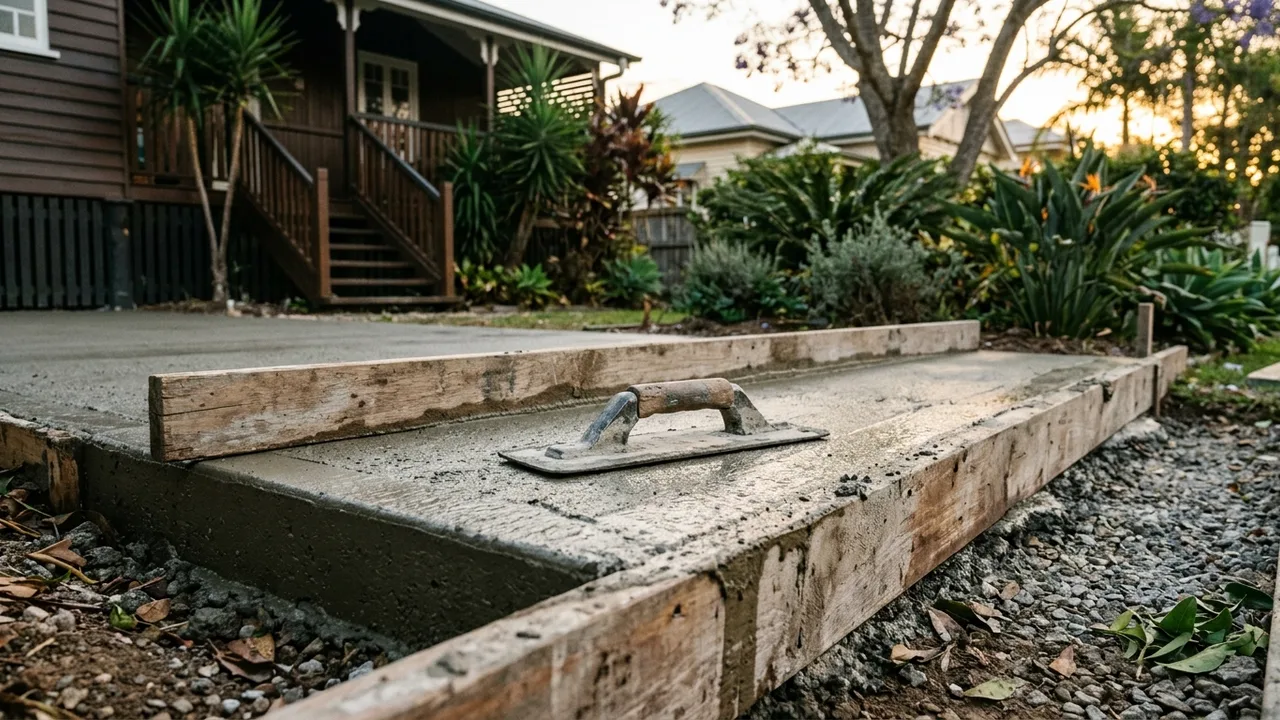
Jobs that tend to suit DIY:
- Small garden paths under 10 metres long
- Stepping stones or informal pavers set in concrete
- Concrete surrounds for letterbox or fence post footings
- Small backyard shed bases under 10 square metres (check your council requirements first)
Jobs that rarely suit DIY:
- Full driveway slabs, especially those needing a crossover permit from Brisbane City Council
- Suspended slabs for decks, extensions, or elevated areas
- Exposed aggregate finishes, which require specific timing and technique to pull off correctly
- Garage slabs where vehicles will load the surface regularly
- Any slab that forms part of a building approval
The dividing line is usually size, load, and whether a permit is involved. In the Inner East Brisbane suburbs, Bulimba, Hawthorne, Norman Park, and Balmoral included, many properties sit on older blocks with established drainage patterns, tree roots, and sloping sites. These conditions raise the complexity level considerably even for what looks like a straightforward job on paper.
Queensland Regulations You Should Know Before You Start
Queensland has specific rules about when concreting requires a building permit, and Brisbane City Council adds its own requirements on top of state legislation.
As a rule of thumb:
- Driveways that connect to a public road almost always need a crossover permit from Brisbane City Council, regardless of who pours the concrete. You apply before work starts.
- Slabs associated with a new structure (like a garage or extension) typically fall under the National Construction Code and may require a building approval, depending on size and use.
- Retaining walls adjacent to a slab are a separate consideration. Walls over 1 metre high in Brisbane generally require approval.
The tricky part with DIY is not just skill, it's documentation. A licensed contractor knows what permits to pull and what inspections to arrange. If you do it yourself and skip a required approval, you may have trouble when selling the property later. A building inspector can flag unapproved works during a pre-sale inspection, and rectifying it then is expensive and stressful.
If you're in any doubt, contact Brisbane City Council's development enquiry service before you buy a bag of cement.
The Real Costs: DIY vs Hiring a Professional
Let's be honest about the numbers. DIY concrete can save money on labour, but that saving can evaporate quickly if things go wrong.
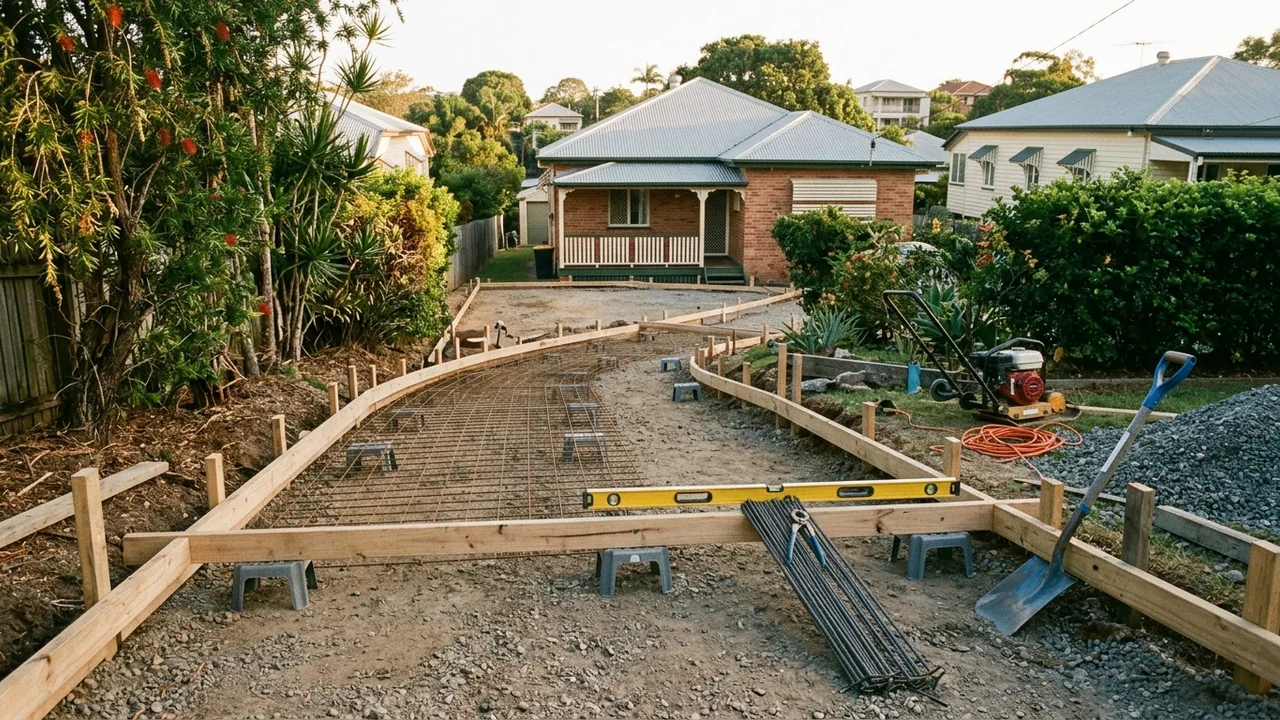
Typical DIY costs for a small slab (around 20 sqm):
- Premix concrete bags or ready-mix delivery: $400 to $900 depending on volume
- Formwork timber, stakes, screws: $80 to $150
- Reinforcement mesh or rebar: $100 to $200
- Tool hire (concrete mixer, screed, tamper): $150 to $250 per day
- Sealer (optional but recommended in Queensland's climate): $60 to $120
- Your time: typically one to two full days for a first-timer, plus preparation days
Total: roughly $800 to $1,600, not counting your time.
Typical professional cost for the same slab:
A concreter in the Inner East Brisbane area would typically quote $2,000 to $4,500 for a 20 sqm slab, depending on site conditions, reinforcement requirements, finish type, and access. That's a real cost difference.
Where the maths shifts is on larger jobs. A driveway for a Bulimba property might run 40 to 60 sqm. At that scale, ready-mix concrete delivery becomes essential (you can't batch-mix that volume in time), formwork complexity increases, and finishing a large pour before it sets is physically demanding and technically unforgiving. Mistakes at that scale are expensive. Cracking from poor subbase preparation or insufficient reinforcement might not show up for six months, but when it does, the repair or replacement cost often exceeds what you would have paid a professional.
What Can Actually Go Wrong (and How Likely It Is)
This section isn't meant to scare you off DIY. It's meant to give you an accurate picture.
Subbase failure is the most common cause of cracked residential concrete in Brisbane. Queensland's clay-rich soils, particularly the dark basalt clay common through much of the Inner East, shrink and swell with moisture. If you don't compact the subbase properly or don't account for drainage, the slab will move. A professional will typically excavate to the right depth, lay compacted road base, and check levels before forming up.
Poor jointing is another common DIY issue. Control joints (the planned grooves that allow concrete to crack in a controlled location) need to be placed at the right intervals and depth. Skip them or get them wrong and the concrete will crack randomly instead.
Finishing timing matters enormously in Queensland's climate. On a hot Brisbane summer day, concrete can start to set faster than expected, especially in direct sun. If you're trowelling or brooming the surface too late, or adding water to make finishing easier (a common novice mistake), you weaken the surface layer. Spalling and dusting follow within a year or two.
Exposed aggregate specifically requires washing the surface retarder off at exactly the right moment to expose the stone evenly. Too early and the aggregate falls out; too late and it's locked in. Most experienced concreters will tell you it takes repetition to get right. It's not a good first project.
Where DIY Makes Sense and Where It Doesn't
To summarise the trade-offs clearly:
DIY is reasonable when:
- The job is small (under roughly 10 sqm)
- No permits are required
- The site is flat and accessible
- You're not chasing a decorative finish
- You have a realistic timeline and physical capacity
- You've done your research and have the right tools
Hire a professional when:
- The job is a driveway, garage slab, or anything load-bearing
- A permit or council crossover approval is involved
- The site is sloped, constrained, or has tree roots nearby
- You want exposed aggregate, a broomed finish to a specific standard, or a coloured surface
- The slab connects to an existing structure
- You want the work to hold up and be defensible at resale
A Straightforward Recommendation
If you're a capable DIYer and you're looking at a small, flat, low-stakes project with no permit obligations, giving it a go yourself is a perfectly reasonable choice. Hire a concrete mixer, get the subbase right, don't rush the finishing, and cure it properly.
If the job involves a driveway, a garage, anything that needs council approval, or anything where the finish matters to you aesthetically, the honest advice is to get at least two or three quotes from local concreters before committing to DIY. The quotes will tell you what the real gap is, and you can make a properly informed decision from there.
For properties across Bulimba, Hawthorne, Balmoral, Norman Park, Morningside, Cannon Hill, Murarrie, and Tingalpa, a referral service like Concreting Bulimba can connect you with local tradespeople who know the specific conditions in the Inner East, the soil types, the council requirements, and the access challenges that come with older residential blocks. That local knowledge matters more than most people realise until they're halfway through a job.
There's no obligation in getting a quote. Sometimes it confirms DIY is the right call. Sometimes it shows the professional price is closer than you expected for the certainty you get.
Quick answers