Concreting guide
Do you need council approval for concreting work in Brisbane City?
Most residential concreting work in Brisbane does not need a building development approval, but some jobs do. The answer depends on what you are pouring, where you are pouring it, and how your property sits relative to boundaries, easements, and overlays. Get those details wrong and you could be asked to remove the work at your own cost.
What the Brisbane City Plan Actually Says
Brisbane City Council administers development through the Brisbane City Plan 2014. Under that plan, most standard concreting on a residential lot falls under "accepted development," which means it can proceed without lodging a formal development application (DA).
The key document to understand is the Low-Medium Density Residential zone code, which applies to most houses in suburbs like Bulimba, Norman Park, Hawthorne, and Morningside. Within that code, accepted development rules cover things like:
- Driveways and vehicle crossings on private property
- Paths and footpaths within the property boundary
- Slabs that are at or near ground level
- Concrete works that do not form part of a "building" as defined by the Building Act 1975
The sticking point is that "accepted development" still comes with acceptable outcomes (AOs) and performance outcomes (POs) that your project needs to meet. If it does not meet those criteria, it tips into code-assessable development and you need a DA.
The Jobs That Usually Need No Approval
As a rule of thumb, the following concreting work in Brisbane's inner east suburbs typically proceeds without council approval:
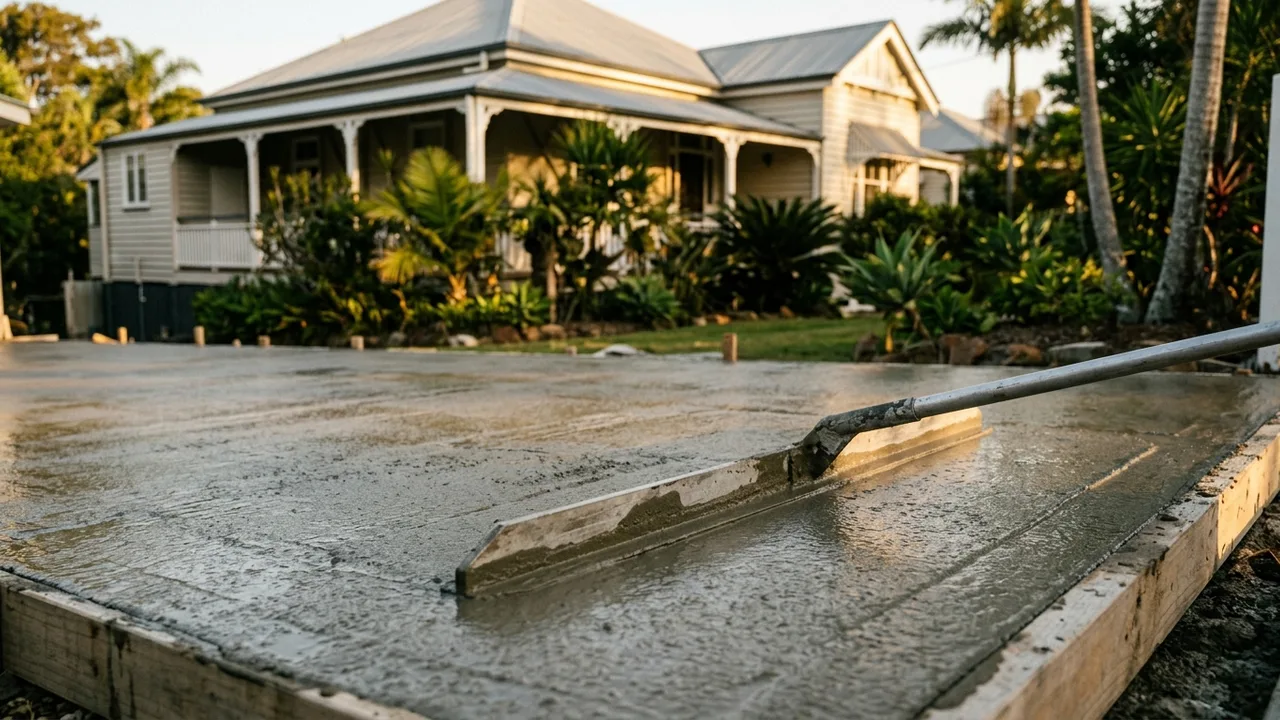
Replacing an existing driveway. If you are lifting old concrete and pouring a new one in the same footprint, on private land, you generally do not need a DA. The vehicle crossing point onto the street is a different matter (more on that below).
Ground-level slabs for garages, sheds, or outdoor areas. A slab that sits on the ground, is not enclosed, and does not raise the floor level above what triggers the building definition under the Building Act, is typically accepted development. A standalone shed slab in Cannon Hill or Tingalpa, for example, would usually fall into this category.
Internal garden paths and side-access paths. These are almost always accepted development. A concrete path running along the fence line from your front gate to your back gate is not going to trigger a DA.
Decorative finishes like exposed aggregate. The finish type, whether it is brushed, broom-finished, or exposed aggregate, does not change the approval category. What matters is the use and location of the slab, not what it looks like on the surface.
That said, "usually" and "typically" are doing real work in those sentences. Your specific lot may carry overlays, easements, or heritage designations that change the answer.
When You Probably Do Need Approval
Several situations do require formal approval, and they come up more often than people expect in Brisbane's inner eastern suburbs.
New vehicle crossovers (kerb cuts). This is one of the most common traps. The driveway on your private land might need no DA, but if you are creating a new opening through the kerb onto the street, that work requires a vehicle crossing application with Brisbane City Council, separate from any building DA. The fee is generally modest, typically a few hundred dollars, but skipping it can mean Council removes the crossing and invoices you for it.
Slabs attached to, or supporting, a structure. If your new slab forms the floor of an enclosed garage, a granny flat, or any structure that requires building approval under the Building Act 1975, the slab is assessed as part of that structure. You cannot separate them.
Work in a flood overlay. Large parts of Morningside, Cannon Hill, Murarrie, and areas along the river corridor in Bulimba and Hawthorne sit within Council's Flood Overlay. Filling or raising ground level with concrete in these areas can alter overland flow and is frequently not accepted development. Check the City Plan's interactive mapping tool (PD Online) before you do anything.
Work near or over drainage easements. Concrete poured over a stormwater or sewer easement is a serious issue. Council or the relevant authority can require removal of any structure over an easement, regardless of whether you got approval for the pour itself. Easement locations show up on your property's survey plan or title documents.
Heritage-listed properties or Neighbourhood Plan overlays. Parts of Norman Park, Hawthorne, and Bulimba have character overlay provisions. These do not typically prevent concreting, but they can restrict the extent of hard surface coverage in front yards and along street frontages, particularly where the character of a Queenslander streetscape is a planning consideration.
How to Actually Check Before You Commit
The fastest legitimate check is Brisbane City Council's PD Online mapping tool. Enter your address and it will show you the zone, overlays, and any relevant designations. It is free and takes about five minutes.
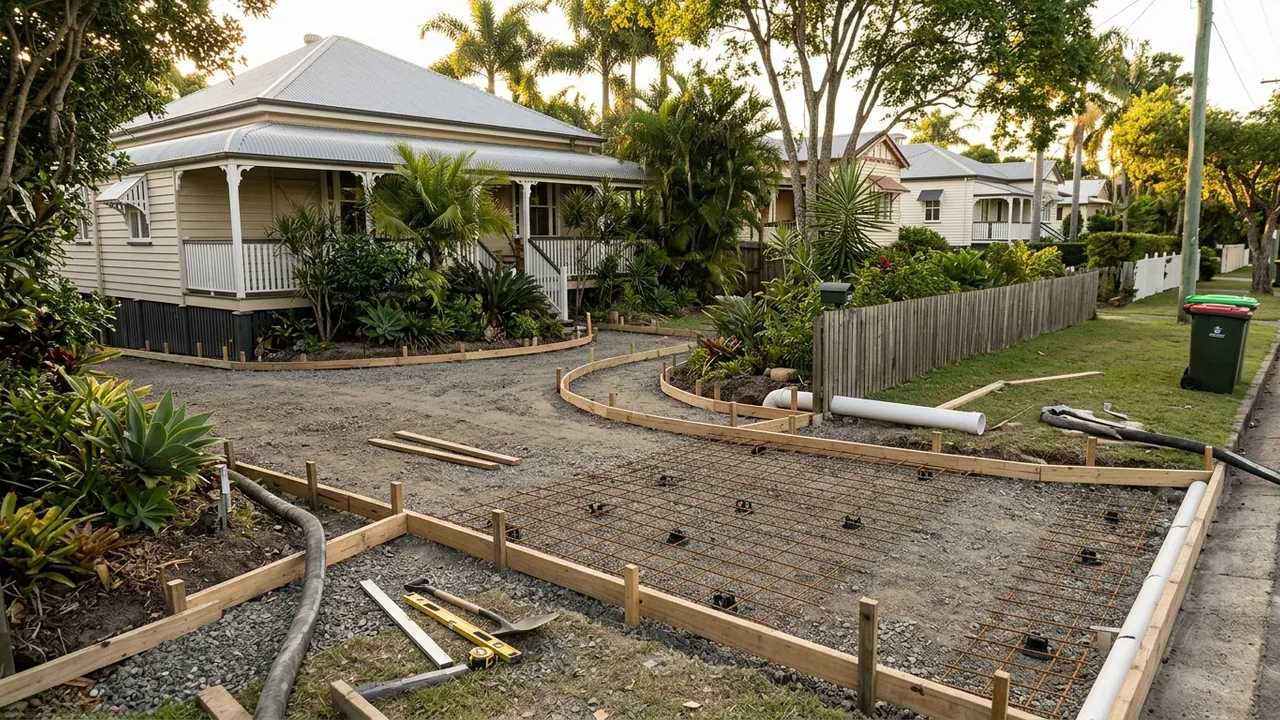
Beyond mapping, you have a few options:
- Pre-lodgement meeting with Council. Free for straightforward residential questions. Useful if your property has overlays or you are doing something non-standard. You book it through the Council website.
- Ask your certifier. A private building certifier can provide an opinion on whether your project triggers the Building Act. They charge for that, typically $150-$400 for a desktop review, but it gives you documented advice.
- Talk to your concreter before committing. An experienced local contractor will have seen most of these situations before. They cannot give you a legal ruling, but they can flag when something smells like it needs a closer look. A contractor who has worked regularly across Bulimba, Balmoral, and Hawthorne will have encountered the flood overlay question more than once.
Do not rely on the rule of thumb your neighbour used. Lots differ, overlays move, and Council's interpretation of the City Plan is updated periodically.
The Practical Cost of Getting This Wrong
If you pour without required approval and Council becomes aware of it, the remediation path is unpleasant. In a typical enforcement scenario, you would receive a show-cause notice, be required to apply for a retrospective approval (which may or may not be granted), and potentially be ordered to remove the work if approval is refused. Removal of a driveway or slab plus reinstatement of the surface underneath can easily cost more than the original job.
For a job that might cost between $3,000 and $8,000 to complete properly, a $300 pre-lodgement check or vehicle crossing application is inexpensive insurance. Most legitimate concreting jobs in residential Brisbane carry no approval requirement at all, which makes those rare cases where you do need one worth taking seriously.
On the other side of the ledger: over-caution wastes time and money too. Some homeowners spend weeks chasing approvals for a side-access path or a shed slab that never needed one. A quick check through PD Online and a conversation with your contractor should resolve most uncertainty without a formal application.
A Sensible Way to Start
Before you call anyone for quotes, pull up your property on PD Online, note any overlays, and check whether your lot touches a kerb crossing or easement. If the mapping shows a flood overlay or a character overlay, mention that specifically when you speak to any contractor.
If you are in the Bulimba, Norman Park, or Morningside area and want to talk through what your particular job is likely to involve, a local concreting contractor with experience in the inner east will be able to give you a straight answer about what they have seen approved and what has caused problems. That conversation costs you nothing and can save a significant amount of frustration later.
Quick answers