Concreting guide
Do You Need Council Approval to Concrete a Driveway or Patio in Brisbane?
Do You Need Council Approval to Concrete a Driveway or Patio in Brisbane?
For most residential driveways and patios in Brisbane, you do not need a full development application (DA). But "most" is doing a lot of work in that sentence. Several specific circumstances do trigger council involvement, and skipping those checks can cause real problems when you sell or insure your home.
Here is what actually applies in Brisbane, with particular attention to the Inner East suburbs from Bulimba to Tingalpa.
The Short Answer: Exempt vs Assessable Development
Brisbane City Council categorises concreting work under Queensland's Planning Act 2016. Most straightforward residential paving falls into exempt development, meaning no approval is required, provided the work stays within certain parameters.
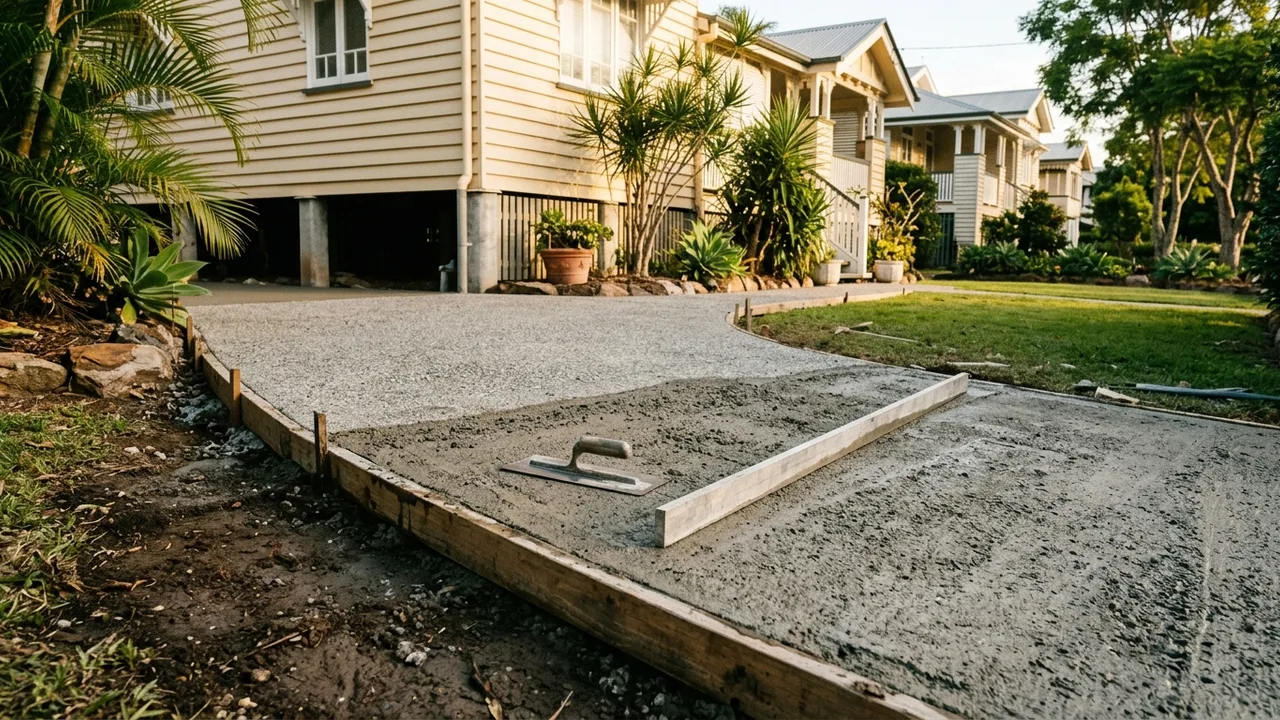
For a standard driveway, those parameters typically include:
- The driveway connects to an existing kerb crossover or a previously approved one
- The width does not exceed what is permitted for the road category
- The property is not in an area with specific overlays (flood, character, steep slopes)
- The work does not alter stormwater flow onto a neighbouring property
A basic backyard patio slab is similarly exempt in most cases, as long as it sits below a certain height (typically 500mm above natural ground level for uncovered slabs) and does not encroach on boundary setbacks.
When none of those conditions apply, the work shifts into assessable development and you need to talk to council before you pour a single metre.
When Approval Actually Becomes Required
This is where homeowners in the Inner West and Inner East of Brisbane need to pay closer attention than those in newer outer suburbs. Several overlays apply disproportionately here.
Character Residential overlays. Suburbs like Norman Park, Hawthorne, and Bulimba contain a significant number of properties under the Traditional Building Character overlay or the Pre-1947 building character provisions. These rules exist to protect the streetscape appearance of older Queenslander streetscapes. A wide exposed aggregate driveway replacing a narrow gravel one may attract scrutiny, particularly if it changes the amount of hard surface visible from the street.
Flood Overlay. The Brisbane River corridor runs directly through this cluster. Properties in Bulimba, Morningside, and Murarrie can sit within the Flood Overlay or the Waterway Corridors overlay. Adding a large impervious slab in a flood-affected area can affect how water moves on your block, which is exactly what council's overlay controls are designed to manage. Check your property's overlays on Brisbane City Council's free online mapping tool before you commit to a design.
Steep slope sites. Less common in the flat river-flat portions of Cannon Hill and Tingalpa, but more relevant on the ridge-side streets of Balmoral and parts of Hawthorne. A slab on a sloping site may require a retaining component, which can push the job into a category that requires an engineer's assessment or a development application.
Kerb crossover approvals. This is separate to council planning approval but is often confused with it. Any new or modified kerb crossover (the concrete cut through the kerb that lets you drive onto your property) requires a separate approval through Brisbane City Council's infrastructure team. This applies even if the driveway itself is exempt. Fees are modest, typically in the $200 to $500 range, but the approval step is not optional.
What About Stormwater and Impervious Surface Rules?
This catches a lot of people out. Adding a large concrete patio or driveway increases the impervious area on your block. Under Brisbane's planning scheme, there are maximum site cover provisions that apply to hard surfaces, not just buildings.
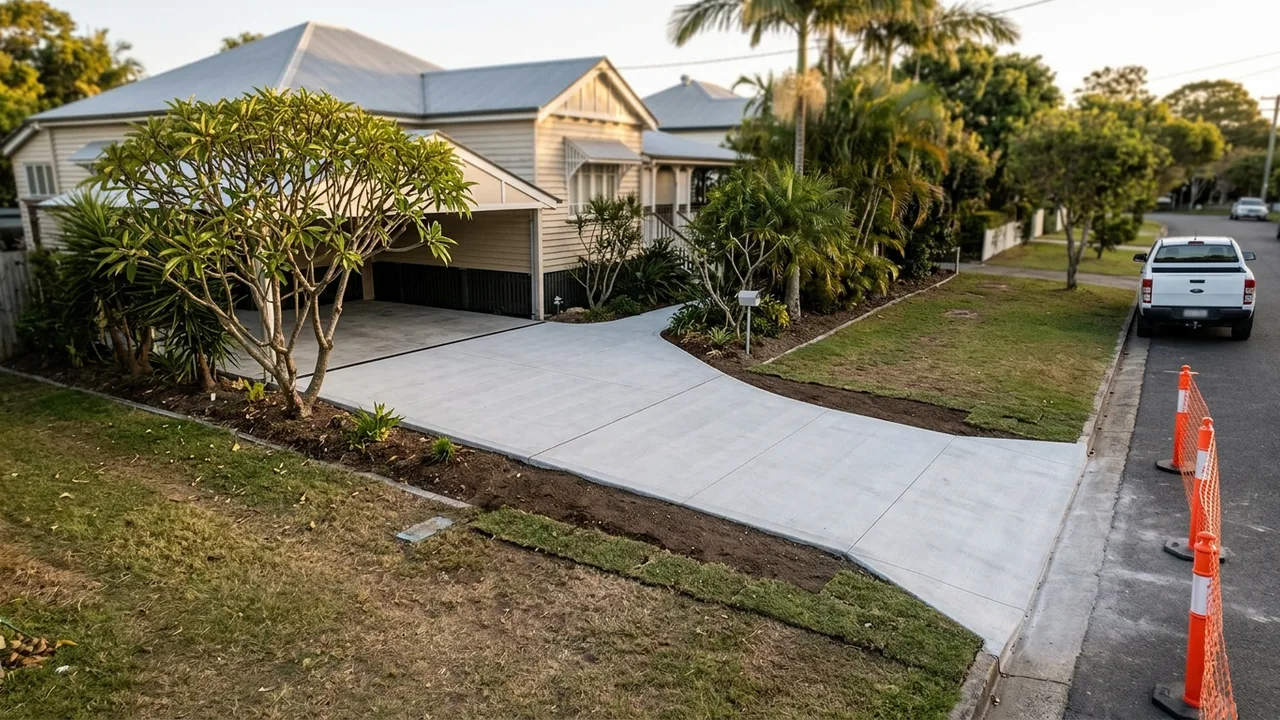
For a low-density residential lot in these suburbs, total impervious cover (buildings, driveways, slabs, patios combined) is generally limited to around 70-80% of the site area, though the exact figure depends on your zone and lot size. If your block already has a large house footprint and a pool, adding a generous patio slab could push you close to or over that limit.
Your concretor will not calculate this for you automatically. It is worth doing a rough estimate yourself or asking the tradesperson to check before they quote the job.
Stormwater discharge is a related issue. Concrete must be designed so water drains onto your own property, to a kerb via your site's drainage, or into a compliant stormwater system. Directing runoff across a boundary to a neighbour's property is not permitted, and council can order rectification work if a complaint is made.
DIY Concreting vs Licensed Trade: Does It Change the Approval Picture?
Technically, approval requirements are the same whether a licensed concreter or a capable DIYer does the work. But in practice, there are real differences worth considering.
A licensed concreter working in Brisbane will typically know which council approvals apply to standard residential jobs. They will flag a kerb crossover approval if you need one and will usually include it in their process. A DIY approach places all that responsibility on you.
For a driveway or patio that sits firmly within exempt development, a confident DIYer with the right tools can absolutely do the work legally. The trade-off is time, physical effort, and the fact that concrete is unforgiving. A poorly finished slab is expensive to fix because you cannot simply sand it back.
For anything touching the overlays described above, working with a professional who understands the local context is genuinely worth the cost premium, not because of any rule about who must do the work, but because they are more likely to get the approval steps right before the slab goes down.
How to Check Your Specific Property
Brisbane City Council provides a free property information tool called MyCity (search Brisbane City Council property lookup). You can enter your address and see:
- Which planning zone your property sits in
- Which overlays apply (flood, character, slope, etc.)
- Whether there are any current approvals or conditions registered against the property
If overlays apply, call council's development services line directly. They offer free pre-lodgement advice for straightforward residential queries and will usually tell you plainly whether your project needs an application or not. That call takes 20 minutes and can save you from having to demolish non-compliant work later.
Your local town planner is another option if the overlays look complex. A single hour of their time (typically $200 to $350) can clarify exactly where you stand.
A Practical Recommendation Before You Start
If your property is in a straightforward residential zone with no flood, character, or slope overlays, your driveway or patio will almost certainly be exempt development. Get your kerb crossover approval sorted if you need one, check your impervious cover limits roughly, and proceed.
If you see any overlays on your property lookup, or if your block is on a slope or close to the river, make that quick call to council first. It costs nothing and the alternative, fixing or removing unapproved work after a complaint or at settlement, is far more expensive than the concrete itself.
The projects in this area typically run from around $1,500 for a modest pathway slab to $12,000 or more for a full exposed aggregate driveway with a kerb crossover. Getting the compliance picture right before you spend that money is just sensible.
If you are ready to get quotes from local concreters familiar with Brisbane's Inner East suburbs, including the overlay issues that come up regularly in Bulimba, Norman Park, and Morningside, you are welcome to use this service to get connected. There is no obligation and no cost to you.
Quick answers