Concreting guide
What Actually Drives the Cost of a Concreting Job in Inner East Brisbane?
What Actually Drives the Cost of a Concreting Job in Bulimba and the Inner East?
Four things drive most of the price on a residential concreting job: the volume of concrete needed, the complexity of the formwork and finish, how easy it is to get equipment onto your property, and what the ground itself looks like once the excavation starts. Everything else is a modifier on top of those four.
If you live in Bulimba, Hawthorne, Balmoral, Norman Park or anywhere else across the Inner East, there are a handful of local conditions that tend to push jobs toward the higher end of what you'd expect to pay. Understanding those conditions before you get quotes puts you in a much stronger position.
Volume and Thickness: The Starting Point on Every Quote
Concrete is priced by the cubic metre. A standard residential slab poured at 100 mm thick uses roughly one cubic metre for every 10 square metres of surface area. Driveways typically go to 100-125 mm; a garage or workshop slab often calls for 150 mm, especially if a vehicle heavier than a standard car will sit on it.
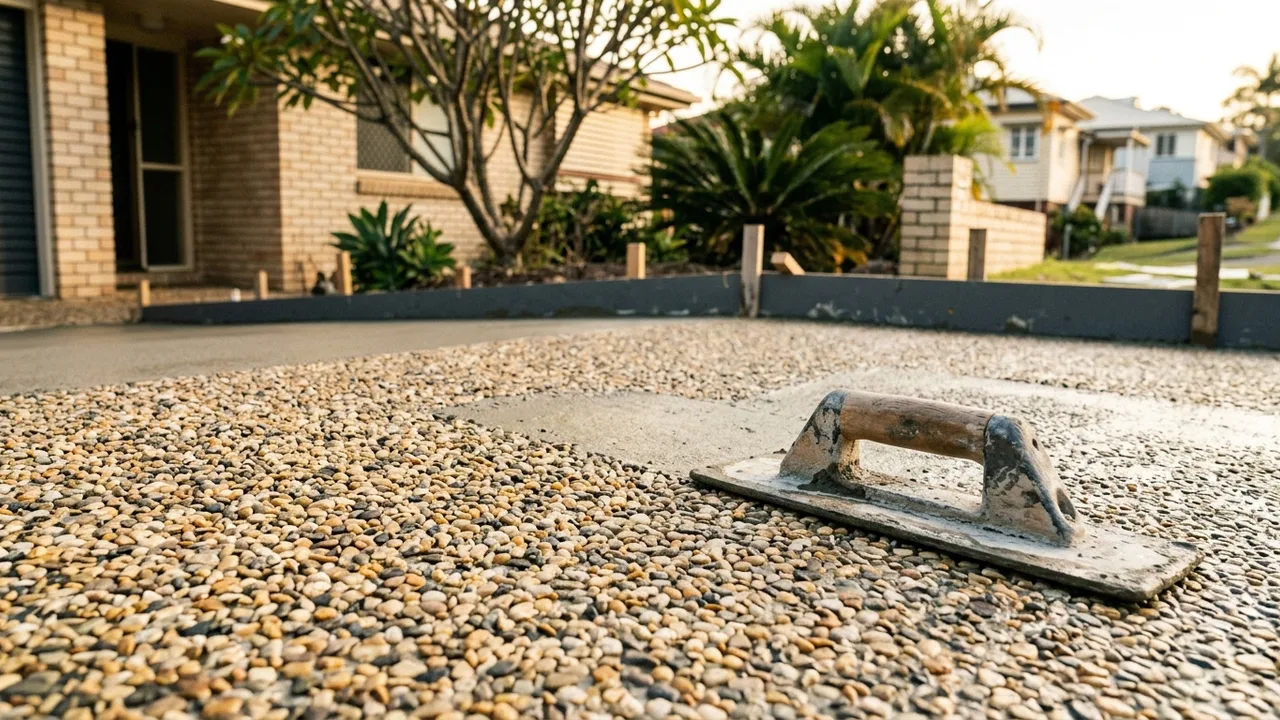
The surface area is usually the first number a concretor wants to know, but thickness matters just as much. A 50 square metre driveway at 100 mm uses about 5 m³ of concrete. Bump that to 125 mm and you're closer to 6.25 m³. At current ready-mix prices in the Brisbane metro area, that difference alone can add $300-$500 to the materials bill before labour is even considered.
As a rule of thumb, expect total job costs (materials plus labour, basic broom finish) to sit somewhere in the $80-$120 per square metre range for a straightforward residential pour. Decorative finishes like exposed aggregate push that to $120-$180 per square metre, sometimes more depending on the aggregate specified and the level of sealing involved.
Access and Site Conditions: Where Inner East Properties Get Expensive
This is where Bulimba, Hawthorne and Morningside jobs often diverge from, say, a new-build slab in Tingalpa or Murarrie.
A lot of properties in the inner suburbs are on narrower lots with tight side access, established landscaping, and older timber or steel fencing that a concrete truck simply cannot get close to. When the truck cannot reach the pour zone, one of two things happens: the concretor uses a pump truck, or the crew moves concrete by barrow. Both add cost.
A concrete pump hire typically adds $600-$1,200 to a job, depending on whether a small line pump or a larger boom pump is needed. Barrowing is slower and harder on labour, which tends to show up as a higher day rate in the quote rather than a separate line item.
Steep slopes are common in Balmoral and parts of Norman Park. A sloped site needs more formwork to hold the concrete at the correct level, and the pour itself takes longer to manage. On very steep driveways, concretors sometimes form the slab in sections or add a broom finish with deep grooves specifically to provide grip, which adds time.
Older homes across the cluster are also more likely to have underground service lines (stormwater, Telstra pits, gas) that the concretor cannot cut through. If a locating service reveals services running through the proposed pour zone, the design may need to change, which changes the price.
Ground Preparation: What Happens Below the Surface
The quoted price almost always assumes the base will be reasonably straightforward. It frequently is not.
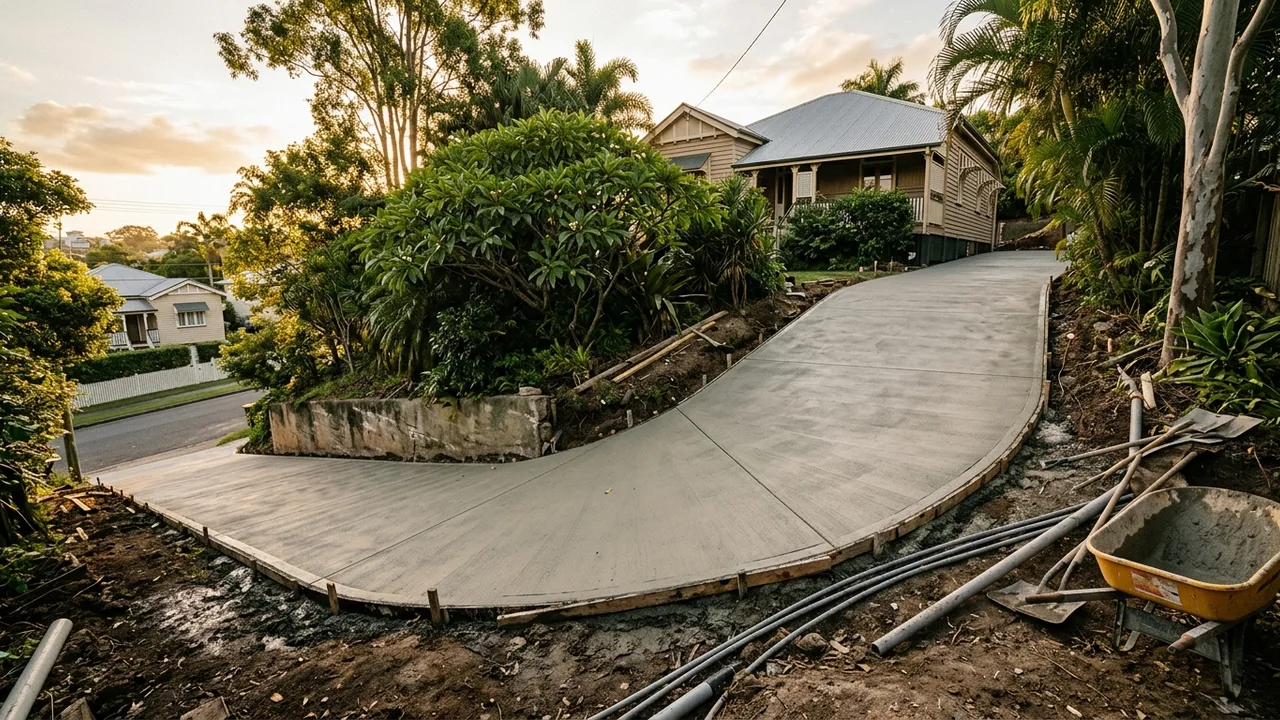
In parts of Morningside, Cannon Hill and Murarrie that were developed on lower-lying ground, fill soil and poor drainage are more common than in elevated areas. Soft or unstable subgrades need either additional compaction, the removal of unsuitable material, or the addition of a thicker road base layer before anything is poured. Each of those steps costs money and time.
For driveways and slabs on homes that have had tree roots move through the area (and in streets lined with mature fig, poinciana or jacaranda, that is very common), the excavated base sometimes reveals root intrusion that needs to be cleared before compaction can begin. That work may or may not be included in an initial quote, which is worth asking about specifically.
Existing concrete removal also sits here. Cutting out and disposing of an old driveway can add $500-$2,000 to a job depending on size and thickness, plus any tip fees. If the old concrete is thick and well-bonded, it takes longer to break up. Some quotes include this as a lump sum; others list it separately.
Finish and Reinforcement: The Choices That Change the Final Number
Plain broom-finished concrete is the most economical option. It works well for functional areas like side access paths, shed slabs and garages.
Exposed aggregate costs more because the process involves seeding or using a specific aggregate mix, applying a surface retarder, and washing off the top layer before the surface sets fully. The timing is critical and there is no room for error. When it is done well, it is durable and looks good for decades. When it is rushed, the aggregate depth is uneven and sections can pop out over time. The extra cost is worth it for high-visibility areas like front driveways and pool surrounds.
Steel reinforcement adds cost but adds structural integrity. A basic residential pathway may use no reinforcement at all. A garage slab supporting a vehicle typically includes SL72 or SL82 mesh, sometimes with bar chairs to hold the mesh at mid-depth. A suspended slab (used for extensions on older Queenslander-style homes on stumps) requires detailed engineering and significantly more steel, which is a large part of why suspended slabs cost considerably more per square metre than ground-level pours.
Control joints, the deliberate cuts made across a slab to direct cracking, are standard practice. Skipping them to save time is a false economy. Check that any quote you receive specifies how joints will be handled.
Timing, Seasons, and the Weather Variable
Brisbane's climate is generally friendly for concreting, but summer heat and the risk of afternoon storms between November and March introduces a variable most homeowners do not think about. Hot concrete sets faster than ideal, which can affect workability and finish quality. Experienced crews manage this with plasticisers and by scheduling pours for early morning, but it does affect how long a pour takes to manage, and a rained-on surface before the concrete has cured properly can ruin the finish.
The practical consequence is that some concretors price Inner East jobs differently in summer, either factoring in a longer day or quoting conservatively to allow for weather delays. Jobs in autumn and winter tend to run more smoothly. If you are planning a large driveway replacement or an outdoor entertaining slab, getting quotes locked in during autumn is sensible timing.
Getting to a Realistic Number Before You Call Anyone
Before you request a quote, spend five minutes doing the following. Measure the area you want concreted, at least approximately. Note whether a truck could realistically get within about three metres of the area, or whether the access is tight. Think about what is under the existing surface, if there is one, and how thick it looks.
Those three pieces of information let a concretor give you a meaningful ballpark in the first conversation rather than a wide range that is essentially useless for budgeting. For a typical Inner East residential job, whether that is a new driveway in Bulimba, a back patio in Hawthorne, or a garage slab in Cannon Hill, the realistic range for most jobs runs from around $1,500 for a small path replacement up to $12,000-$15,000 for a full driveway and slab combination with a decorative finish.
Getting two or three quotes from concretors who are familiar with inner Brisbane properties is the best protection against both overpricing and a quote that sounds cheap because it has left out excavation, reinforcement or the cost of removing what is already there.
If you would like to be connected with a local concretor who knows the Inner East, the form on this page sends your details to a small pool of operators we have vetted for this area. It is a free referral, no obligation, and you are under no pressure to proceed.
Quick answers