Concreting guide
What actually drives the cost of concreting jobs in Brisbane's Inner East?
What actually drives the cost of concreting jobs in Brisbane's Inner East?
The short answer is this: volume of concrete, site accessibility and the finish you choose. Those three factors account for most of the variation you'll see between quotes. Everything else, ground conditions, reinforcement, mix design, is a modifier on top of that base.
If you're in Bulimba, Norman Park, Hawthorne or anywhere else in the Inner East and you've just had two concreting quotes that are $2,000 apart, this article will help you understand why.
Concrete volume and slab thickness
Every quote starts with a cubic metre calculation. The contractor works out the area, multiplies by the depth, and that number drives the raw material cost plus the pour time.
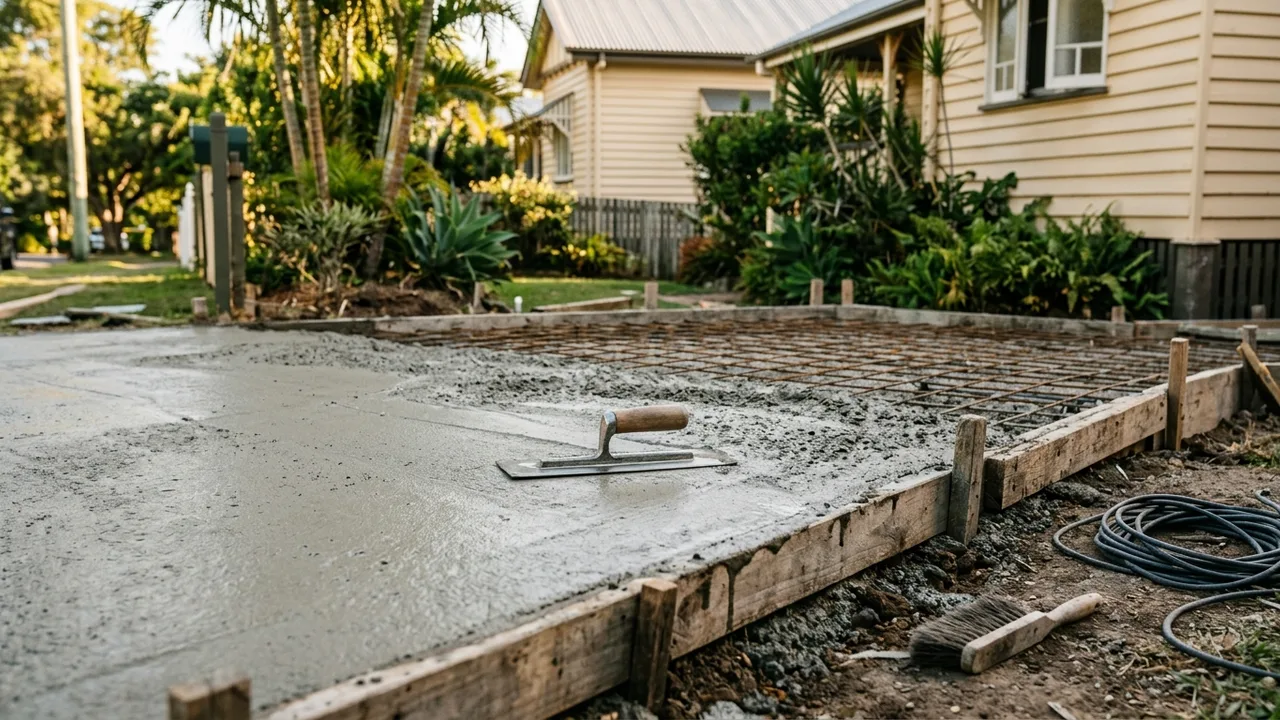
Residential driveways in this area are typically poured at 100 mm for a standard sedan, or 125 mm if you're parking a ute or a loaded tradie van regularly. Shed slabs and garage floors for a two-car space usually land somewhere around 100-125 mm as well, though heavier machinery pushes that number up.
What this means practically:
- A single-vehicle driveway at roughly 25 m² and 100 mm deep uses around 2.5 m³ of concrete.
- A double driveway at 50 m² uses around 5 m³.
- That difference in material alone can add $700-$1,200 before you count formwork, labour or finishing.
Thickness is where some quotes get quietly inflated or quietly cut. If one contractor is quoting 125 mm and another is quoting 85 mm, the cheaper quote isn't necessarily better value. Ask each contractor to confirm the depth in writing.
Site access in the Inner East: the factor that bites hardest
This is probably the biggest price driver that homeowners in suburbs like Morningside, Cannon Hill and Hawthorne don't anticipate. Access is tight in older parts of Brisbane's Inner East. Narrow side passages, elevated house pads, rear lots and established gardens all push labour and equipment costs up significantly.
If a concrete truck can park close to the pour site and the chute reaches the slab, you're in good shape. But in many Inner East properties, the truck can't get close enough. In that case, the contractor has one of three options:
- Pump the concrete using a separate pump truck. This is common and effective, but adds $600-$1,500 to most residential jobs depending on the pump size and duration.
- Wheelbarrow the load from the truck to the site. Labour-intensive, slower, and the cost shows up in the hourly rate or as a line item for extra labour.
- Use a smaller agitator truck to fit through tight access. These carry less volume per load, which sometimes means multiple truck fees.
If your property has a side passage narrower than 900 mm, a steep rear yard or significant tree root zones (Norfolk Island pines and big Moreton Bay figs are common near Hawthorne and Bulimba esplanade properties), mention this upfront. It affects how a contractor prices the job, and a quote given without seeing the site is worth very little.
Ground conditions and what's already there
Brisbane's Inner East has some genuinely variable ground. Parts of Murarrie and Tingalpa sit on low-lying fill. Some Norman Park and Balmoral streets are on clay-heavy soil that expands and contracts significantly with seasonal moisture changes.
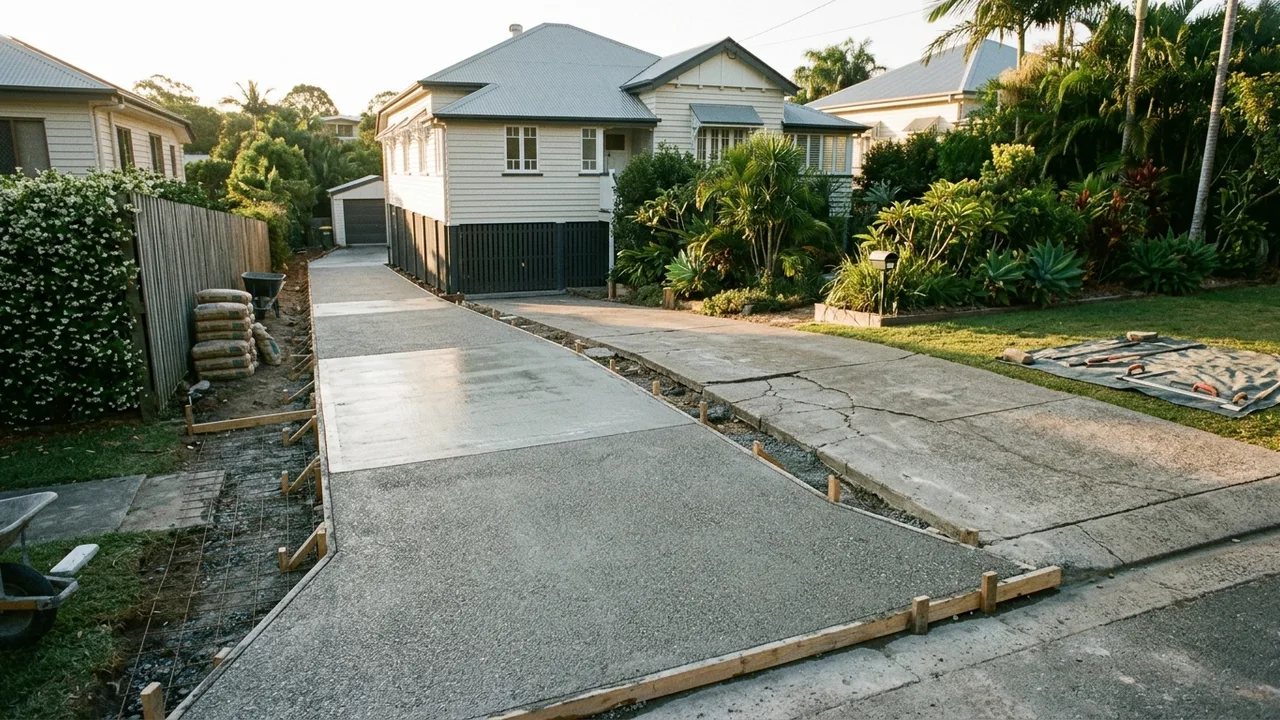
This matters for two reasons.
First, if existing concrete needs to be broken up and removed before a new pour, that's a separate cost. Concrete removal and disposal for a standard driveway typically runs $500-$1,500 depending on thickness and volume. It's sometimes bundled into a replacement quote, sometimes listed separately. Check.
Second, sub-base preparation affects how long a slab lasts. On reactive clay soil, proper compaction and a well-graded base material beneath the concrete make a real difference. This isn't glamorous work, but cutting it short often means cracking within five to ten years. A contractor who seems cheap might be quoting with minimal sub-base preparation. Ask what depth of compacted base they're including.
Reinforcement follows a similar logic. Standard mesh (SL72 or SL82) is fine for residential paths and light driveways. Steel bar (reo bar) is typically used for slabs that carry heavier loads, like garage floors, retaining walls or elevated slabs. If a quote includes reo bar where mesh would do, ask why. If it only includes mesh for a job that clearly needs more, that's a conversation worth having.
Finish type and decorative options
A plain broom finish is the cheapest option and perfectly functional. It's what most driveways in the Inner East would have had when they were first poured in the 1970s and 80s.
Exposed aggregate (also called exposed pebble) is a popular upgrade for entertaining areas and driveways. The surface is washed after pouring to reveal the aggregate beneath. It costs more, typically $40-$80 per m² compared to $50-$70 per m² for a broom finish in this region (though both figures vary with job size and current input costs). It handles Brisbane heat well, stays relatively cool underfoot compared to dark concrete, and has good slip resistance when wet.
Stencilled and coloured concrete adds another layer of cost. These finishes suit alfresco entertaining areas in Bulimba and Balmoral particularly well, where outdoor living spaces are a genuine priority. Expect to pay a premium of roughly $20-$50 per m² over exposed aggregate for complex stencil work, and factor in that some decorative finishes require periodic resealing every few years.
For most functional applications like a side pathway or a backyard shed slab, a plain finish is the honest choice. Save the decorative budget for surfaces you actually see and use daily.
Labour, timing and quote variation
Labour rates vary, and so does demand. Concreting in Brisbane's Inner East tends to stay busy through spring and autumn. During peak periods, some contractors won't chase small jobs aggressively, so their quotes might reflect that.
A job quoted in October might cost 10-15% more than the same job quoted in late January, simply because the contractor has more work than he needs. This isn't gouging; it's ordinary market behaviour.
Getting two or three quotes is sensible for any job over $3,000. Below that threshold, the time you spend managing multiple quotes often isn't worth the saving. For a larger project like a full driveway replacement with a new exposed aggregate finish, comparing quotes from different contractors can easily save $1,500-$2,500.
When comparing quotes, look at what each one actually includes:
- Formwork and removal
- Sub-base preparation and depth
- Reinforcement type
- Concrete strength (MPa rating, typically 25 MPa for residential)
- Disposal of any demolished material
- Sealing (if applicable to the finish)
A quote missing several of these line items isn't necessarily dishonest; some contractors bundle costs differently. But you need to be comparing the same scope of work, not just the bottom-line number.
A practical way to approach your next quote
Before you call anyone, spend fifteen minutes walking the site and noting the constraints: access width, slope, any existing concrete to remove, tree roots near the pour zone, and how far the truck would need to park from the slab. Write it down.
When you speak to a contractor, share that information upfront rather than waiting to be asked. It helps them price accurately the first time, and it signals that you're an easy client to work with, which sometimes matters.
Be sceptical of any quote given without a site visit for jobs above $3,000. Concrete pricing has enough variables that a phone quote for a complex job is more of a guess than an estimate.
If you want a referral to a local concreter who works regularly in the Bulimba and Inner East area, that's something we can help with. But even if you go your own way, the framework above should help you read a quote clearly and ask the right questions.
Quick answers