Concreting guide
How Do Concreters Handle Sloped Blocks in Bulimba and Hawthorne?
How Concreters Tackle Sloped Blocks in Bulimba and Hawthorne
Sloped blocks are not the exception in Bulimba and Hawthorne — they are close to the rule. Concreters working in this part of Brisbane's Inner East deal with fall and grade almost every day, and the core answer is this: they manage it through a combination of cut-and-fill earthworks, formed steps and levels, retaining structures, and careful water management. The approach depends on how steep the slope is, what the concrete is for, and what sits uphill or downhill of it.
Why the Bulimba–Hawthorne Terrain Creates Real Challenges
Hawthorne and Bulimba sit on the ridgeline and slopes running down toward the Brisbane River. Many blocks in streets like Riding Road, Norman Avenue, and the quieter residential pockets off Oxford Street carry a natural fall of anywhere from a few degrees to something quite steep across a standard 400 to 600 square metre lot.
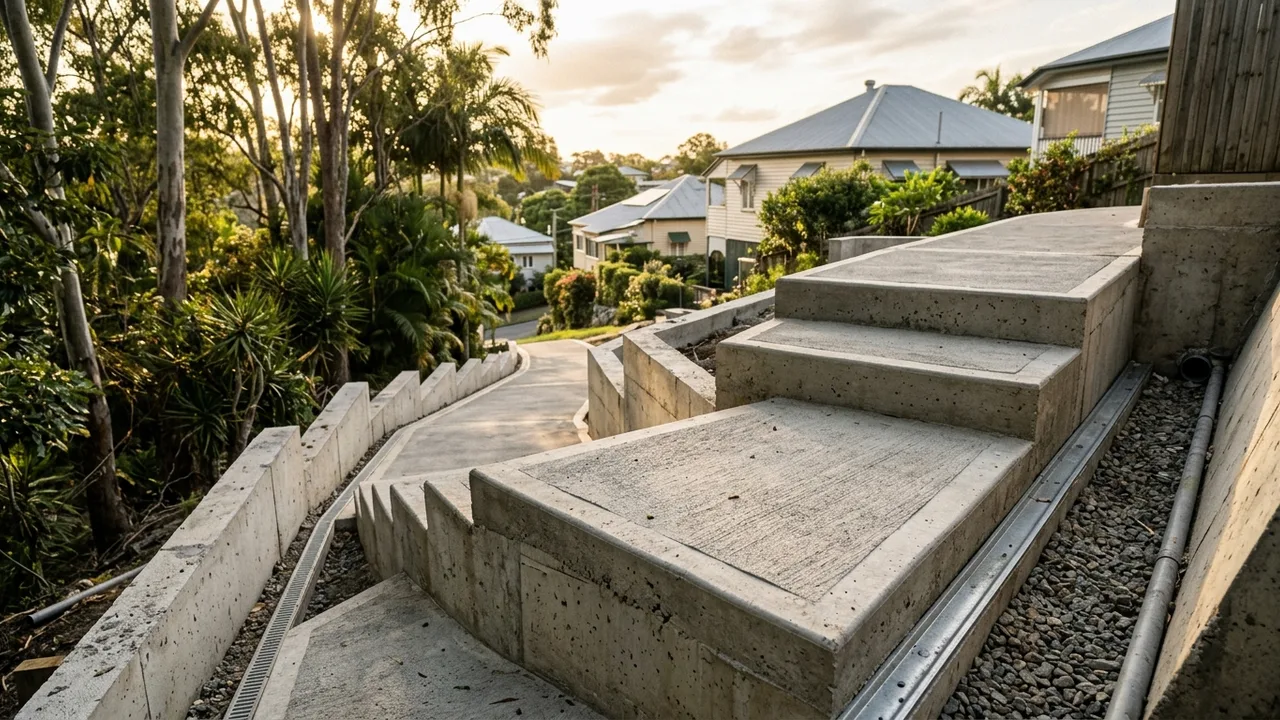
Add in the traditional Queenslander housing stock — built up on stumps partly because of that very terrain — and you have a situation where the ground beneath a proposed driveway, shed slab, or entertaining area can change level by half a metre or more from one side to the other.
Stormwater is the underlying concern here. Brisbane's summer rainfall events are intense. If a concrete surface is laid flat on a falling block without proper planning, water pools against the house, runs toward the garage, or sheets across the footpath and into the street in a concentrated flow. The concreter is not just laying concrete; they are managing drainage for the life of the slab.
Cut and Fill: The Most Common Starting Point
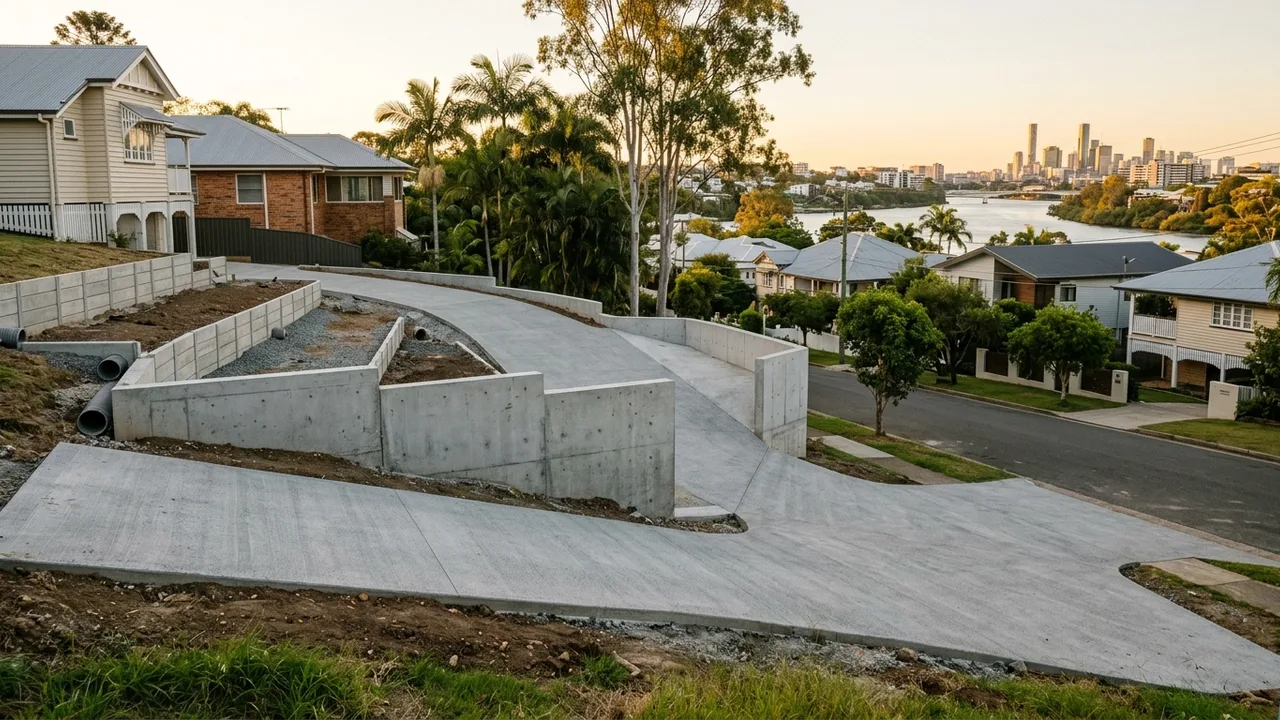
Before any formwork goes down, most concreting jobs on sloped blocks require some degree of earthworks. Cut and fill means cutting into the high side of the block to create a level platform, then using that excavated material to build up the low side.
For a driveway or shed slab on a moderately sloped Bulimba block, this can be relatively straightforward — a bobcat hire and a few hours of earthmoving. On steeper sites, or where the soil is reactive clay (common through the Inner East), it becomes a more involved exercise. Clay soils expand and contract with moisture changes, which affects how stable a filled platform will be over time.
In practice, a concreter will typically assess whether the fill material is suitable for compaction or whether it needs to be removed and replaced with road base or similar. Poorly compacted fill under a concrete slab leads to cracking and settlement — one of the more common causes of concrete failure on sloped suburban blocks.
Stepped Slabs and Varying Levels
For entertaining areas, patios, and backyard slabs where a flat surface is the goal but the ground is not, concreters often work in stepped or split levels. Rather than forcing the entire slab to one elevation, the design creates two or three distinct levels connected by a small rise — sometimes just 100 to 150 millimetres between each step.
This approach has a few advantages. It reduces the volume of fill required. It also creates natural drainage breaks between sections, so water has somewhere to go without flooding the lowest corner of your alfresco area.
The trade-off is visual. A single-level entertaining slab feels more open and unified; a stepped slab suits some homes and feels awkward in others. For homes in Hawthorne with a Queenslander set high off the ground, a stepped approach often integrates well with the existing architecture. For a newer lowset home in Morningside or Cannon Hill, the look may feel disjointed.
This is worth talking through with your concreter before any formwork is placed, because reversing that decision later is expensive.
Retaining Walls and What They Mean for Your Budget
On steeper blocks, you may need a retaining structure before any concrete can be poured safely. This is where costs can escalate quickly. A small garden wall to hold back a few hundred millimetres of fill on one side of a driveway is one thing. A wall carrying significant lateral load from uphill soil — particularly after rain when that clay is saturated and heavy — is an engineering problem.
In Brisbane, retaining walls over a certain height (typically 1 metre, though this varies depending on what is above it) require council approval and sometimes a structural engineer's sign-off. If the wall is in a side boundary setback or close to a neighbouring structure, the Brisbane City Council regulations apply and should be checked before work starts.
The practical implication for a homeowner in Bulimba or Hawthorne: if your concreter quotes you for a sloped driveway or entertaining slab and does not mention anything about retaining, drainage, or earthworks, ask directly. A quote that skips these elements is likely to attract variations once work is underway.
Typical costs for a modest concrete retaining wall in the Inner East, separate from the slab itself, can run from $1,500 upward depending on length and height. More complex engineered walls are a separate category entirely.
Drainage Design and Surface Fall
Concrete that sits perfectly flat looks good in theory but performs poorly outdoors. Every concreted surface needs a fall — a deliberate slope designed to move water away from structures and toward a drain or lawn edge.
The standard minimum fall for a concrete slab exposed to weather is typically 1:100, meaning 10 millimetres of drop for every metre of run. In practice, most concreters aim slightly higher, around 1:80, to allow for any minor irregularities in the finished surface.
On a sloped block, this calculation has to work in harmony with the natural fall of the land. If the block runs downhill toward the house, the concreter needs to ensure the slab directs water laterally across and away, rather than funnelling it toward the footings. This is sometimes achieved with a central ridge or crown across the slab width, or by directing fall toward a side channel drain.
Subsoil drainage is the other piece. If there is significant water moving through the ground uphill of a new slab, a slotted agricultural pipe (ag pipe) buried in gravel before the concrete is poured can prevent hydrostatic pressure from building up beneath the slab and causing heave or cracking over time. In higher rainfall years, this is worth asking about specifically.
What This Means for Your Planning and Budget
Jobs on sloped blocks in Bulimba and Hawthorne typically cost more than equivalent work on a flat site. That is simply the reality. Earthworks, retaining, drainage solutions, and extra formwork time all add to the final figure. A driveway that might come in at $4,000 to $6,000 on a flat block can run $7,000 to $12,000 on a challenging fall with retaining and drainage requirements factored in.
That does not mean you should avoid concreting a sloped site — it means you should budget for it properly and get a quote that itemises earthworks, drainage, and retaining separately from the concrete work itself.
A few practical steps worth taking before you call anyone:
- Walk the site after heavy rain and observe where water pools or flows. That information is directly useful to any concreter assessing the job.
- Check whether any existing retaining structures on your boundary are in good condition. A failing neighbour's wall can complicate your project.
- Ask your concreter specifically how they intend to handle drainage from the finished surface.
The concreters working regularly in the Bulimba cluster understand this terrain. Most have laid slabs in streets with 10-degree cross-falls and know what the soil does after a wet summer. When you're getting quotes, it is worth asking whether they have recent experience on sloped sites nearby — not as a test, but because the answer will tell you a fair bit about how thorough their site assessment is likely to be.
Quick answers