Concreting guide
Does slab thickness really matter for a residential job?
Yes, slab thickness matters — but not always in the way you might think. For most residential jobs in Brisbane, the difference between a slab that performs well for decades and one that cracks within a few years comes down to matching thickness to the actual load it will carry, not simply pouring more concrete and hoping for the best.
What Thickness Actually Controls
Concrete thickness is one of three things that determine how a slab behaves under load. The other two are the subgrade (what sits underneath) and the reinforcement (steel mesh or rebar). Thickness without good subgrade preparation is like a bridge built on sand. Reinforcement without adequate thickness leaves the steel too close to the surface or bottom, where it corrodes or contributes almost nothing structurally.
That said, thickness does the primary work of distributing point loads across a wider area of the subgrade. A thinner slab concentrates load; a thicker one spreads it. If your application involves heavy or repeated loads, like a car parked daily or a loaded trailer, thickness directly affects how long the slab lasts before stress cracking starts.
Standard Thicknesses for Residential Applications
In Australian residential work, there are broadly accepted starting points. These are not fixed rules, but they reflect what most concreters and engineers consider appropriate for common jobs.
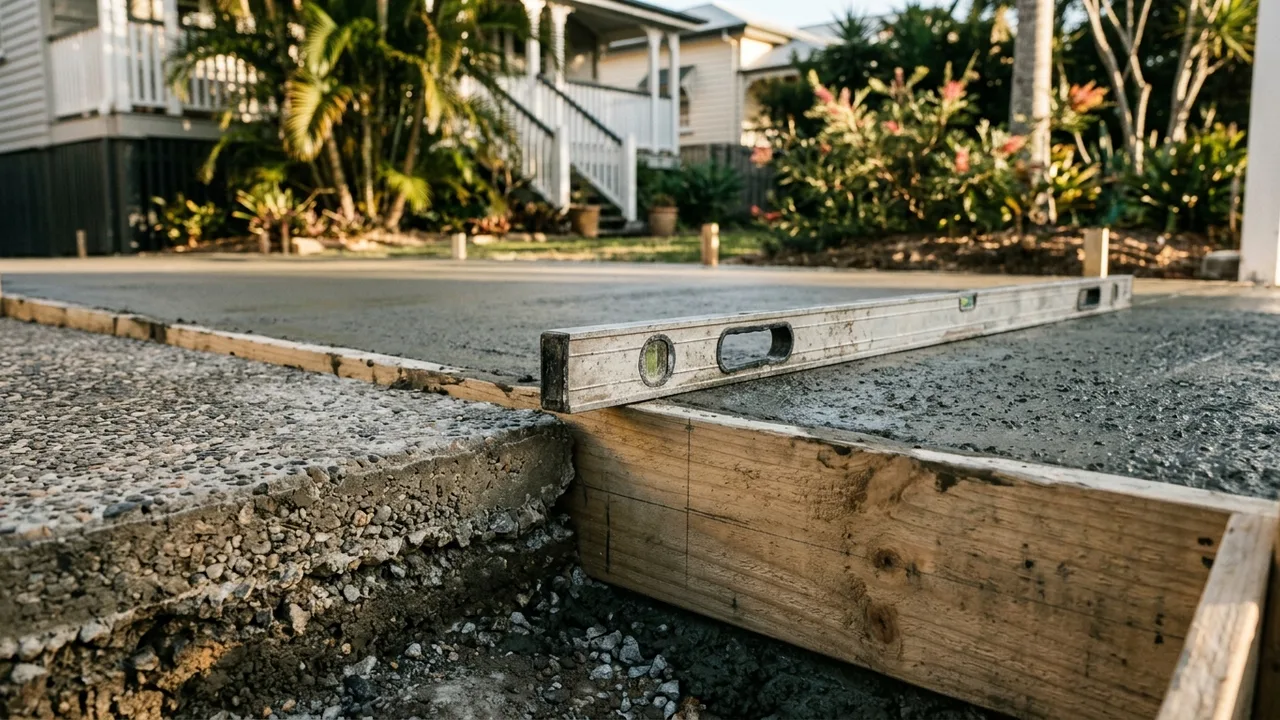
Pathways and garden paths: 75mm to 100mm is typical. A garden path carrying foot traffic only rarely needs anything more than 75mm if the base is well compacted. Side-access walkways that need to take wheelbarrow or trolley loads are better at 100mm.
Entertaining areas and alfresco slabs: Usually 100mm. Some concreters will pour at 85mm for a sheltered, lightly loaded patio, but 100mm gives you a safer margin and makes resurfacing later more viable if you want to add an overlay.
Driveways: This is where thickness starts to matter more noticeably. For a standard passenger vehicle, 100mm is generally accepted as the minimum. If you have a larger SUV, a ute, or regular delivery vehicles, 125mm is a more sensible target. For something heavier, you are moving into a conversation about engineering specifications.
Garage and shed slabs: Residential garages for one or two passenger cars are typically 100mm. Workshop slabs that might carry a hoist, heavy machinery, or a loaded camper trailer should be 125mm to 150mm, with appropriate reinforcement. Getting this wrong is expensive because you cannot easily thicken a slab after it is poured.
How Brisbane Conditions Affect the Answer
Brisbane's climate and geology introduce a few complications worth knowing about.
Reactive clay soils are common across the Inner East, including Morningside, Norman Park, and parts of Balmoral. These soils expand when wet and shrink when dry, which creates movement underneath a slab. That movement puts the slab in tension, which is its weakest mode. On a reactive site, thickness alone does not fix the problem; you need appropriate subbase preparation, sometimes a sand layer or a membrane, and you may need control joints at closer intervals. A 100mm slab on well-prepared subgrade on a reactive site will usually outperform a 150mm slab on a poorly prepared one.
Older Queenslander blocks in Hawthorne and Bulimba often have significant slope. A sloped block means the slab can be thicker at one end than the other, or the concreters need to build up the subbase to level the pour. Neither of these is a problem if it is accounted for; it just needs to be specified and checked during the job, not discovered afterwards.
Tree root systems are a genuine issue in the Inner West. Jacarandas and fig trees along older streets can put pressure on subgrade over time. A thicker slab resists root intrusion better simply because it is harder for roots to deflect. This is not a reason to pour 200mm everywhere, but it is a reason to talk to your concreter about root barriers if you have large street trees close to the work area.
The Cost Trade-Off: Thicker vs Adequate
Every extra 25mm of thickness across a standard 40 square metre driveway adds roughly 1 cubic metre of concrete. At current Brisbane rates, that is typically $150 to $250 in raw materials, plus the labour to screed and finish a slightly deeper pour. So going from 100mm to 125mm on a driveway might add $300 to $500 to your job, depending on size and finish.
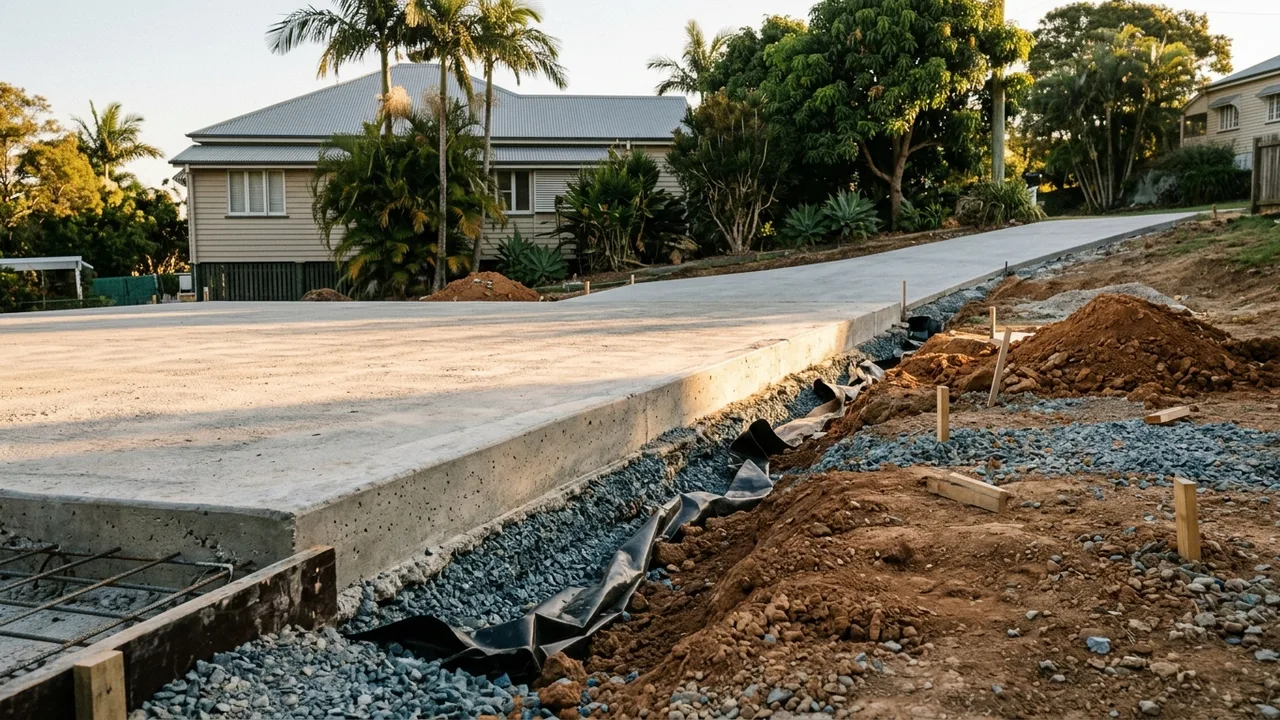
That is not a large sum when you are already spending $4,000 to $8,000 on a driveway. The question is whether you actually need it. If you drive a standard sedan and the subgrade is properly prepared, the extra thickness may give you marginal benefit. If you drive a four-wheel drive loaded regularly for camping trips, or you plan to park a boat trailer on the driveway, that $400 is worth spending.
The opposite trap is paying for extra thickness when the problem is actually a poor subbase. If the compaction or the subgrade preparation is inadequate, a thicker slab will still move and crack. Pouring at 150mm on a soft or variable subbase is a worse investment than pouring 100mm on a properly compacted, well-prepared base.
Reinforcement and Thickness Work Together
You cannot separate thickness from reinforcement in any useful discussion. SL72 mesh (the most common grade used in residential work) is typically specified at a depth of roughly one third from the bottom of the slab, sitting on bar chairs that hold it off the formwork. In a 100mm slab, the mesh ends up at approximately 30 to 40mm from the bottom. In a 75mm slab, the cover becomes marginal and the mesh can corrode if moisture gets in.
This is why 75mm is generally the floor for anything with mesh reinforcement. Below that, you either have no reinforcement or inadequate cover to protect it. For a lightly loaded path that will not be near vehicles, unreinforced concrete at 75mm with control joints can work fine. For anything that cars or significant loads will touch, reinforcement and thickness need to be specified together.
Getting the Specification Right Before You Pour
The single most useful thing you can do before a concrete job is have the concreter walk the site with you and talk through what loads the slab will actually carry, not just now but in three to five years. A new driveway for a unit you plan to convert to a home with a double garage later is a different specification from a simple path between the fence and the house.
Get the intended thickness written into your quote. It sounds obvious, but many quotes describe the job by area and finish only. If thickness is not specified, you have no way to verify what was poured after the fact without core sampling, which is expensive and nobody wants to do it on a freshly finished slab.
A reputable local concreter operating in Inner East Brisbane should be able to tell you what subbase preparation they intend, what mesh specification they are using, where the control joints will go, and what finished thickness you are paying for. If those details are absent from the quote, ask for them before you sign anything.
If you would like help finding a qualified concreter who works regularly in Bulimba, Hawthorne, Morningside and the surrounding suburbs, we can connect you with local operators who cover exactly this kind of residential work.
Quick answers