Concreting guide
Concreting near large trees: what Brisbane's Inner East suburbs need to watch
Concreting near large trees in Brisbane's Inner East is genuinely tricky. Roots from mature trees can lift, crack and undermine concrete within a few years of pouring, and the dense canopy coverage across suburbs like Hawthorne, Norman Park and Balmoral makes this a real, recurring problem - not a theoretical one.
If you're planning a driveway, path or entertaining slab near an established tree, the decisions you make before the pour matter far more than the ones you make during it.
Why Inner East Brisbane Has a Particular Problem With Tree Roots
The Inner East suburbs sit on a mix of older residential blocks, many developed in the post-war era or earlier. Mature trees - poinciana, fig, jacaranda, mango, silky oak and camphor laurel - are common, and some have been in place for 50 years or more. Their root systems are substantial.
Poinciana roots in particular are notorious in this part of Brisbane. They grow fast, they grow shallow, and they actively seek out water and disturbed soil - exactly the conditions created when you dig and pour concrete. Figs are even more aggressive. If you have a large Moreton Bay fig near a proposed concrete area, that alone warrants specific advice before you proceed.
Jacarandas, popular streetside in Norman Park and Hawthorne, tend to have less destructive roots than figs or poincianas, but they are not risk-free on narrow footpath strips or side access paths where the soil profile is shallow.
How Root Damage to Concrete Actually Happens
Roots do not crack concrete by pushing up suddenly. It's a slow process. A root grows laterally under a slab, and as it thickens year by year, it creates upward pressure. The slab develops a crack, then a ridge, then sections start to lift unevenly. Depending on the tree species, soil type and slab thickness, this can take anywhere from three to ten years.
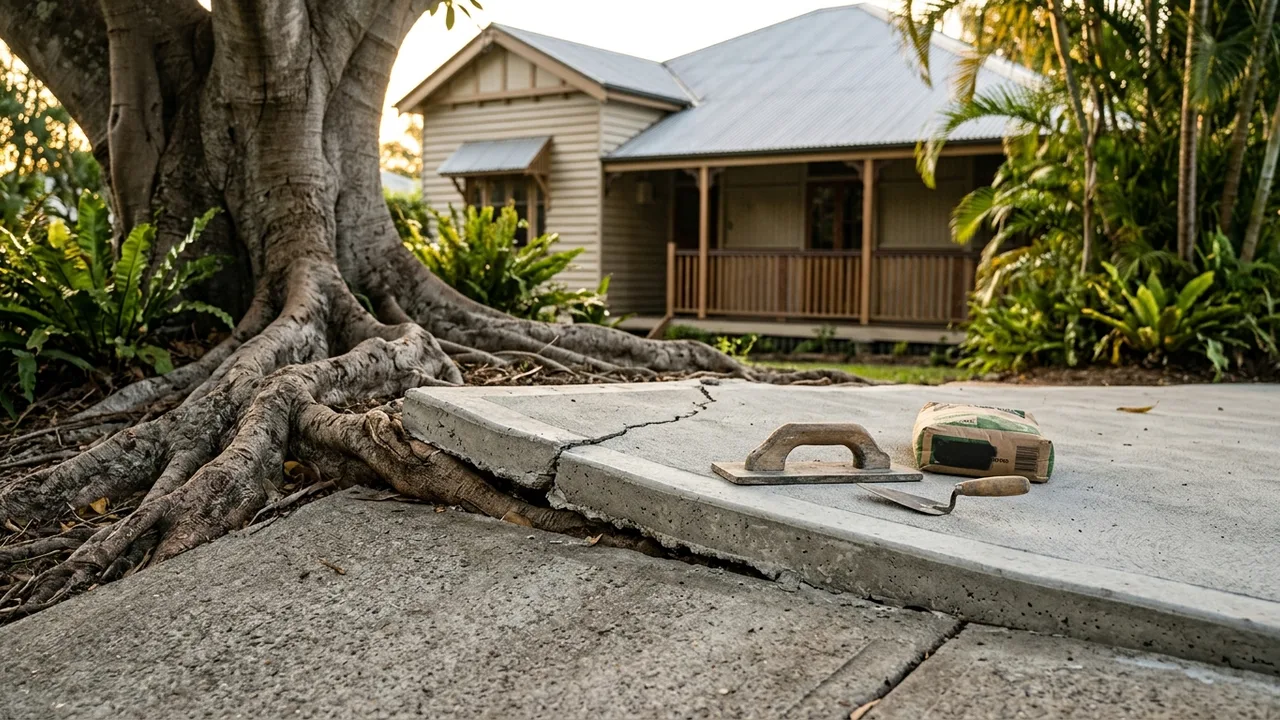
The type of concrete installation matters too. A thin 75mm path poured without reinforcement is far more vulnerable than a 100mm reinforced driveway slab. Reo mesh or steel bar adds tensile strength, but it does not stop a determined root. What it does is keep a cracked slab from fragmenting completely, which at least contains the problem.
Expansive clay soils, common across much of Inner East Brisbane, make things worse. Clay swells when wet and shrinks when dry. Combined with root activity, this creates multiple competing forces under the slab that no pour can fully resist.
What You Can Actually Do Before Pouring
This is where some honest trade-off thinking is useful.
Option 1: Root barriers. A physical root barrier (typically a heavy-duty HDPE sheeting installed vertically in a trench between the tree and the slab) can redirect root growth downward and away. They work reasonably well when installed correctly at depth - typically 500mm to 600mm in Brisbane's conditions. The trade-off is cost and effort. Adding a root barrier to a concreting job adds meaningful time and materials, and the trench work needs to avoid damaging major roots in the process, otherwise you're stressing the tree while trying to protect the slab. An arborist consultation before trenching is worth the fee.
Option 2: Redesign around the tree. Sometimes the smarter move is adjusting the layout of the concrete area so it sits further from the trunk and major root zones. As a rule of thumb, the structural root zone of a mature tree extends at least as far as the canopy drip line, and often further. If a proposed driveway runs through that zone, consider whether gravel, pavers on sand or a permeable surface might be a better fit for that section. These surfaces tolerate some root movement without cracking, and they can be re-levelled more easily.
Option 3: Pour thicker, reinforce properly, and accept that maintenance is part of the deal. Some homeowners decide to go ahead with a standard concrete pour but with upgraded reinforcement - 100mm depth with F72 mesh, or bar reinforcement for heavier-use areas like driveways. They understand the slab may need grinding or resurfacing in ten to fifteen years. In areas where removing a large tree is either impossible (council protection orders) or undesirable, this is often the pragmatic path.
Option 4: Remove the tree. This is sometimes the right answer, but it comes with conditions. Many mature trees in Bulimba, Hawthorne and surrounding suburbs are covered by Brisbane City Council's Significant Tree Register or fall under vegetation protection rules. Removal without council approval can attract significant fines. Check the Council's PD Online tool before making any assumptions about what can be taken down. Even where removal is permitted, a large, established tree may be providing meaningful shade to your home - removing it has energy and liveability costs that are easy to underestimate.
Council Considerations and Protected Trees
Brisbane City Council applies vegetation protection orders to trees that meet certain size and species criteria. In the Inner East, with its mature residential streetscapes, protected trees are common. Before any concreting work near an established tree, it's worth checking whether that tree has any protection status.
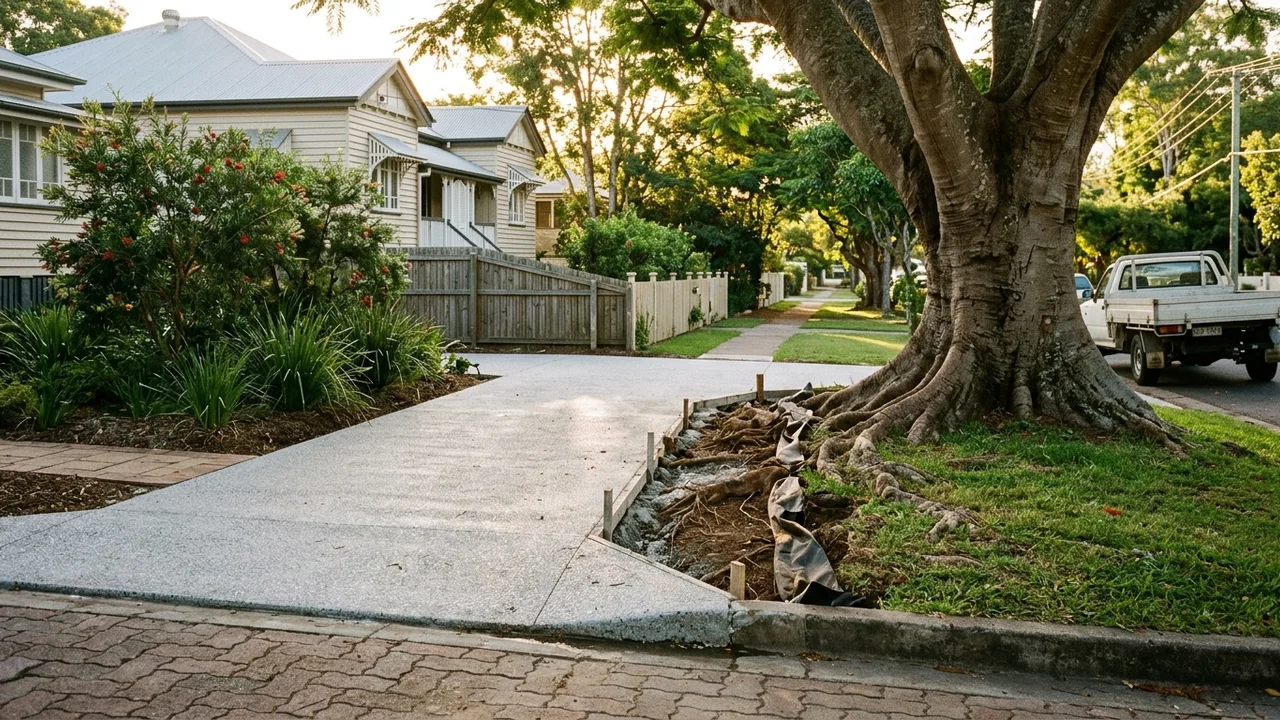
Beyond formal protection, there is a practical point about tree health. Concreting over a significant portion of the root zone can damage or kill a tree by cutting off water infiltration and gas exchange at the soil surface. Council can and does require applicants to demonstrate that proposed works won't unreasonably harm significant trees. If you're planning a large entertaining area or driveway near a mature tree, a tree report from a certified arborist may be required as part of any development application.
What a Good Concretor Should Be Asking You
When you get quotes for a job near established trees, the conversation you have upfront is a good indicator of quality. A concretor worth engaging will ask about the trees, not ignore them. They should want to know:
- Species, approximate trunk diameter and canopy spread
- How close the proposed slab edge will be to the trunk
- Whether there are visible surface roots in the area
- Whether any excavation is needed, and to what depth
They should also be straightforward about what they can and cannot control. No concrete installation near a mature root system is a permanent, zero-maintenance outcome. A concretor who tells you otherwise is either optimistic or not thinking it through.
Specific design choices - control joints placed at closer intervals, a slightly raised edge to accommodate future movement, or leaving a deliberate gap around the base of the tree - are all worth discussing. None of them are complicated, but they need to be agreed before the forms go in, not after.
Repairs and Resurfacing When Root Damage Has Already Happened
If you've got an existing path or driveway that's already showing root-related lifting, you have options short of full replacement. Grinding down a raised section is a common fix on concrete paths around Norman Park and Morningside, and it's usually significantly cheaper than re-pouring. It's not permanent - the root will continue to grow - but it can buy years of safe, level surface.
For more severe displacement, a partial slab replacement with a root barrier added during the repair can reset the clock more meaningfully. The cost for this kind of repair typically sits between $600 and $3,000 depending on the area involved, though jobs with significant excavation or arborist involvement can run higher.
Full driveway replacement, when roots have caused widespread damage, typically ranges from $4,000 to $12,000 across Inner East Brisbane - heavily dependent on site access, area and finish choice.
A Closing Thought
If you're planning concrete work near a mature tree in Bulimba, Hawthorne, Norman Park or anywhere else in the Inner East, the tree is not an obstacle to work around at the last minute. It's a planning factor from the start. Talk to your concretor about it early. If the tree is significant - large canopy, thick trunk, over a street or neighbouring property - spend the money on a brief arborist consultation. That $300 to $500 investment often changes the design decisions meaningfully and can save you from a much more expensive repair job in five years.
You don't need to be scared of concreting near trees. You just need to go in with accurate expectations and a layout that acknowledges the tree's root system, not one that pretends it doesn't exist.
If you'd like to talk through a specific job in the Inner East, we can connect you with a local concretor who's familiar with the tree species, soil conditions and council rules in this part of Brisbane.
Quick answers