Concreting guide
How thick should a residential concrete driveway actually be?
For a standard residential driveway in Brisbane, 100 mm is the minimum practical thickness. Most concreters will quote you 100 mm as the baseline, but if you have heavier vehicles, poor subgrade soil, or steep access, 125 mm or even 150 mm is worth considering. Getting this decision right before the pour is a lot cheaper than fixing it afterwards.
Why Thickness Matters More Than Most People Realise
Concrete is strong in compression but relatively weak in tension. When a vehicle parks on a slab, the load spreads downward and outward. If the slab is too thin, or if the ground beneath it shifts (and Brisbane soil certainly does), the slab flexes slightly. Over enough cycles, that flexing causes cracking from the bottom up.
You might not see that crack for a year or two. By then, the slab has already failed structurally. Adding a decorative resurfacing coat over it, or grinding back the surface, only masks the problem. The fix at that point is usually a full replacement, which costs significantly more than getting the thickness right at the start.
Thickness also works together with the concrete mix strength and the reinforcement inside the slab. These three things are not interchangeable. You cannot compensate for a thin slab by using stronger concrete alone. All three components need to be appropriate for your specific situation.
The Standard 100 mm Recommendation: Where It Applies
A 100 mm slab is adequate for most suburban Brisbane driveways carrying standard passenger vehicles, SUVs, and light utes. At this thickness, the concrete is typically specified at 20 MPa or 25 MPa compressive strength, with steel mesh reinforcement (usually SL72 or SL82 mesh) placed in the lower third of the slab.
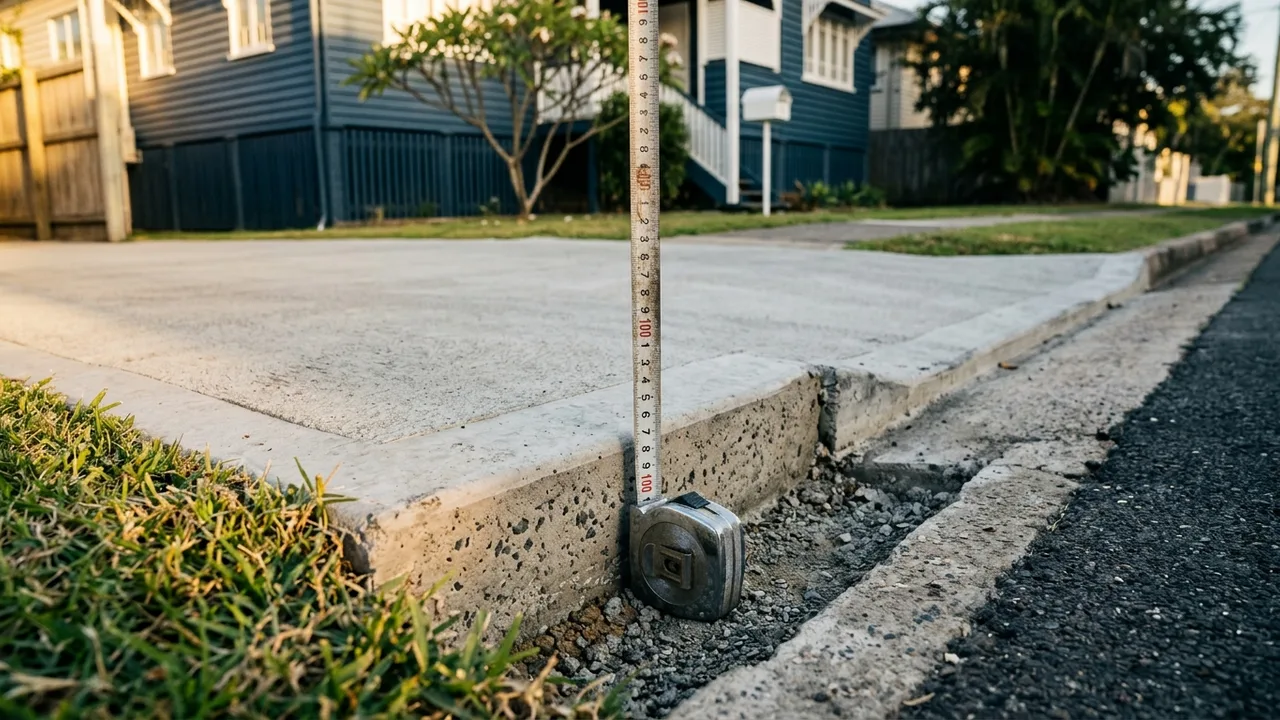
This is the combination that most residential concreters in the Inner East Brisbane area, including Bulimba, Hawthorne, Morningside, and Cannon Hill, will quote as a starting point. It suits a single-car or double-car driveway on reasonably stable ground, with a prepared compacted sub-base underneath.
The key phrase there is "reasonably stable ground." Brisbane's Inner West and Inner East have a lot of clay-heavy soil, particularly in older suburb pockets like Norman Park and parts of Balmoral. Clay expands when wet and contracts in dry periods. A 100 mm slab on unmodified, poorly compacted clay subgrade is more likely to crack than the same slab on a properly prepared gravel base.
So the 100 mm standard is not a guarantee. It is a starting point that assumes competent subgrade preparation underneath it.
When You Should Go Thicker
There are clear situations where stepping up to 125 mm or 150 mm makes sense.
Heavier vehicles. If you park a large 4WD, a work van, a dual-cab ute with a canopy, or a caravan on the driveway, the point loads are higher. A 100 mm slab will usually handle these, but it has less margin for error. At 125 mm, you get noticeably better load distribution without a dramatic cost increase.
Steep driveways. Many Queenslander-era homes in Bulimba, Hawthorne, and Balmoral sit above street level. Steep driveways create braking and acceleration forces that act differently on the slab than simple static parking weight. Thicker concrete handles these dynamic loads better.
Poor or variable soil. If your property has had fill placed over it, or if you have tree roots that have been removed (jacaranda and Moreton Bay fig roots are common culprits in the Inner East), the subgrade may be uneven or unstable in pockets. Thicker concrete bridging over a weak spot performs better than thinner.
Commercial-adjacent use. Some homeowners run small businesses from their property and regularly have delivery trucks or trailers in the driveway. A residential-spec 100 mm slab is not designed for this. You would want 150 mm minimum and likely a higher-strength mix like 32 MPa.
The cost difference between 100 mm and 125 mm on a standard double driveway is typically somewhere in the range of $400 to $800 extra, depending on job size and access. Spread over the life of the driveway, that is a small premium for meaningful added durability.
Sub-Base Preparation: The Part Nobody Sees
Thickness measurements refer to the concrete itself. But what sits underneath the concrete is equally important, and it is the part that is hardest to verify once the job is done.
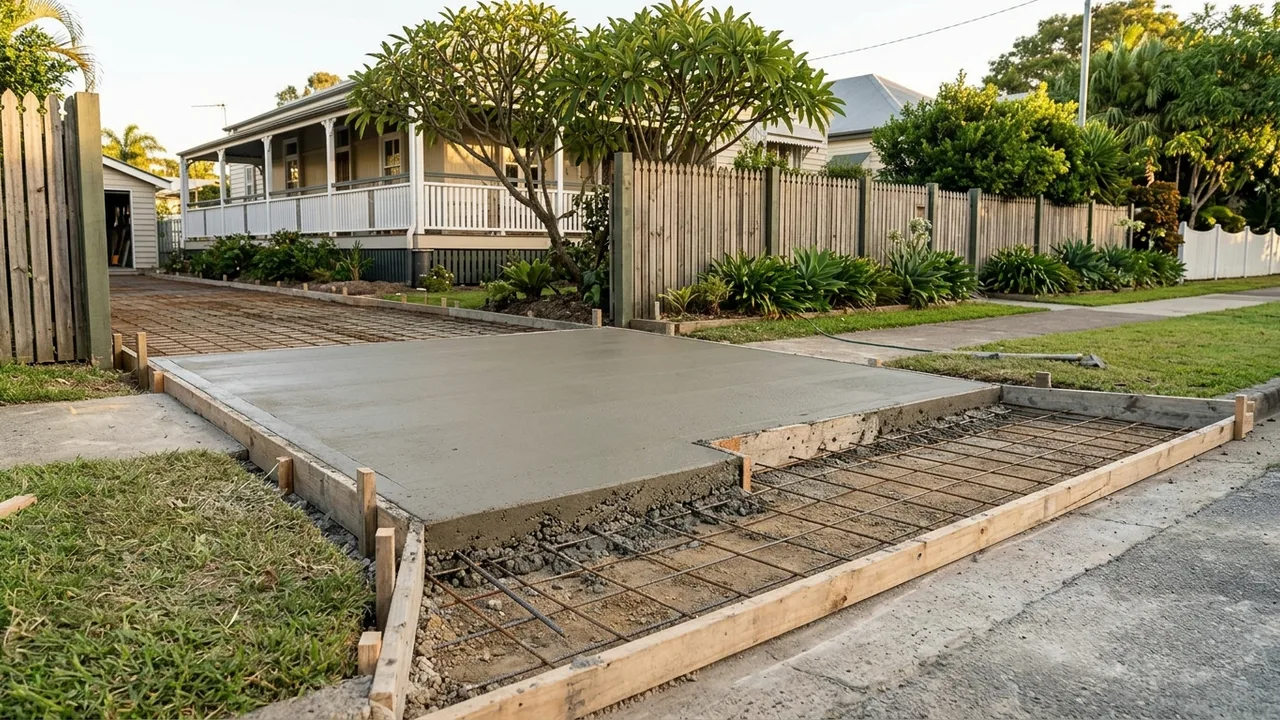
A properly prepared sub-base for a residential driveway in Brisbane typically involves:
- Excavating to the required depth (accounting for both the concrete thickness and the base layer)
- Placing and compacting a layer of road base gravel, usually 75 mm to 100 mm deep
- Checking for level and even compaction before the pour
Skipping or skimping on this step is one of the most common reasons driveways fail prematurely. You can pour 150 mm of high-strength concrete, but if it is sitting on loose or uneven fill, you will still get cracking.
When getting quotes, it is reasonable to ask each concreter what they plan to do with the sub-base and how deep they will excavate. Their answer tells you a lot about the quality of the job they intend to deliver.
Reinforcement: Mesh Versus Fibres Versus Rebar
Concrete thickness does not work in isolation from reinforcement. The two most common options for residential driveways are:
Steel mesh (trench mesh or sheet mesh). This is the traditional approach and still the most common in Inner East Brisbane residential work. It adds tensile strength and controls cracking if the slab does flex. Mesh needs to be placed correctly at the right depth within the slab; mesh sitting on the ground or floating near the top is not doing its job properly.
Polypropylene fibres (or steel fibres) mixed into the concrete. Fibre reinforcement is added to the mix at the batch plant and distributes evenly through the pour. It controls plastic shrinkage cracking well and eliminates the placement variable. Some concreters use fibres in addition to mesh, not instead of it.
Rebar (deformed bar). Typically used for heavier applications, steep driveways, or areas with significant soil movement. More expensive than mesh but provides superior structural performance in challenging conditions.
For a typical Bulimba or Morningside residential driveway, mesh is standard and appropriate. If your site has any of the complicating factors mentioned above, it is worth asking whether fibres or additional rebar is warranted.
A Practical Guide to What to Ask For
When you are getting quotes for a new driveway or a full replacement, you do not need to be a concreter to ask the right questions. Here is what to clarify before you sign anything:
- What thickness are you quoting? Get a specific number in millimetres.
- What concrete strength (MPa) will you use? For residential, 25 MPa is a reasonable minimum; 32 MPa if you have heavier use in mind.
- What reinforcement is included? Mesh, fibres, or both. Ask what size mesh.
- What sub-base preparation is included? How deep will you excavate, and will you compact a road base layer?
- What control joints are you planning? These are the lines cut or tooled into the slab to guide cracking to predictable locations. A driveway without them is more likely to crack randomly.
Getting clear answers to these five questions will tell you whether you are comparing quotes for the same job or for different levels of quality dressed up as similar prices.
The Honest Bottom Line
A 100 mm slab with a proper compacted sub-base, adequate reinforcement, and 25 MPa concrete will serve most Brisbane residential driveways well for many years. If your situation is straightforward and your concreter has prepared the ground correctly, you do not need to overthink it.
Where homeowners run into trouble is when they accept a quote without understanding what is included beneath the surface. Thickness is visible when the concreter measures the forms. Sub-base quality, concrete strength, and reinforcement placement are not. Those are where the real differences between a $4,000 driveway and a $6,500 driveway often live.
If you are weighing up quotes for a driveway in the Bulimba, Hawthorne, or Morningside area and you would like to talk through what a particular quote is actually offering, we are happy to help point you toward someone who can give you a straight answer.
Quick answers