Concreting guide
How Thick Does a Residential Concrete Driveway Actually Need to Be?
The short answer is 100 mm
For a standard residential driveway in Brisbane, 100 mm (10 cm) of concrete is the commonly accepted minimum. That covers a single or double bay used by everyday passenger vehicles. If you stop reading here, that number will serve you well for most Bulimba and Norman Park driveways.
But thickness is only one part of the equation. The strength of the mix, the preparation of the base underneath, and the way the slab is reinforced all interact with thickness to determine how long your driveway actually lasts. So it's worth understanding what goes into that number before you sign off on a quote.
Why 100 mm Is the Starting Point
Concrete is strong in compression but relatively weak in tension. When a loaded vehicle sits on a slab, the edges and middle flex slightly. If the slab is too thin, or the ground beneath is poorly prepared, that flexion causes cracking.
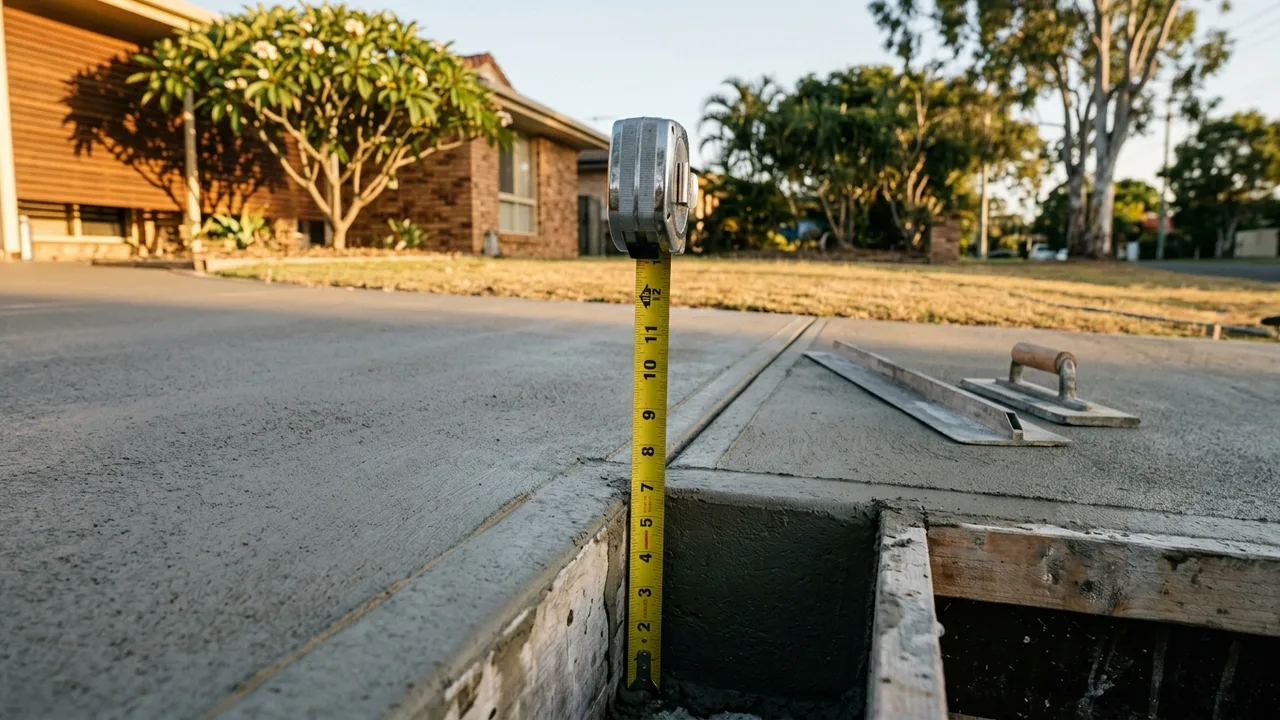
The 100 mm figure is a reasonable balance between cost and structural performance for passenger cars, SUVs, and small tradesperson vans. A typical passenger car weighs somewhere around 1,400 to 2,000 kg. A concrete slab poured at 100 mm with adequate reinforcement can handle that load across a properly compacted sub-base without issue.
Australian standards don't prescribe a single mandatory residential thickness, but 100 mm is what most qualified concreters in Brisbane work to as a baseline for domestic driveways. If a quote comes in specifying 75 mm, ask questions.
What Changes the Required Thickness
This is where homeowners get caught out. The 100 mm baseline assumes a standard scenario. Several real-world factors push that number up.
Vehicle type and frequency
If you're regularly parking a large four-wheel drive, a camper trailer, or a ute loaded with tools and materials, 100 mm is still generally workable, but 125 mm gives you a reasonable margin. If you're running a small fleet vehicle in and out daily, or you sometimes back a boat trailer onto the driveway, 125 mm is worth the extra cost.
Concrete slabs for heavy vehicles, like a full-size motorhome, horse float, or any vehicle over roughly 3,500 kg, typically need 150 mm minimum and a richer concrete mix.
Sub-base quality
In parts of Morningside and Cannon Hill, particularly in older subdivisions close to the creek systems, the natural ground can be softer or more reactive than typical Inner East Brisbane soil. Expansive clay, backfill areas, or previously disturbed ground requires either thicker concrete, a more engineered sub-base, or both.
A competent concreter will assess the sub-base before pricing. If yours doesn't mention it, ask what they found.
Slope and drainage
Sloped driveways in hilly pockets of Hawthorne and Balmoral can create higher stress points where water sits and erodes the base over time. Steeper grades also concentrate load at the lower end of the slab. These scenarios don't always demand thicker concrete, but they do demand better detailing at the joints and edges.
Tree roots
This one catches Inner West Brisbane homeowners more than most. Bulimba, Norman Park, and Hawthorne all have significant mature tree canopies. Poinciana, fig, jacaranda, and camphor laurel root systems can undermine a concrete slab from below. If there's a large established tree within five or six metres of the driveway line, thicker concrete (125 mm or more) combined with proper control joints is a sensible precaution, not an upsell.
Mix Strength: The Other Variable
Thickness and mix strength work together. Residential driveways in Brisbane typically use a 20 MPa mix at a minimum, but 25 MPa is increasingly standard and is what most reputable concreters will specify.
MPa (megapascals) measures how much compressive force the cured concrete can withstand. A 25 MPa mix at 100 mm will outperform a 20 MPa mix at the same thickness over time, particularly in our climate. Brisbane summers are hard on concrete. Repeated wetting and drying, UV exposure, and the occasional significant downpour put more stress on residential concrete than many people appreciate.
If you're told your driveway will be poured at 20 MPa to save money, weigh that against the expected service life. The difference in material cost across a typical double driveway is a few hundred dollars. The difference in longevity can be several years.
Reinforcement: Steel Mesh vs Fibres vs Nothing
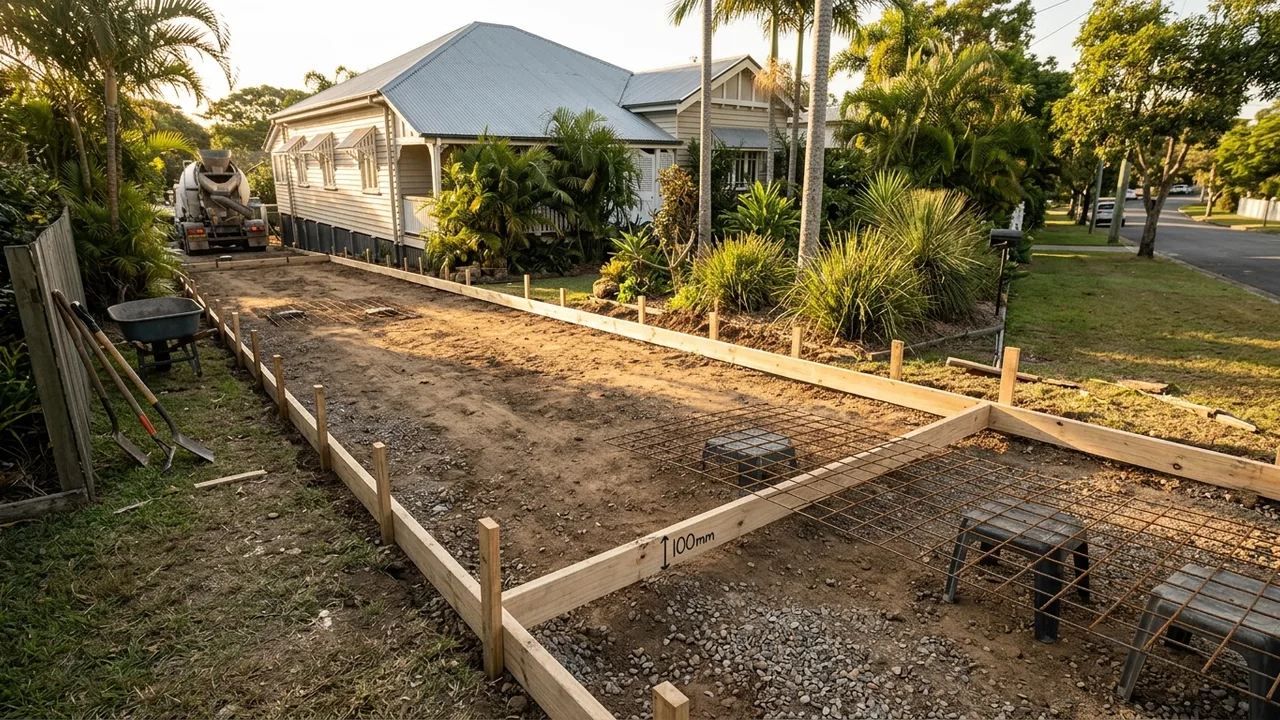
A correctly specified residential driveway should include some form of internal reinforcement. The two practical options are steel mesh (SL72 or SL82) laid centrally within the slab depth, or polypropylene fibres added directly into the concrete mix.
Steel mesh is the traditional approach and performs well at controlling cracking, particularly in longer or wider slabs. It needs to be positioned correctly within the pour, roughly at the mid-depth of the slab. If it's sitting too low or too high, it doesn't do its job properly.
Fibre reinforcement is increasingly common. The fibres don't replace the structural function of mesh in thicker applications, but for a standard 100 mm residential driveway, a quality fibre-reinforced mix performs comparably and removes some of the human error risk around mesh placement.
Some concreters offer both. That's not necessarily overkill for a large driveway or one subject to the tree root and reactive soil conditions mentioned earlier.
Control joints, those intentional shallow cuts made in the slab surface, allow the concrete to crack in predictable lines rather than randomly across the middle of your driveway. Their placement matters as much as the reinforcement choice.
What This Looks Like in Practice: Rough Cost Context
For a typical Bulimba or Hawthorne double driveway, say 6 metres wide by 6 metres deep, poured at 100 mm with SL72 mesh and a 25 MPa mix, you're typically looking at somewhere in the $3,500 to $6,000 range depending on site access, base preparation required, and finishes chosen.
Stepping up to 125 mm adds to the concrete volume (and therefore cost) but typically represents a $300 to $600 increase across a slab that size, not a project-doubling expense. On a 10-year view, that trade-off usually makes sense.
Decorative finishes, exposed aggregate or stencilled concrete, don't change the structural specification. Thickness and mix requirements are the same regardless of what the surface looks like.
Removing and replacing an existing cracked driveway adds to the cost, typically $800 to $2,000 for a standard double bay depending on access and concrete condition. That's worth factoring in if you're comparing new-build pricing against a replacement quote.
The Honest Bottom Line
For most Inner East Brisbane homes, a 100 mm slab at 25 MPa with steel mesh or fibre reinforcement is a solid, defensible specification. It's what a good concreter should propose without being asked.
If you have large trees nearby, reactive clay, or you park anything heavier than a standard SUV on the driveway, ask specifically about 125 mm and whether the sub-base needs additional preparation. Those questions cost you nothing and could save you a cracked slab in five years.
The best thing you can do before any concreter breaks ground is to have that conversation openly. A professional who explains their reasoning is a better sign than one who just tells you what you want to hear.
If you'd like to be connected with a local concreter who works regularly in Bulimba, Hawthorne, Norman Park, and the surrounding suburbs, that's what this service is here for. No pressure, just a straight referral to someone who knows the ground conditions in this part of Brisbane.
Quick answers