Concreting guide
Why is your concrete cracking and is it actually a problem?
Most concrete cracks eventually. That's not a cop-out — it's just the nature of the material. The real question is whether a given crack is cosmetic, structural, or something in between.
What Causes Concrete to Crack in the First Place?
Concrete is strong in compression but relatively weak in tension. When it's placed wet and hardens, it shrinks slightly as moisture leaves. That shrinkage creates internal stress. If the stress exceeds what the slab can handle at a given point, it cracks.
Several forces drive this:
- Drying shrinkage. Fresh concrete loses moisture unevenly. The surface dries faster than the core, which sets up tension near the top.
- Thermal movement. Concrete expands in heat and contracts in cold. In Brisbane's climate, slabs bake in summer sun and cool overnight. That daily cycling adds up over years.
- Ground movement. Brisbane's inner east suburbs — including Bulimba, Norman Park, and Morningside — sit on a mix of fill material, alluvial clay, and decomposed rock. Clay soils shrink in dry spells and swell after rain. If the ground moves, the slab follows.
- Load stress. A driveway bears the weight of vehicles repeatedly over the same spots. Over time, that concentrated loading can exceed what the slab was designed for.
- Poor joints or no joints. Control joints (the straight, tooled or saw-cut lines in a slab) are deliberately weakened lines that guide where shrinkage cracks form. If a slab was poured without adequate joints, cracks appear wherever they please.
Understanding the cause matters because it tells you whether the crack is likely to grow, stay stable, or whether the ground beneath is the real problem.
How to Tell a Cosmetic Crack from a Structural One
Not all cracks are equal. Here's a practical way to assess what you're looking at.
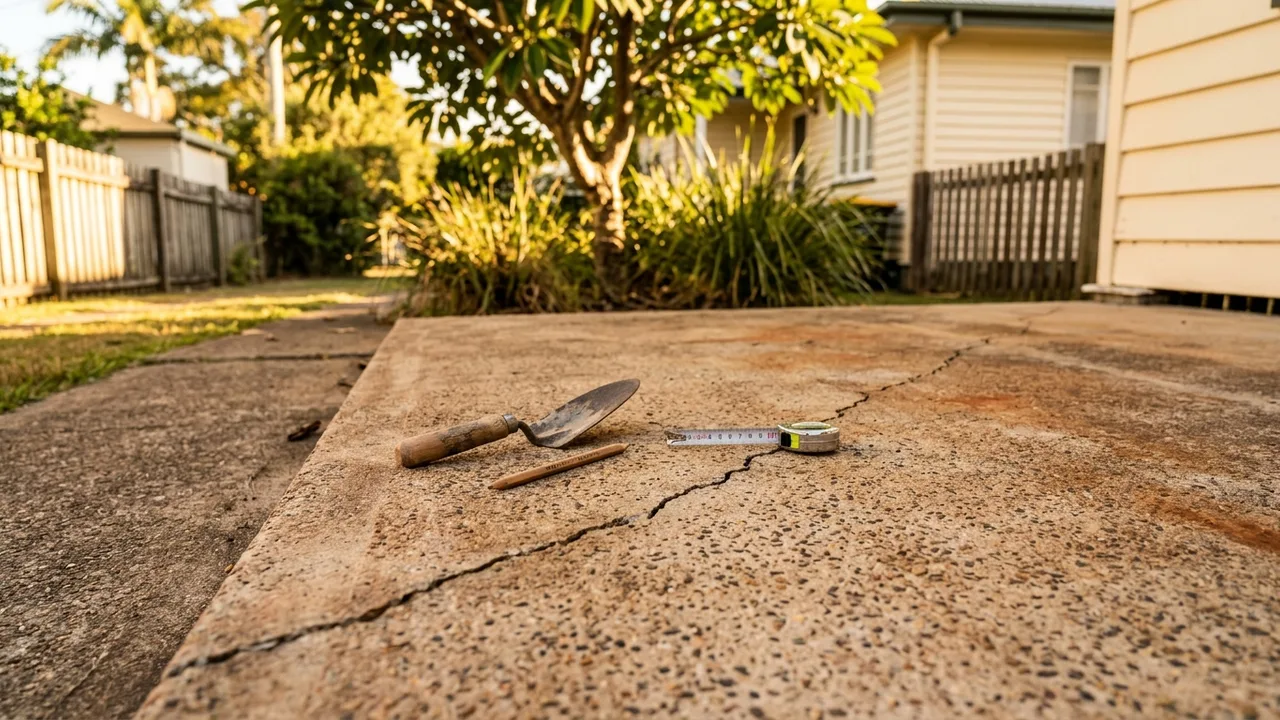
Hairline surface cracks are typically less than 0.3 mm wide. They often appear within the first few weeks of a new pour as the concrete cures. In most cases these are purely cosmetic. They don't compromise load capacity and rarely let meaningful water through.
Wider cracks (1 mm and above) deserve more attention. Run your finger across the crack. If both sides are level, the crack is likely the result of shrinkage or thermal movement. If one side has risen or dropped relative to the other — that's called differential settlement — it suggests the ground below has moved unevenly. That's a more serious sign.
Pattern cracking (map cracking or crazing) looks like a network of fine lines across the surface, a bit like dried mud. It's usually a curing or finishing issue rather than a structural one, but it does weaken the surface layer over time and can allow water infiltration.
Long cracks running the full width of a driveway or path often mean the slab has cracked where a control joint should have been. Whether this is a problem depends on the width, displacement, and whether it's growing.
A simple way to monitor a crack: mark each end with a pencil line and date it. Check it again in three to six months. A stable crack that hasn't extended is generally not urgent. A crack that keeps growing needs investigation.
The Brisbane Context: Clay, Heat, and Old Slabs
If you're in Bulimba, Hawthorne, Balmoral, or the surrounding suburbs, a few local factors are worth knowing.
Much of Brisbane's inner east was developed from the 1940s through the 1980s. A lot of concrete from that era was poured to lower standards than today, with less reinforcement, lower-strength mixes, and minimal joint planning. If your home is a post-war Queenslander on a concrete path from the 1960s, some cracking is simply age.
The clay subsoil common in this area is particularly reactive. During dry summers, it can shrink enough to leave voids beneath a slab. When rain returns (and Brisbane's wet seasons can be dramatic), the clay expands and pushes back up. Slabs that weren't poured with adequate sub-base compaction are vulnerable to this movement.
Tree roots are another factor specific to older, well-established suburbs. Large street trees and mature garden trees in Morningside, Norman Park, and Cannon Hill are well-documented for lifting paths and driveways. A crack near a tree root is almost always the tree's doing, and patching it without addressing the root usually means the crack returns.
Bayside suburbs in Brisbane deal with salt-air corrosion, but the inner east cluster around Bulimba is far enough from the bay that this isn't a primary concern for most properties.
When to Repair, When to Resurface, and When to Replace
This is where honest trade-offs matter.
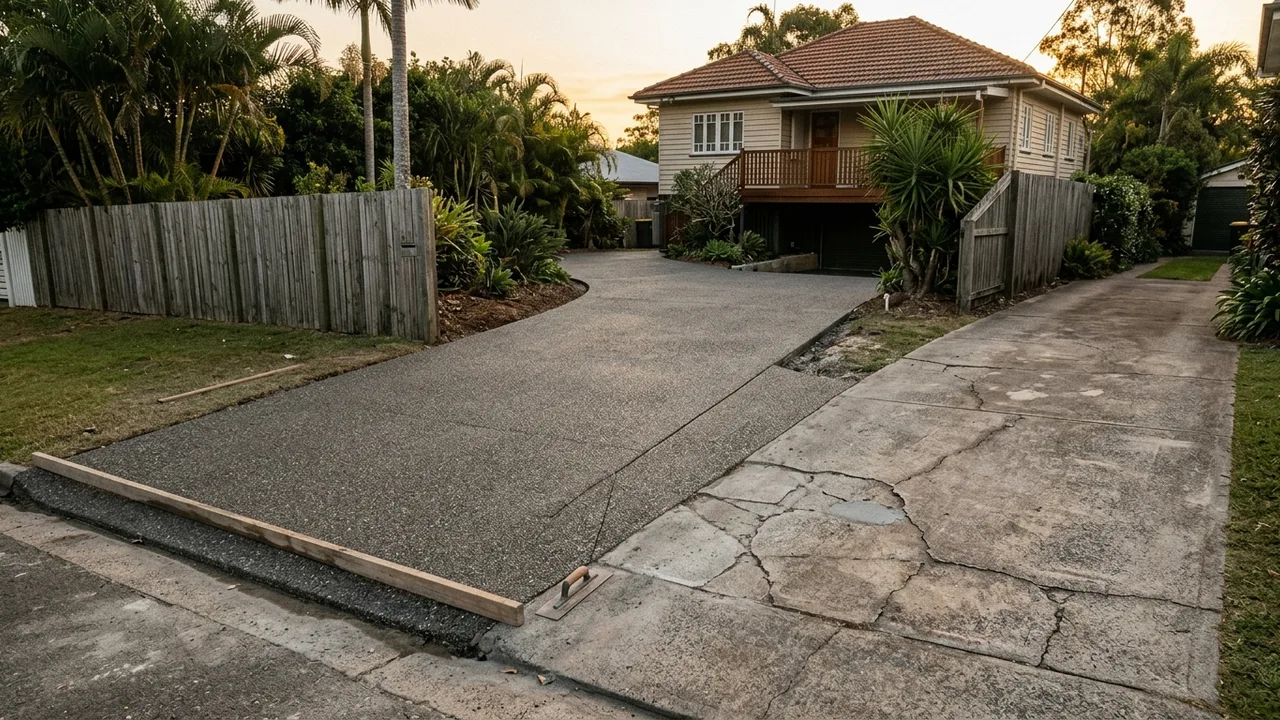
Patching and crack filling suits stable cracks that aren't growing and haven't caused displacement. It's the cheapest option, typically a few hundred dollars, and it keeps water out. The trade-off: patch repairs are usually visible, and if the underlying cause (ground movement, tree roots) isn't addressed, the crack often returns.
Resurfacing involves grinding back the surface and applying a new layer, sometimes a polymer-modified topping, over the existing slab. This makes sense when the slab structure is sound but the surface is heavily crazed, pitted, or has multiple smaller cracks. It can refresh an old driveway at a fraction of the cost of replacement. The limitation is thickness: a resurfacing layer is typically only 10-20 mm thick, so it won't fix a slab with significant structural movement underneath.
Full replacement is the right call when a slab has major differential settlement, when roots have pushed sections significantly out of level, or when the concrete has deteriorated right through (delamination, spalling, or deep cracking across the full depth). It costs more in the short term, typically $3,000 to $10,000 for a standard residential driveway in this area depending on size and finish, but it solves the problem properly rather than deferring it.
The honest advice: if you're patching the same crack for the third time, it's worth getting an assessment of whether the ground conditions mean the slab simply won't hold long-term.
What Good New Concrete Should Include
If you do end up replacing a slab or pouring new concrete, a few basics protect against premature cracking:
- Proper sub-base preparation. This means compacted roadbase or crusher dust, not just concrete over bare clay or loose fill.
- Appropriate reinforcement. Steel reinforcement (mesh or bar) doesn't stop cracks forming, but it holds them together and prevents the slab from separating or settling unevenly.
- Control joints at the right spacing. As a rule of thumb, joints should be no more than 24-30 times the slab thickness apart. For a 100 mm slab, that's roughly 2.4 to 3 metres.
- Proper curing. Covering the fresh concrete and keeping it moist for the first few days reduces surface shrinkage cracking significantly.
Concrete that's poured in the middle of a Brisbane summer afternoon with no curing cover is far more likely to craze than concrete poured in mild weather and properly protected.
A Practical Recommendation
If you have a crack, don't panic and don't ignore it. Measure it, mark it, and check whether it's growing. If it's narrow, stable, and level across both sides, it's likely cosmetic and a good-quality filler is reasonable. If it's wide, displaced, or keeps extending, get someone to look at the slab and the ground beneath it before you spend money on surface repairs that won't hold.
For anything in the Bulimba area through to Tingalpa and Murarrie, a conversation with a local concretor who knows the ground conditions in the inner east is genuinely worthwhile. They'll be able to tell you quickly whether a repair is the right call or whether the slab's time is up.
Quick answers