Concreting guide
Why Does Concrete Crack So Often in Brisbane's Inner East?
Concrete cracks in Brisbane's Inner East for a handful of very predictable reasons. The soil moves, the weather swings hard between wet and dry, and a lot of the housing stock sits on ground that was never prepared with modern concrete work in mind. Understanding why helps you make smarter decisions about repairs, replacements, and prevention.
Brisbane's Climate Does Real Work on Concrete
The Inner East suburbs (Bulimba, Hawthorne, Norman Park, Balmoral and their neighbours) sit in a subtropical climate that is genuinely hard on rigid materials. Summer delivers heavy, concentrated rainfall. Winter is dry. That cycle repeats every year, and concrete feels every iteration of it.
Concrete expands slightly in heat and contracts in cold. Brisbane's temperature range is moderate compared to southern capitals, but the moisture swings are extreme. A concrete driveway or patio slab absorbs water during a summer downpour, then dries out over weeks of warm, low-humidity winter days. Over several years, that repeated swelling and shrinking opens up hairline cracks. Once a crack forms, water gets in, widens it, and the process accelerates.
This is not a defect in the concrete itself. It is physics. The honest answer is that all outdoor concrete eventually cracks. The question is how soon, and how badly.
The Soil Under Inner East Brisbane Is Particularly Problematic
Most of the Inner East sits on reactive clay soils. The technical term is "expansive clay," and it earns the name. When it gets wet, it swells. When it dries out, it shrinks and pulls back. The movement is not enormous in absolute terms, but it is enough to lift and drop a concrete slab repeatedly over years.
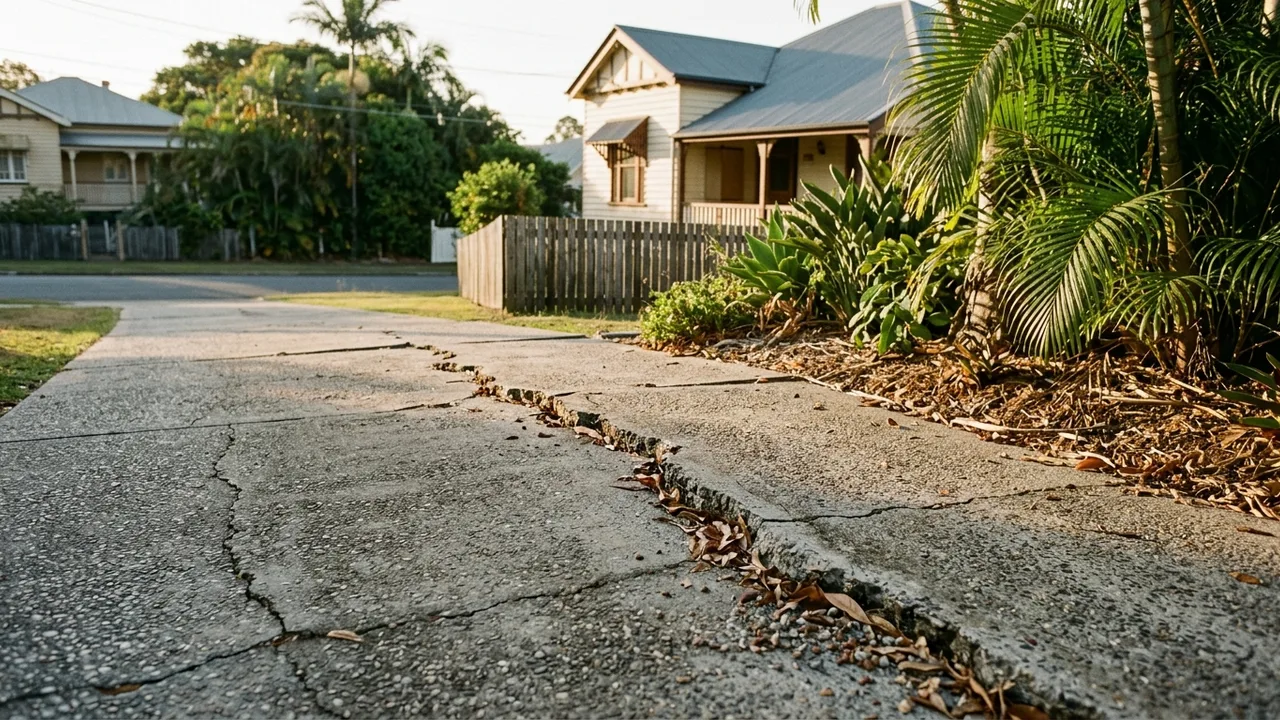
In Norman Park, Morningside, and parts of Cannon Hill, you will find pockets of fill soil as well, particularly in older subdivisions where land was levelled decades ago. Fill that was not compacted properly continues to settle slowly, and the slab above it follows. That produces the classic "sunken panel" you see in older driveways and pathways around the area, where one section drops a centimetre or two relative to its neighbours.
The Bulimba and Hawthorne riverfront areas introduce a slightly different variable: proximity to the Brisbane River means the water table sits higher, and soil moisture levels shift more dramatically after flood events. The 2011 and 2022 floods left lasting changes in subsoil saturation levels across these suburbs that still affect how ground behaves under slabs today.
Tree Roots Are Doing More Damage Than Most People Realise
The Inner East is one of the leafier parts of Brisbane. That is genuinely part of what makes suburbs like Balmoral and Hawthorne appealing. But the mature fig trees, poinciana, and jacaranda that line streets and fill older gardens are also quietly destroying concrete all across the area.
Tree roots follow moisture. Concrete slabs trap moisture beneath them and create a perfect growing environment along their edges and through any small crack or joint. A jacaranda root does not punch through solid concrete immediately; it finds a gap, grows into it, and expands over years until the slab lifts or fractures along the line of least resistance.
Street setback driveways in Bulimba and Norman Park are particularly vulnerable because council street trees often sit just a metre or two from the edge of the concrete. There is not much a homeowner can do about those roots without involving council. For trees on your own property, root barriers installed during a concrete replacement job can buy you many more years before the problem returns. They are not cheap (typically $200-$500 extra on a driveway job), but they are far less expensive than replacing the same slab twice.
Poor Original Installation Compounds Every Other Problem
A lot of the concrete around the Inner East was poured decades ago, under standards that were simply less demanding than current practice. There are three installation factors that matter most.
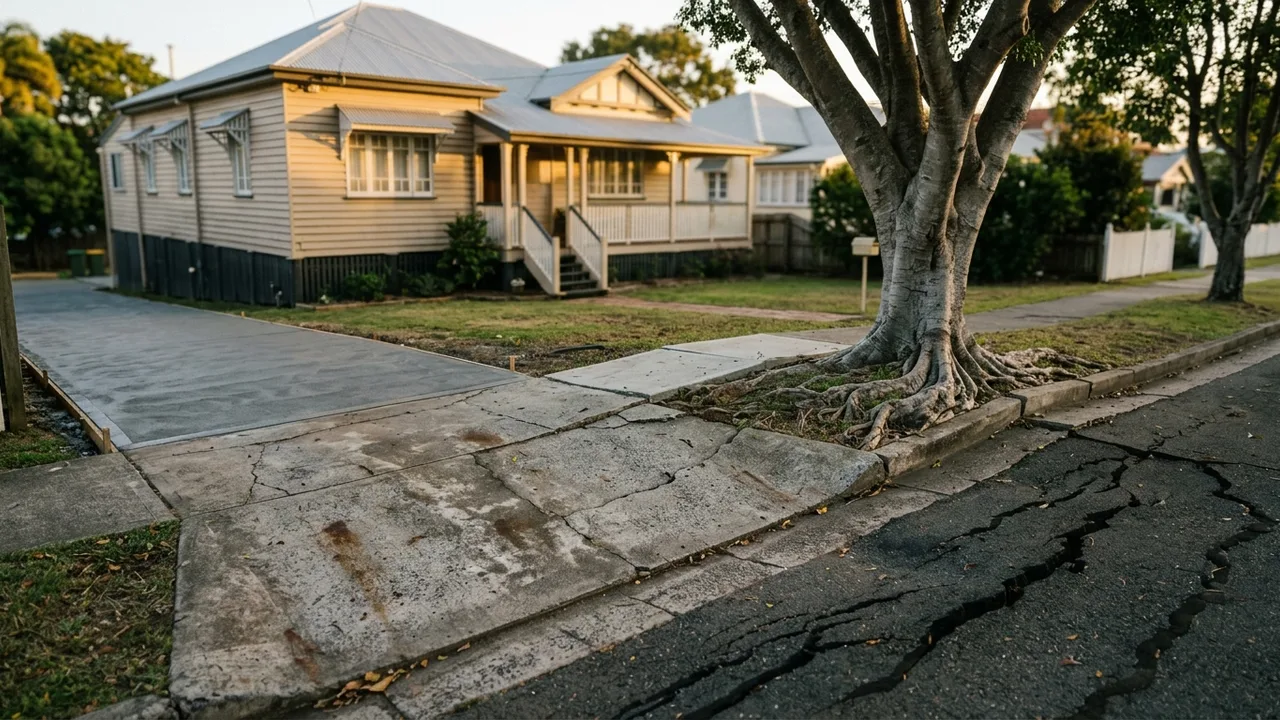
Inadequate base preparation. Concrete needs a compacted, stable base beneath it. Older residential jobs often skipped this, pouring directly onto loose or poorly graded soil. The result is a slab with no consistent support, and it cracks wherever the ground underneath moves or settles.
Wrong mix or thickness. Residential concrete is typically specified at 100mm thick for pathways and light-use slabs, and 100-125mm for driveways. Older pours were sometimes thinner, or used mixes with too much water added on-site (which weakens the finished product significantly). A watery mix is easier to work with on a hot day, but it cures weaker and cracks sooner.
Missing or badly placed control joints. Control joints are the deliberate saw cuts or formed gaps you see in concrete slabs. They exist to give the slab a predictable place to crack as it moves, so the cracking happens in a straight, controlled line rather than randomly across the surface. When they are absent, spaced too far apart, or cut too shallow, random cracking is the predictable result. As a rule of thumb, control joints should be placed at intervals roughly 24 to 30 times the slab thickness, so about every 2.4-3 metres in a 100mm slab.
When Is a Crack Worth Fixing, and When Should You Replace?
This is the practical question most homeowners in the Inner East eventually face, and there is no single answer.
Hairline surface cracks (under about 3mm wide, stable, no vertical displacement between panels) are mostly cosmetic. They can be sealed with a flexible polyurethane filler to slow water ingress, and left alone. Cost is low, typically under $100 in materials if you do it yourself, and the repair is reasonable DIY work.
Cracks with vertical displacement (where one side has risen or sunk relative to the other) are a different problem. They indicate ongoing movement underneath the slab. Filling the crack does not solve the movement. If the displacement is minor (under 10mm), grinding down the raised edge can eliminate the trip hazard while you monitor whether the movement has stabilised. If the slab is still actively moving, patching is a temporary measure at best.
Full replacement makes sense when: multiple panels are cracked and sunken, the base preparation was clearly inadequate, tree root damage is extensive, or the original concrete was too thin to repair reliably. In Brisbane's Inner East, a typical driveway replacement runs $3,000-$8,000 depending on size, access, and finish. A patio or entertaining slab might run $2,000-$6,000. Those are not trivial numbers, but pouring over bad subbase preparation just repeats the problem in another decade.
The honest trade-off: spend less now on patches and expect to revisit the problem, or spend more on a proper replacement with good base preparation and come back in 20-plus years instead of five.
What Good Practice Looks Like Now
Current residential concrete work in the Inner East should include proper excavation and compaction of the sub-base (typically 100mm of compacted road base), an appropriate concrete mix (usually 25 MPa or 32 MPa for driveways), correct slab thickness for the application, and control joints at sensible intervals. Steel reinforcement (mesh or reo bar) helps limit crack width if cracking does occur, though it does not prevent cracking entirely.
If your property has large trees within a few metres of any slab, raising that conversation with your concreter before the job starts is worthwhile. Root barriers, strategic joint placement, or slightly thicker concrete near root zones are all options worth discussing.
A written quote that specifies mix strength, thickness, base preparation method, and control joint locations is a reasonable thing to ask for. Any experienced local operator should be comfortable providing that detail.
If you are trying to work out whether your existing concrete is worth repairing or due for replacement, a site assessment from a concreter familiar with Inner East soil conditions will give you a more reliable answer than a general guide like this one can. The soil, the trees, the age of the original pour, and how the slab is currently moving all matter, and they vary house to house even within the same street.
Quick answers