Concreting guide
Why does concrete crack and when is it actually a problem?
Concrete Cracks: Normal Wear or a Real Problem?
Concrete cracks. Almost all of it does, eventually. The real question is whether the crack you are looking at is a cosmetic nuisance or a sign that something structural is failing underneath. Most cracks fall into the first category, but a handful of patterns are worth taking seriously.
Here is how to tell the difference.
Why Concrete Cracks in the First Place
Concrete is strong in compression (pushing down on it) but relatively weak in tension (pulling it apart). When the slab or path experiences any force that stretches or bends it, cracks are how it responds. Several things cause that tension.
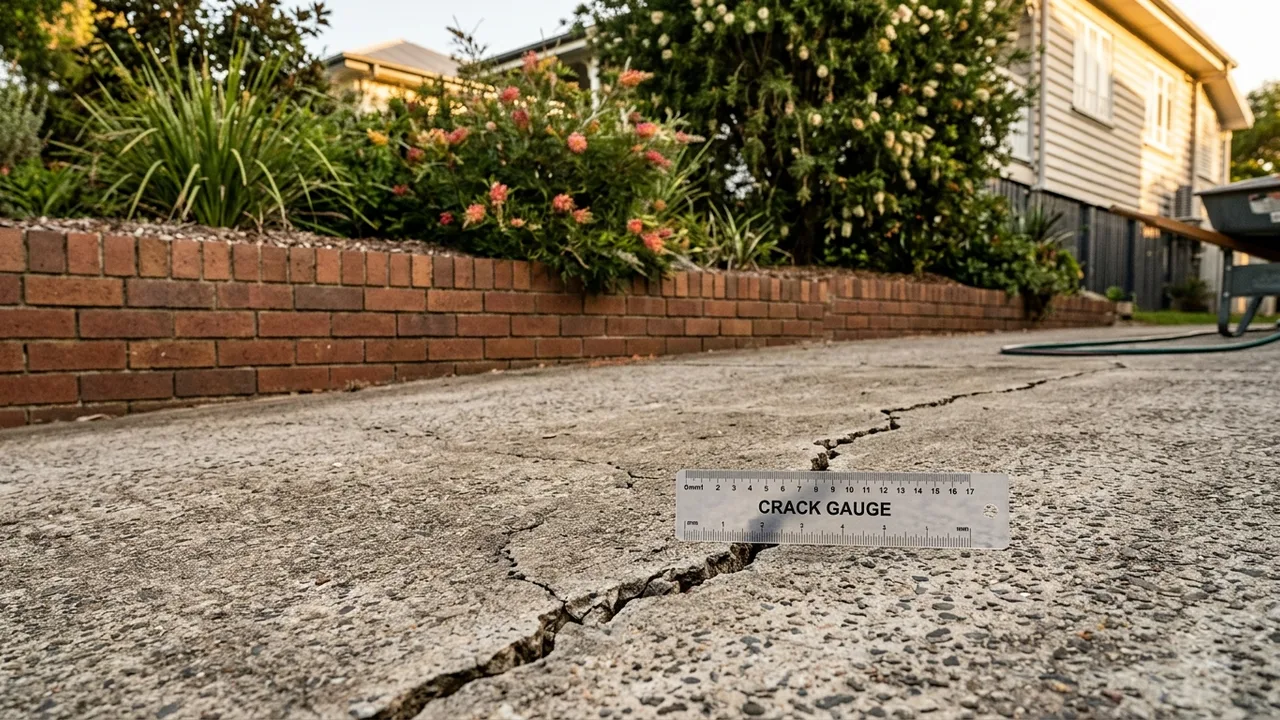
Shrinkage during curing. Fresh concrete contains a lot of water. As it cures and that water evaporates, the slab shrinks slightly. Because the base or reinforcement resists that shrinkage, the concrete pulls against itself. Hairline cracks across the surface are the typical result. In Brisbane's climate, with hot summers and low humidity on some days, this process can happen faster than ideal if the pour is not kept moist during curing. An experienced concretor will wet-cure or use a curing compound to slow it down.
Thermal expansion and contraction. Brisbane temperatures can swing from around 10°C on a winter night to over 35°C on a summer afternoon. Concrete expands in heat and contracts in cold. Control joints (the straight lines cut or formed into a slab) are deliberately placed to give the concrete somewhere to crack predictably and invisibly. If joints are missing or spaced too far apart, random surface cracking becomes more likely.
Ground movement. This is where the Inner East suburbs of Brisbane need specific attention. Areas like Norman Park, Bulimba, Morningside and Hawthorne sit on clay-heavy soils. Brisbane's black soil and reactive clays expand significantly when wet and shrink when they dry out. That heave-and-settle cycle puts ongoing stress on anything sitting on top of it, including driveways, garage slabs and entertaining areas. A driveway poured on unstable, poorly compacted fill soil will likely crack sooner than the same slab poured on stable ground.
Tree roots. Jacarandas and poincettias are common along the streets of Hawthorne, Balmoral and Bulimba. Their roots do not punch through concrete dramatically, but they can lift a slab edge over years of slow growth, creating a trip hazard and cracking patterns that follow the root direction.
Overloading. A residential concrete driveway is typically designed for cars and light SUVs. A skip bin delivery, a concrete truck, or a heavy tradesperson's vehicle parked for days can exceed what a standard residential pour is built to handle, especially if it is an older slab with minimal reinforcement.
The Crack Types That Usually Do Not Worry
Hairline surface cracks (less than about 0.3mm wide, too thin to fit a coin edge into) are almost always cosmetic. They are a normal result of curing shrinkage and do not compromise the structural integrity of the slab. Sealing them is an option if you want to prevent water or staining getting in, but it is not urgent.
Crazing is a network of fine surface cracks that looks like a dry creek bed. It typically happens when the top layer of a slab dries faster than the body beneath it, often because of sun, wind, or over-working the surface during finishing. Crazing sits in the top few millimetres and does not affect load capacity.
Control joint cracks. If the crack follows the control joint, the system worked as designed. That is the concrete breaking where you wanted it to, not where you did not.
The Crack Types Worth Investigating
Wide cracks. A crack you can fit the edge of a $2 coin into, roughly 2mm or more, suggests more significant movement. Width alone is not the whole story, but it is a prompt to look closer.
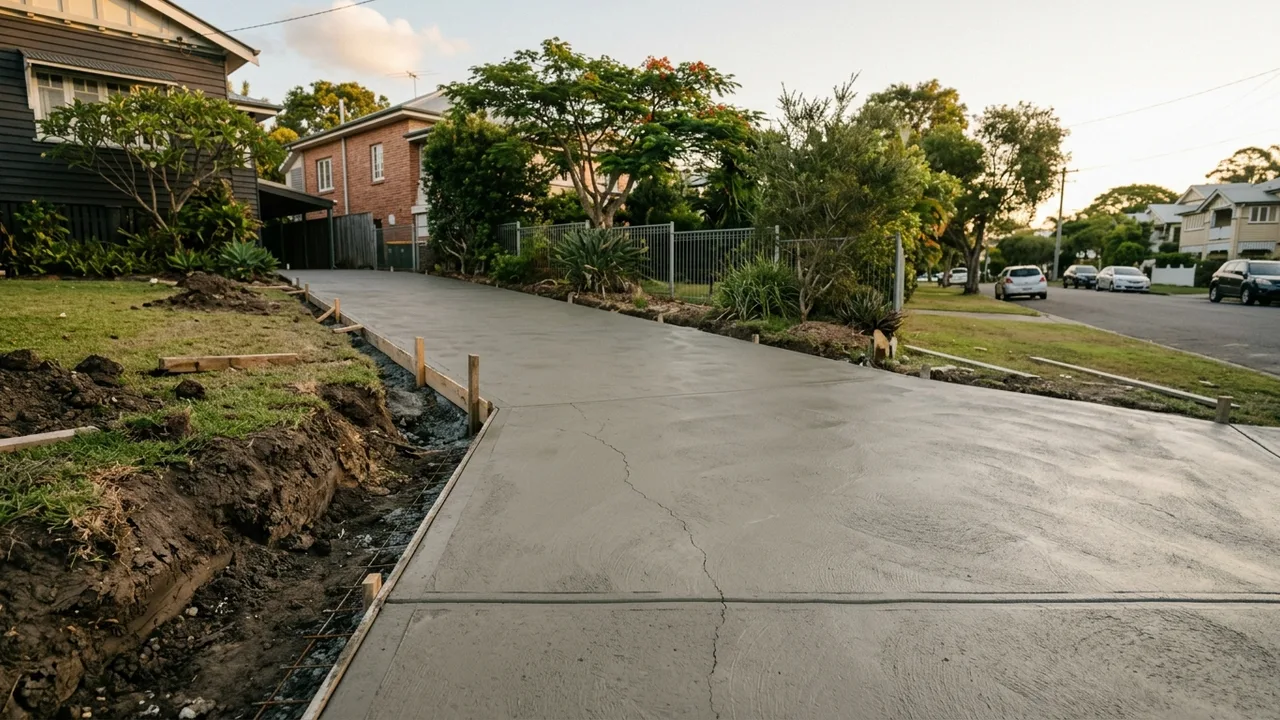
Displacement cracks (step cracks). One side of the crack is higher than the other. This means the two sections of slab have moved in different directions, almost always because of differential settlement or significant root lift beneath. A step crack in a driveway is also a trip hazard and tends to collect water, which accelerates the problem.
Long, continuous cracks that run the full width of a slab. These can indicate that the slab has actually separated into two pieces. If the crack widens or narrows with the seasons, reactive clay soil movement is typically the cause.
Cracks near load-bearing edges. A crack running close to the edge of a garage slab or the corner of an entertaining area is more of a concern than one in the centre, because edge sections have less support beneath them.
Multiple cracks in a new slab. If significant cracking appears within the first year or two, it can indicate insufficient sub-base compaction, inadequate reinforcement, a poor concrete mix, or curing that was rushed. This is where the quality of the original work matters.
Brisbane's Clay Soils: A Context Worth Understanding
If you own a property in the Inner East, the ground beneath your slab is doing something constantly. Brisbane's reactive clay soils (often classified as Class M or Class H under the Australian Standard AS 2870) are among the more challenging in South-East Queensland. They absorb moisture from rain and tree roots and shed it during dry spells.
That movement is slow and seasonal, typically a few millimetres of heave or settlement over months, but it is relentless. Slabs poured in autumn on dry soil will be sitting on slightly different ground come spring. Over a decade or two, the cumulative effect on an unreinforced or poorly detailed slab is visible cracking and surface displacement.
This is not a reason to panic about every slab in Morningside or Cannon Hill. It is a reason to understand that some movement-related cracking in older slabs here is expected, and that new work benefits from proper sub-base preparation and reinforcement appropriate to site conditions.
When to Repair and When to Replace
Not all cracked concrete needs replacing. A few honest trade-offs to consider:
Resurfacing works well on slabs that are structurally sound but showing widespread surface crazing, staining, or shallow cracking. It applies a bonded overlay to restore appearance. Cost is typically lower than replacement, often in the $30-$60 per square metre range depending on preparation and finish, though this varies with site conditions.
Crack injection and patching suits isolated cracks that are stable (not actively widening). A flexible polyurethane or epoxy filler seals the crack and prevents water ingress. It will not disappear the crack visually in most cases, but it extends the life of the slab.
Replacement is the more practical answer when: the slab has moved significantly, multiple displacement cracks are present, the sub-base has failed, or the root cause (reactive soil, poor drainage, tree roots) cannot be managed with repairs.
Choosing repair over replacement to save money in the short term makes sense when the underlying cause is stable. If the ground is still moving, patching over the problem is a temporary answer.
What to Do If You Are Not Sure
Start by taking a photo of the crack with something for scale next to it, like a coin or a ruler. Note whether the crack has changed size over a few months; a pencil mark at each end is a simple way to track it. If it is stable, you have time to think about it. If it is widening or the edges are lifting, it is worth getting someone to look at it before a trip hazard develops or water starts getting under the slab.
A good local concretor will be straight with you about whether a repair makes sense or whether the slab has had its run. The cost difference between an honest repair recommendation and an unnecessary full replacement is real money, typically several thousand dollars on a driveway.
If you are in Bulimba, Hawthorne, Norman Park, Morningside or the surrounding Inner East suburbs, we can connect you with a local concreting provider who knows the soil conditions in the area. There is no obligation in asking for an assessment.
Quick answers