Concreting guide
Does the soil in Bulimba and along the river affect how concrete performs?
Yes, the soil along the Brisbane River and through suburbs like Bulimba, Hawthorne, and Norman Park genuinely affects how concrete behaves, both during the pour and over decades of use. It is not the most dramatic factor in a concrete job, but ignore it and you will likely be repairing cracks or dealing with slab movement sooner than you should.
This is a practical rundown of what the ground in this part of Brisbane is actually doing beneath your driveway or slab, and what that means for the decisions you make before the truck arrives.
What kind of soil are we actually dealing with here?
The Inner East suburbs sit on a mix of ground types, and the river corridor makes things more variable than many homeowners realise.
Much of Bulimba, Hawthorne, and Balmoral sits on Quaternary alluvial deposits, which is a geological way of saying the soil was laid down by river activity over thousands of years. These soils tend to be fine-grained, often clay-heavy, and can behave unpredictably when their moisture content changes. When clay gets wet, it expands. When it dries out in a Queensland summer, it contracts. That cycle of swelling and shrinking is one of the most common causes of cracked concrete slabs and footpaths in the area.
Further inland through Morningside, Cannon Hill, and Tingalpa, the soil profile shifts somewhat. You find pockets of older weathered rock and different clay compositions. The behaviour is not uniform, and what is true for a block right on the riverfront in Bulimba may not apply a kilometre south on a ridge in Morningside.
As a general guide, if your block is within a few hundred metres of the river, or sits in a low-lying area that retains water after heavy rain, clay reactivity is worth taking seriously. A soil report will tell you definitively. They typically cost $300 to $600 and are standard on new builds; they are less common on smaller residential concrete jobs, which is where problems often start.
How reactive clay actually damages concrete
Concrete itself does not mind clay. The issue is movement in the base below it.
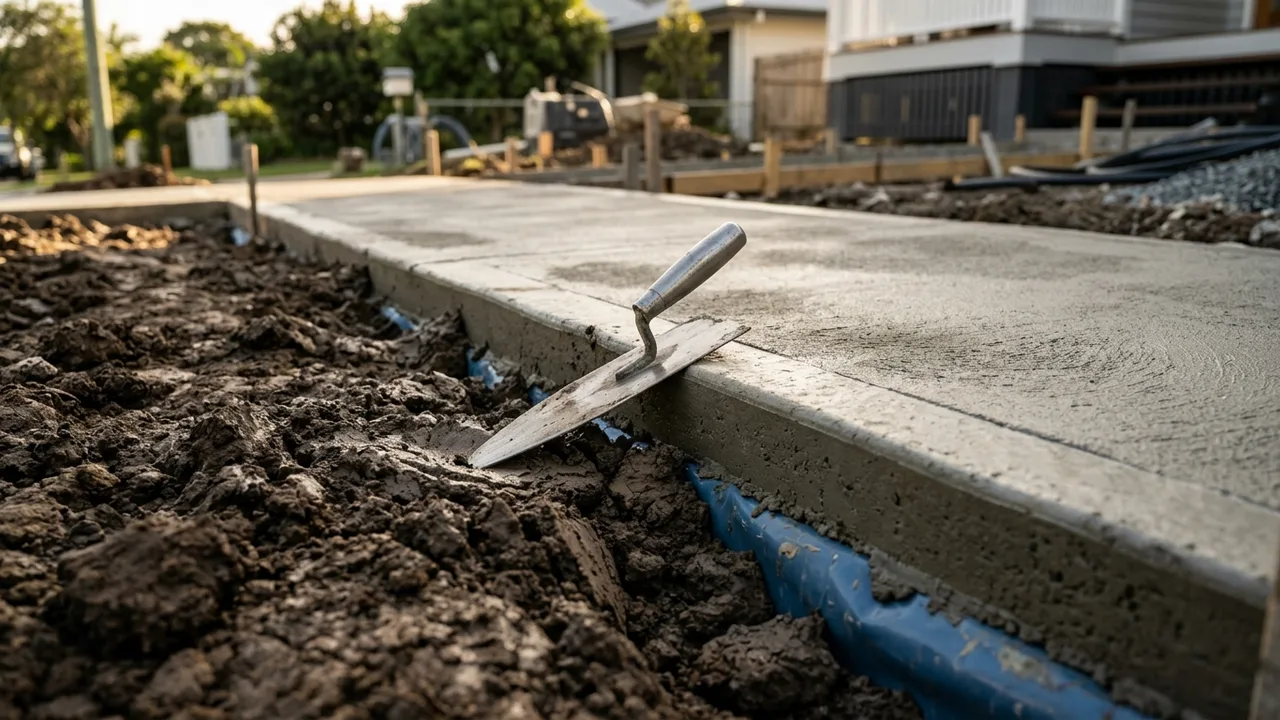
When the clay beneath a slab swells after wet weather and then shrinks in dry conditions, it creates uneven pressure and support. Concrete slabs, driveways, and paths are rigid structures. They are not designed to flex with that movement. The result, typically, is cracking, usually along lines of weakness like construction joints, or in the middle of a pour where no reinforcement is present.
In practical terms, this is why you see a lot of cracked paths and driveways in older Bulimba and Hawthorne properties. Many of those slabs were poured decades ago on minimal base preparation, often with little more than compacted fill or the original clay subgrade. They worked fine for years, then the combination of root intrusion, seasonal moisture swings, and time caught up with them.
A reactive soil classification, typically rated S, M, H, or E under Australian Standard AS 2870, will influence the slab design your concreter should be specifying. A highly reactive (H1 or H2) classification in a riverside suburb will usually mean deeper edge beams, more steel reinforcement, and a controlled sub-base rather than the minimum.
The flood and drainage factor
Flooding history is relevant in a way that often gets overlooked. Parts of Bulimba, Rocklea Road corridor through Morningside, and lower sections of Murarrie have experienced inundation in major flood events. Post-flood soil is not just wet. It can be structurally different, with changed compaction, displaced material, and hidden voids where water has moved through.
If your property flooded in 2011 or 2022, and you have not had the subgrade assessed since, that history matters before you pour any new concrete. A slab poured onto ground that looks dry but has been through repeated saturation cycles may not have the bearing capacity it appears to have.
Drainage around existing and planned concrete is also worth thinking through before, not after, the job. Water that pools against a slab edge or is directed under a driveway by poor grading will accelerate clay movement. Small adjustments to fall and drainage direction at the planning stage are far cheaper than resurfacing or re-pouring in five years.
What this means for base preparation and concrete specification
This is where the practical decisions live.
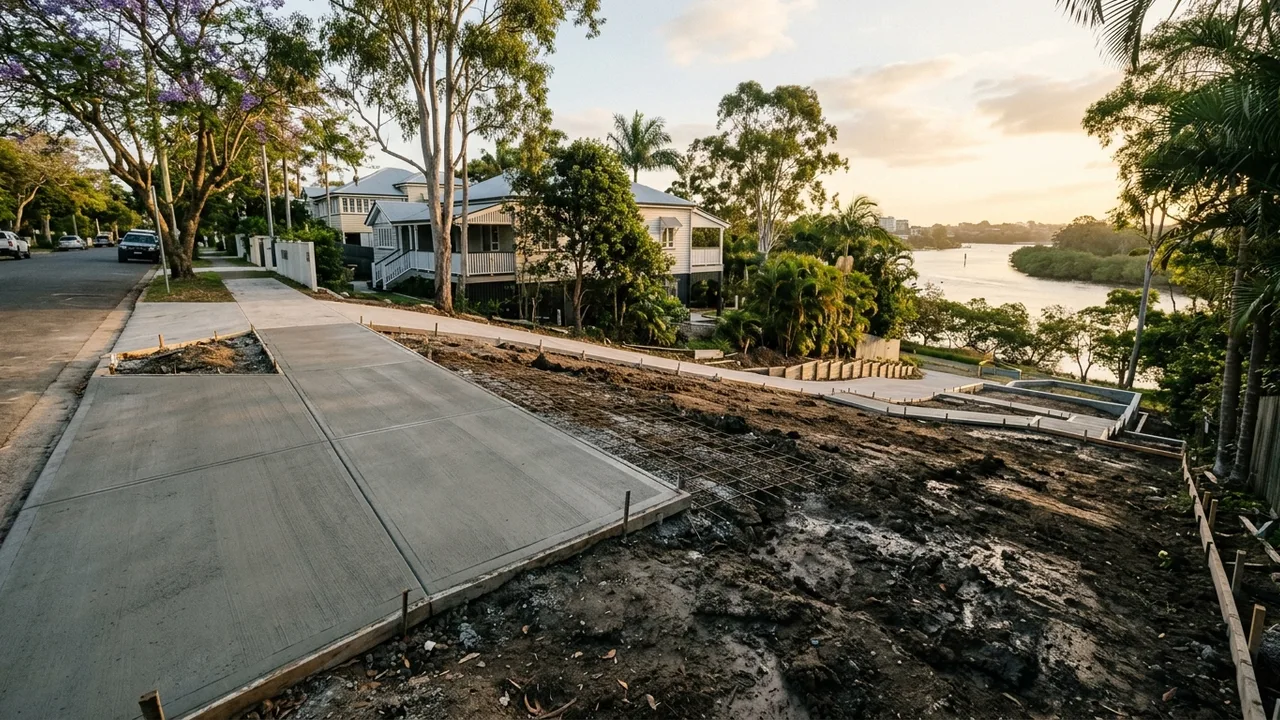
For a standard residential driveway or slab in a low-reactivity area, a 100mm reinforced slab on compacted roadbase is often adequate. Move into moderately reactive clay country and the minimum shifts. You would typically want deeper edging, a vapour barrier where moisture wicking is a concern, and either steel mesh or fibre reinforcement throughout. For highly reactive sites, that base preparation cost goes up and the design gets more specific.
The trade-off is straightforward: spending more upfront on base preparation and correct specification is almost always cheaper than repairing or replacing a failing slab. A standard driveway replacement in Bulimba typically runs $4,000 to $10,000 depending on size and finish. A set of crack repairs or partial resurfacing might cost $1,500 to $4,000. But if the underlying cause is not addressed, those repairs are temporary.
Exposed aggregate and decorative finishes, which are popular in Hawthorne and Balmoral where street appeal matters, are more vulnerable to cracking than plain concrete simply because any surface defect is more visible. If you are planning that kind of finish on a reactive site, the case for doing the base preparation properly is even stronger.
Tree roots, old fill, and other local complications
Inner East Brisbane properties often have large established trees, including mature fig trees, jacarandas, and camphor laurels in some older gardens. Root systems from these species are persistent and can reach well under driveways and paths over time.
Root intrusion does not always cause cracking directly. More often, roots disturb the compaction of the sub-base, create voids, and allow moisture to move through the soil in ways that accelerate clay reactivity. If a large tree is within five metres of a planned slab, it is worth discussing root barriers with your concreter. They are not always necessary, but they are worth considering.
Old fill is another variable in Bulimba and surrounding suburbs. Properties that have been developed and redeveloped over decades sometimes have mixed, unengineered fill under what looks like a flat, stable yard. Fill material can include anything from demolition rubble to soil from off-site, and it compacts inconsistently. If your property has had a lot of earthworks in its history, or if you notice any soft spots or low areas in the lawn, flag that with whoever is quoting the job. Probing the sub-base before pouring adds a small amount to the cost and can prevent a significant problem.
Making a sensible decision before you pour
You do not need to become a soil scientist to make good decisions about concrete in this part of Brisbane. But a few straightforward steps will significantly reduce the risk of problems later.
First, find out roughly what soil classification your site sits on. Your local council, a geotechnical report from a previous build on the property, or a site-specific soil test can all help here. If you are on a flat block close to the river, assume moderate to high reactivity until proven otherwise.
Second, ask any concrete contractor you get a quote from what base preparation they are including, and why. A detailed answer that references your specific site conditions is a good sign. A vague answer that just says "we compact it properly" is worth probing further.
Third, match your finish choice to your site conditions. Plain broom-finished concrete is more forgiving on a reactive site than polished or exposed aggregate. If you want the decorative finish, make sure the preparation justifies it.
There is no single answer that fits every property in this cluster of suburbs. The ground varies, the drainage varies, and the history of each block is different. What does not vary is that concrete poured onto properly prepared, correctly assessed ground lasts significantly longer than concrete that was not. That is true in Bulimba, Hawthorne, Tingalpa, and anywhere else in the Inner East.
If you want to talk through your specific site with someone who works in this area, we can connect you with a local concreter who knows the ground conditions here. No pressure, just a useful conversation before you commit to anything.
Quick answers